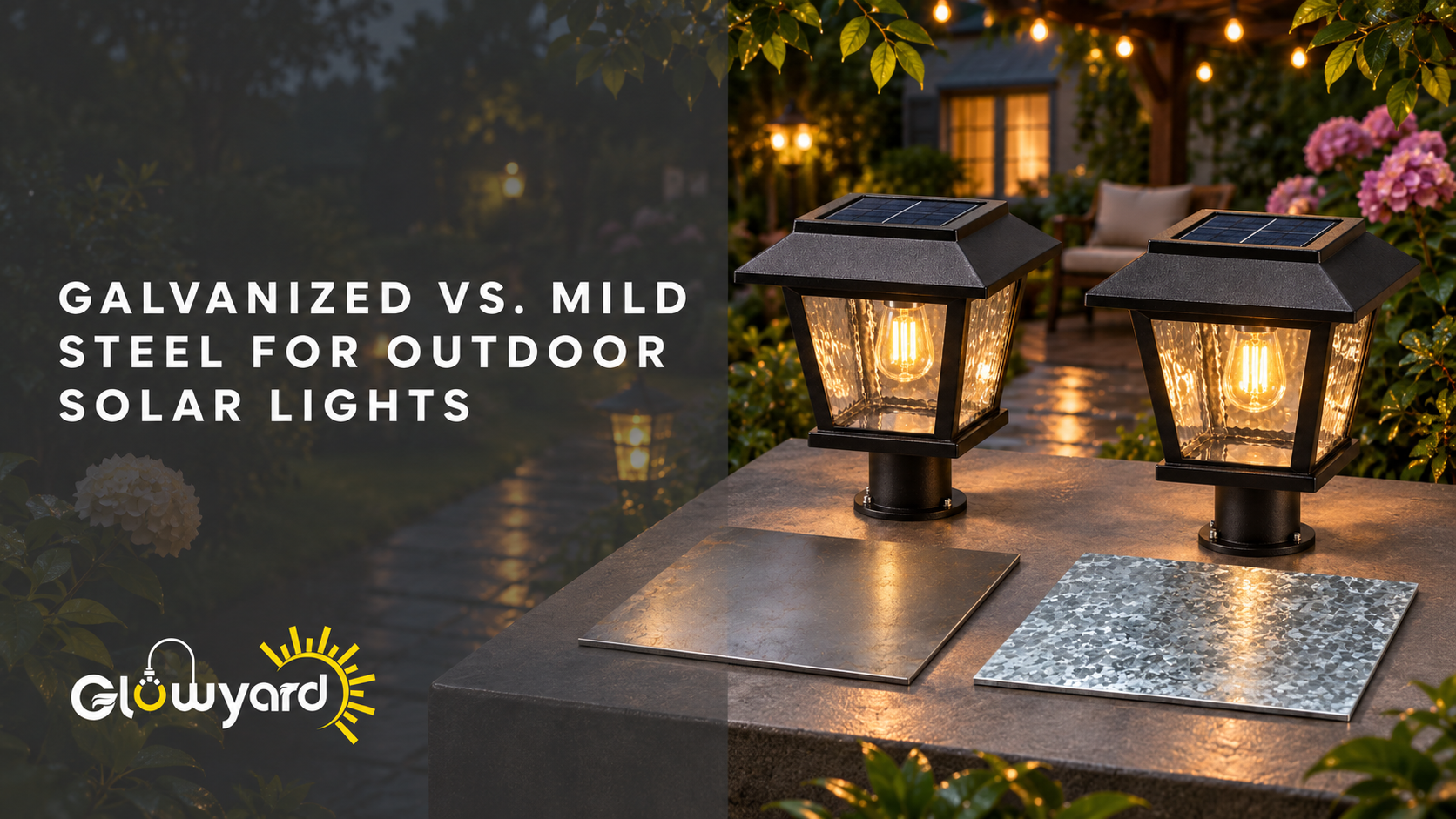
Galvanized vs. Mild Steel for Outdoor Solar Lights: Cost, Corrosion Resistance & Powder Coating
Choosing the right steel and surface treatment for long-lasting solar garden lighting
When sourcing outdoor solar garden lights, buyers often focus on solar panel efficiency, battery capacity, LED brightness, and product design. However, one important factor is frequently overlooked: the corrosion resistance of the metal housing.
For decorative solar lanterns, solar stake lights, and solar memorial lights, material selection and surface treatment can significantly affect product durability, appearance, and long-term maintenance costs.
For a broader comparison across resin, metal, plastic, and glass, see our guide to outdoor decorative light materials.
Two common material options are mild steel and galvanized steel. Both can be used to manufacture outdoor solar lighting products, but their corrosion resistance, processing requirements, and costs differ.
In this guide, we compare galvanized steel and mild steel, explain how powder coating affects their performance, and explore how OEM solar lighting manufacturers can improve corrosion protection without unnecessarily increasing production costs.
What Is Mild Steel?
Mild steel is a low-carbon steel widely used in metal fabrication because of its relatively low cost, good formability, and excellent processing flexibility.
Cold-rolled steel sheets, such as SPCC, are commonly used to manufacture decorative outdoor lighting components.
Typical applications include:
- Decorative solar garden lanterns
- Metal solar stake lights
- Solar memorial and cemetery lanterns
- Outdoor decorative lighting housings
- Custom metal lighting accessories
Advantages of Mild Steel
Cost efficiency: Mild steel is generally economical and readily available.
Excellent formability: It is suitable for stamping, bending, laser cutting, and welding.
Design flexibility: Manufacturers can create complex decorative patterns, customized shapes, and intricate metal structures.
Good powder coating compatibility: With appropriate surface preparation, mild steel can achieve attractive and durable finishes.
Disadvantages of Mild Steel
The main limitation is corrosion resistance.
Unlike stainless steel or galvanized steel, untreated mild steel does not have a protective metallic coating.
When exposed to moisture and oxygen, it can develop rust. If the powder coating is damaged or poorly applied, corrosion may spread beneath the coating.
This is particularly important for outdoor solar lights exposed to rain, humidity, irrigation water, and seasonal temperature changes.
What Is Galvanized Steel?
Galvanized steel is carbon steel protected by a zinc coating.
The zinc layer acts as a barrier and provides sacrificial corrosion protection, helping protect the underlying steel when small areas are exposed.
Continuous hot-dip galvanized steel sheets are commonly used for fabricated metal products.
Advantages of Galvanized Steel
Improved corrosion resistance: The zinc coating provides an additional layer of protection against atmospheric corrosion.
Better protection at minor coating defects: Zinc can help protect adjacent exposed steel through sacrificial action.
Suitable for outdoor applications: Properly specified galvanized steel is widely used in outdoor equipment and metal structures.
Compatibility with protective coatings: With suitable surface preparation, galvanized steel can be powder coated to create a duplex corrosion protection system.
Limitations of Galvanized Steel
Galvanized steel is not completely rust-proof.
Cutting, welding, bending, and stamping can affect the zinc coating. Welded areas may require additional corrosion protection.
Galvanized steel also requires appropriate cleaning and surface pretreatment before powder coating.
Using the same aggressive acid-pickling process designed for untreated mild steel may damage the zinc coating.
Therefore, changing from mild steel to galvanized steel requires more than simply replacing the raw material.
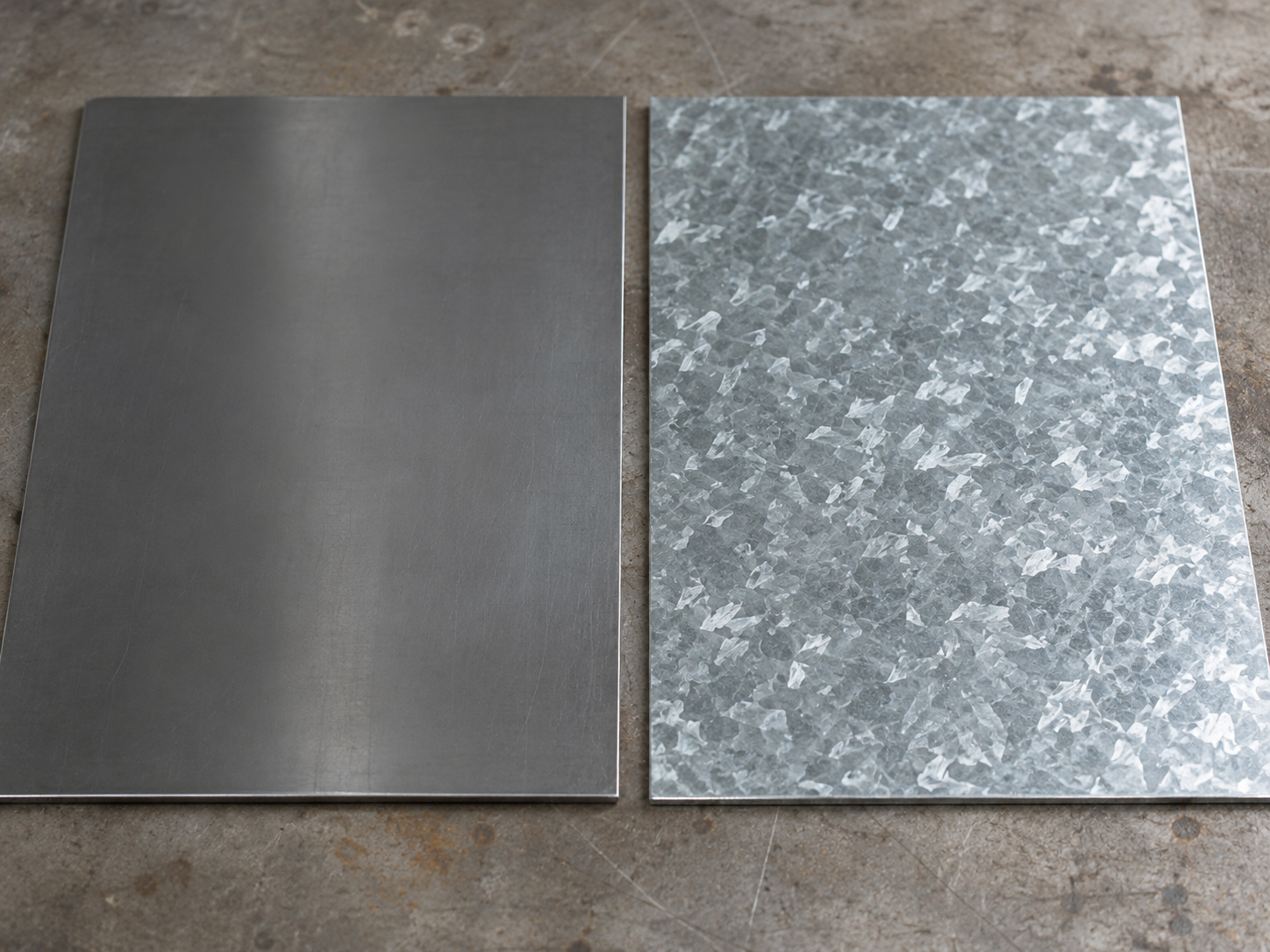
Illustrative image: mild steel and galvanized steel samples.
Galvanized Steel vs. Mild Steel: Key Differences
| Feature | Mild Steel | Galvanized Steel |
|---|---|---|
| Raw material cost | Generally lower | Generally higher |
| Natural corrosion resistance | Low | Higher |
| Stamping and bending | Excellent | Good |
| Welding | Relatively straightforward | Requires zinc-related precautions |
| Powder coating | Requires proper pretreatment | Requires galvanized-compatible pretreatment |
| Corrosion protection at damaged coating areas | Limited | Additional protection from zinc |
| Outdoor durability | Depends heavily on coating system | Depends on zinc layer and coating system |
| Typical applications | Cost-sensitive decorative lighting | Outdoor lighting requiring additional corrosion protection |
For outdoor solar lighting, galvanized steel generally offers better corrosion protection at the material level.
However, a well-designed coating system on mild steel may perform better than a poorly prepared and coated galvanized steel component.
The manufacturing process matters just as much as the raw material.
Why Powder Coating Alone Is Not Enough
Powder coating is widely used in outdoor solar lighting manufacturing.
It provides an attractive surface finish and forms a protective barrier between the steel and the surrounding environment.
However, the coating system can fail when surface preparation is inadequate.
Common problems include:
- Rust forming around welded joints
- Corrosion at sharp edges and cut surfaces
- Paint bubbling after prolonged moisture exposure
- Coating delamination
- Rust spreading beneath scratched or damaged coatings
These problems may be caused by inadequate cleaning, residual chemicals, poor coating adhesion, insufficient edge coverage, or incorrect curing conditions.
A reliable coating system therefore begins before the powder is applied.
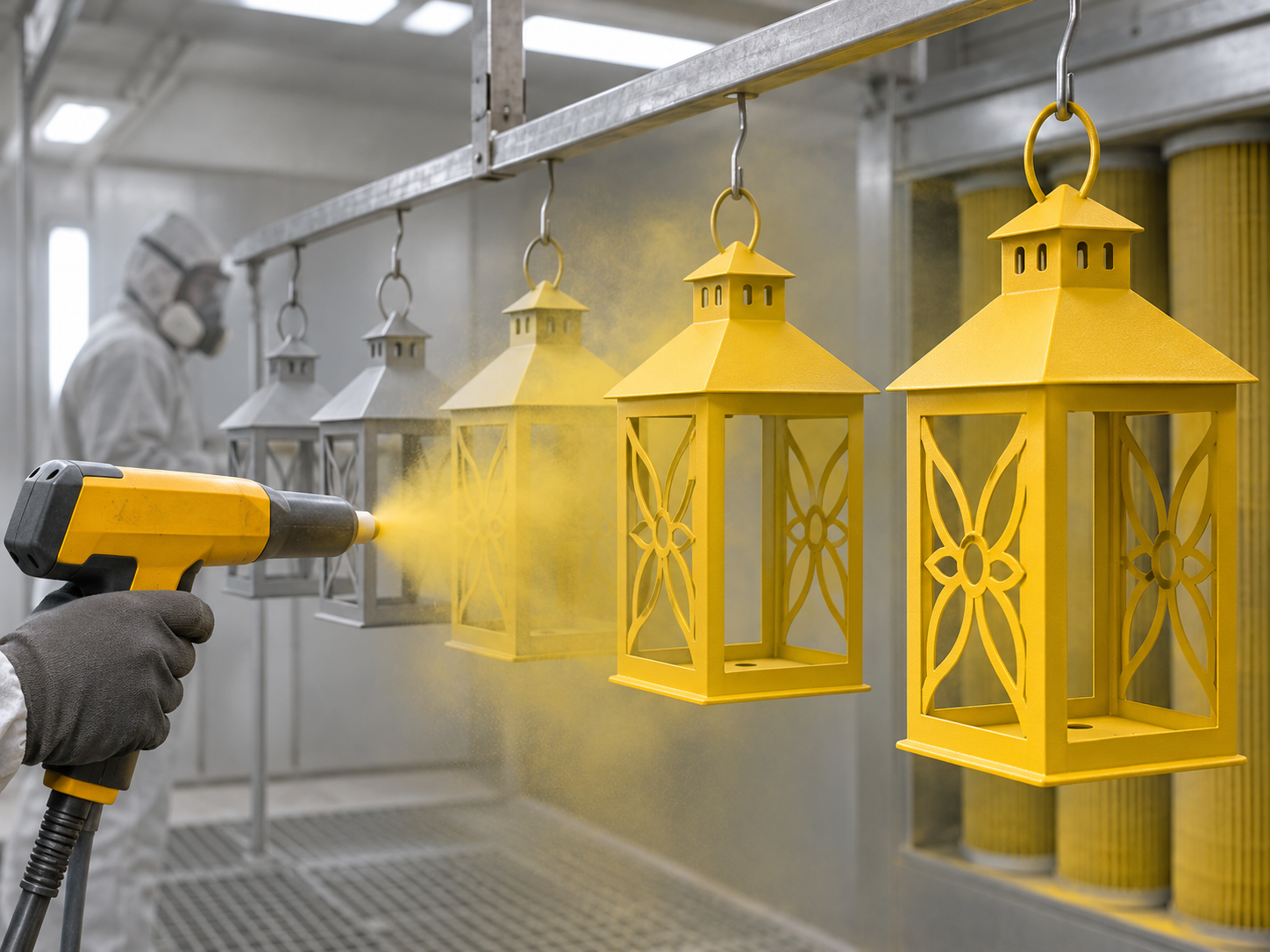
Illustrative image: a powder coating process, not Glowyard factory photography.
Understanding Acid Pickling, Phosphating, and Powder Coating
Several surface treatment processes are commonly used in steel fabrication.
Acid Pickling
Acid pickling removes rust and oxide layers from steel surfaces.
It can improve surface cleanliness before subsequent treatment.
However, acid pickling alone does not create a durable corrosion-resistant conversion layer.
After pickling, thorough rinsing and timely processing are necessary to minimize chemical residue and flash rust.
Phosphating
Phosphating creates a chemical conversion coating on the steel surface.
When properly applied, it can improve paint adhesion and enhance the corrosion resistance of the overall coating system.
Zinc phosphating is often considered for steel products requiring enhanced corrosion protection.
Iron phosphating may offer a more economical alternative for certain applications, although performance depends on the complete process.
Zirconium-Based Pretreatment
Zirconium-based conversion coatings are another option for preparing metal surfaces before powder coating.
These systems may offer advantages in chemical consumption, sludge generation, and process efficiency.
However, their suitability depends on the substrate, coating system, operating conditions, and required corrosion performance.
Electrophoretic Coating (E-Coating)
E-coating uses an electrically deposited coating layer to provide additional corrosion protection.
For some complex metal components, it can provide more uniform coverage than conventional spray methods.
Combining e-coating with powder coating can improve the overall protective system, but it also increases processing complexity and cost.
The appropriate solution should be selected through product-specific testing.
Recommended Surface Treatment for Outdoor Solar Lights
Different outdoor lighting products may require different corrosion protection systems.
Option A: Mild Steel + Phosphating + Powder Coating
A practical option for cost-sensitive decorative solar lighting.
Typical process:
- Metal fabrication and welding
- Degreasing and cleaning
- Rust removal where necessary
- Thorough rinsing
- Phosphating or another validated conversion treatment
- Rinsing and drying
- Outdoor-grade polyester powder coating
- Controlled curing and quality inspection
This approach can improve the reliability of powder-coated mild steel without requiring a complete change in base material.
Option B: Mild Steel + E-Coating + Powder Coating
This option may be suitable for products with complex welded structures or higher corrosion protection requirements.
The additional coating layer can provide improved protection, provided the process is compatible with the product design.
Option C: Galvanized Steel + Pretreatment + Powder Coating
For products requiring additional outdoor corrosion protection, galvanized steel combined with a properly engineered powder coating system can be an effective solution.
Important manufacturing considerations include:
- Zinc coating specification
- Protection of welded areas
- Suitable surface cleaning
- Galvanized-compatible conversion treatment
- Powder coating adhesion
- Correct curing conditions
- Corrosion resistance testing
For premium outdoor solar lighting, this option deserves consideration, particularly when the additional manufacturing cost is relatively small.
Does Galvanized Steel Significantly Increase Manufacturing Costs?
Not necessarily.
The raw material price difference between mild steel and galvanized steel varies according to market conditions, sheet thickness, zinc coating weight, purchase volume, and steel grade.
For lightweight decorative solar lights, the additional raw material cost per unit may be relatively small.
However, manufacturers must also consider:
- Fabrication and welding requirements
- Surface pretreatment costs
- Powder coating compatibility
- Scrap and rework rates
- Quality inspection costs
- Long-term warranty and replacement risks
The correct comparison is not simply the price per kilogram of steel.
OEM buyers should compare the total manufacturing cost of the finished product and the corrosion performance achieved by each process.
How Should Solar Lighting Manufacturers Test Corrosion Resistance?
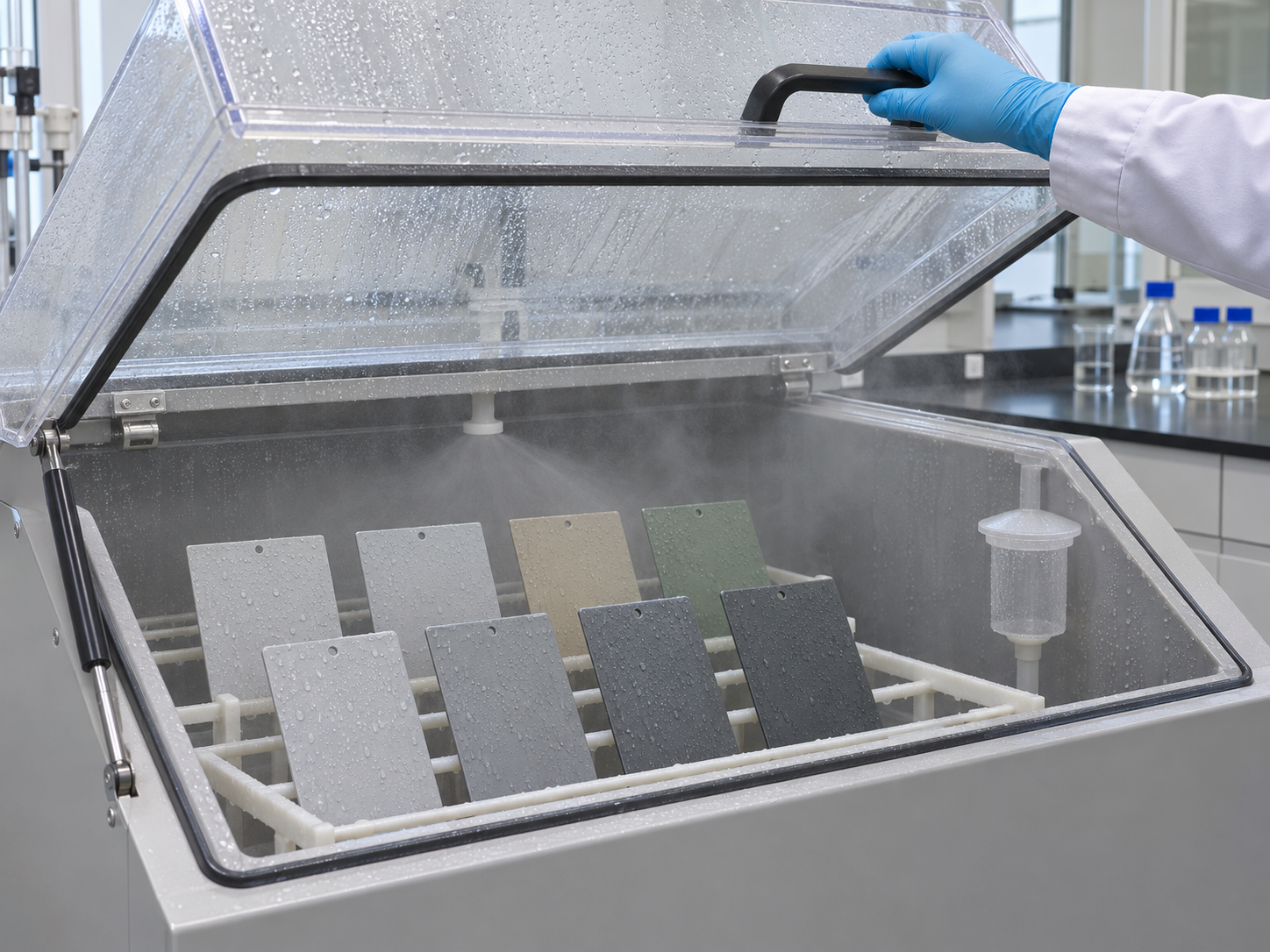
Illustrative image: a salt spray test setup, not a Glowyard test result.
A reliable corrosion protection system should be verified through appropriate quality testing.
Common methods include:
Coating thickness measurement: Checks whether the coating has been applied at the specified thickness.
Cross-cut adhesion testing (ISO 2409): Evaluates coating adhesion to the substrate.
Neutral salt spray testing (ISO 9227): Provides a controlled accelerated corrosion environment for comparative evaluation.
Humidity resistance testing: Helps identify moisture-related coating failures.
Outdoor exposure testing: Provides additional information about real-world performance.
For product development, manufacturers may compare different pretreatment and coating systems using identical metal components.
Salt spray test durations such as 240 or 480 hours may be selected as development checkpoints, but they should not be interpreted as a direct prediction of outdoor service life.
Acceptance criteria should define rusting, blistering, coating adhesion, and corrosion creep around intentional scratches where applicable.
Which Material Is Best for Solar Garden Lights?
The best material depends on the product’s intended application, price positioning, and operating environment.
For cost-sensitive decorative solar lights: Properly pretreated and powder-coated mild steel can be a practical choice.
For premium solar garden lanterns: Galvanized steel with a suitable coating system may provide additional corrosion protection.
For solar cemetery and memorial lights: Special attention should be paid to moisture exposure, drainage, welded joints, and coating durability.
For coastal outdoor lighting: Stainless steel or other corrosion-resistant materials may be more appropriate, depending on environmental conditions and product requirements.
Material selection should be based on realistic performance requirements rather than price alone.
How Glowyard Approaches Metal Solar Lighting Development
At Glowyard, we focus on OEM and ODM decorative solar garden lighting, including metal lanterns, solar stake lights, and memorial lighting products.
Our product development process considers not only appearance and lighting performance but also material selection, fabrication methods, surface treatment, and outdoor durability.
For customized projects, we can evaluate different metal materials and surface finishing options according to the customer’s product design, target market, budget, and corrosion resistance requirements.
Rather than assuming that one material is suitable for every application, we believe the right approach is to match the material and protective coating system to the product’s intended use.
For brands, importers, and wholesalers, this can help balance manufacturing costs, product quality, and long-term customer satisfaction.
Conclusion
Both mild steel and galvanized steel can be suitable materials for outdoor solar lighting.
Mild steel offers excellent formability and cost advantages, while galvanized steel provides additional corrosion protection through its zinc coating.
However, the most important factor is the complete manufacturing system.
Proper cleaning, conversion coating, powder coating, curing, product design, and quality inspection all contribute to corrosion resistance.
For OEM solar lighting projects, the best solution is the one that achieves the required durability at a commercially reasonable cost.
Looking for an OEM Solar Garden Lighting Manufacturer?
Glowyard specializes in decorative solar garden lighting and custom OEM/ODM solutions for international brands, wholesalers, and importers.
Whether you are developing metal solar lanterns, decorative garden lights, or solar memorial lighting, our team can help evaluate suitable materials, finishes, and manufacturing options for your project.
Contact Glowyard to discuss your custom solar lighting requirements.
Frequently Asked Questions
Is galvanized steel better than mild steel for outdoor solar lights?
Galvanized steel generally offers better corrosion resistance because its zinc coating provides additional protection. However, the overall durability of a finished solar light also depends on fabrication quality, pretreatment, powder coating, and environmental exposure.
Can mild steel solar lights be used outdoors?
Yes. Mild steel can be used for outdoor solar lighting when an appropriate protective coating system is applied and maintained.
Does powder coating prevent steel from rusting?
Powder coating provides a protective barrier, but it does not guarantee permanent rust prevention. Damaged coatings, poorly treated surfaces, and exposed edges can still develop corrosion.
Is phosphating necessary before powder coating?
Not in every application, but phosphating or another validated conversion treatment can improve adhesion and corrosion protection. The appropriate pretreatment depends on the substrate and performance requirements.
Can galvanized steel be powder coated?
Yes. Galvanized steel can be powder coated when suitable cleaning, surface pretreatment, and curing procedures are followed.
Which material is best for solar cemetery lights?
The choice depends on expected exposure conditions, design, target price, and durability requirements. Properly coated mild steel and galvanized steel can both be considered, while more aggressive environments may require additional protection.