IP44 Outdoor Lights: Why Decorative Solar Garden Lights Don’t Always Need IP65
Many buyers search online and quickly find the same general advice: outdoor lights should be IP65.
That advice is not completely wrong, but it is too simple.
A decorative solar garden light is not the same product as a pool light, an underground spotlight, a high-power floodlight, or a commercial wall washer. These products face different water exposure, different installation risks, different cost structures, and different customer expectations.
For most decorative solar garden lights, IP44 is not a “low-quality” choice. It is often the most practical balance between splash protection, product cost, appearance flexibility, and real outdoor use.
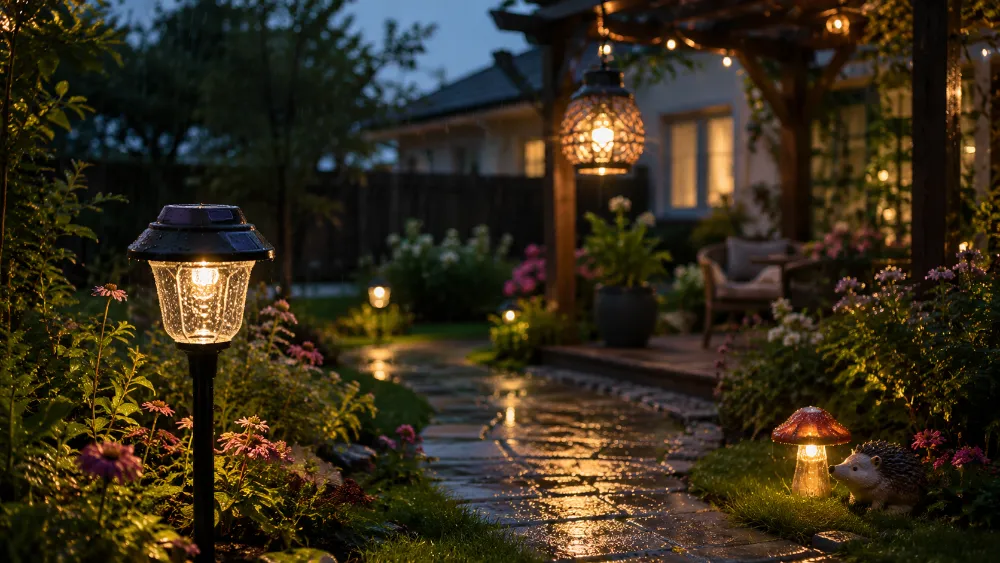
At Glowyard, we manufacture many types of custom decorative solar garden lights for importers, wholesalers, retailers, and private-label brands. In real product development, the smarter question is not simply:
“Is IP65 better than IP44?”
A better question is:
“What waterproof rating is actually suitable for this product, this installation environment, and this target price?”
This article explains why IP44 is enough for many decorative solar garden lights, when IP65 is still worth choosing, and how buyers should think about waterproof ratings more practically.
What Does IP44 Mean for Outdoor Lights?
IP ratings are used to describe how well an enclosure protects against solid objects and water entering the product. The rating normally has two digits.
For IP44:
- The first “4” means protection against solid objects larger than 1 mm.
- The second “4” means protection against splashing water from different directions.
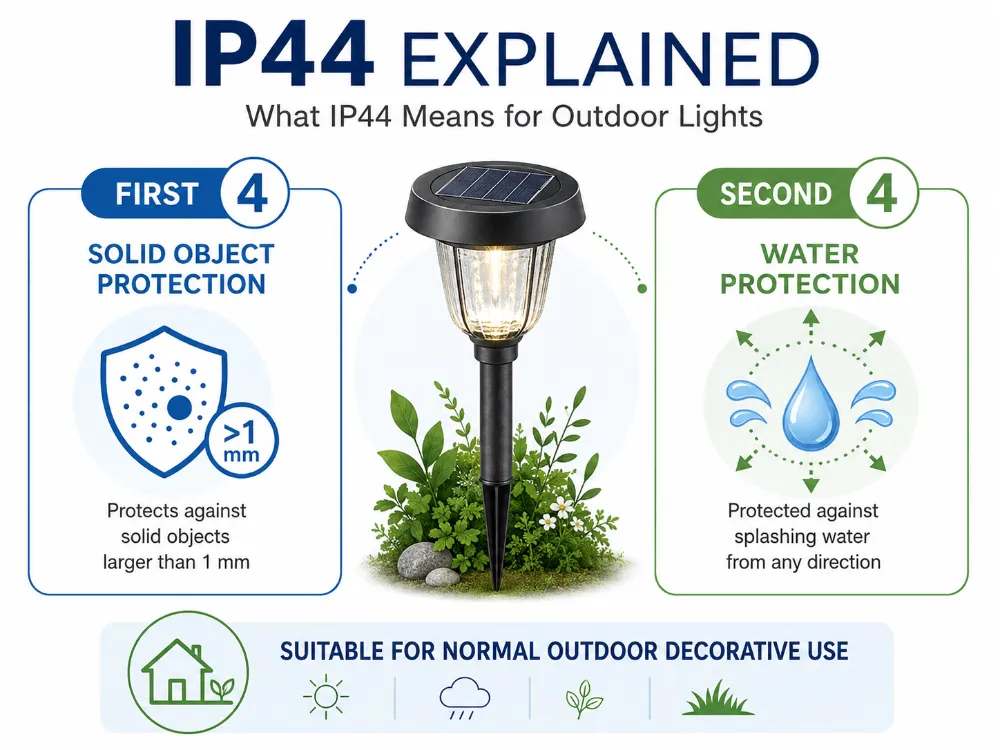
In simple terms, IP44 outdoor lights are designed to handle normal splashing conditions, such as rain, dew, garden moisture, and occasional water contact.
However, IP44 does not mean the product is suitable for:
- being submerged in water;
- being installed inside a pond or pool;
- being cleaned with high-pressure water jets;
- standing in waterlogged soil for long periods;
- being placed where water collects around the electronics.
This distinction matters.
IP44 is not the same as “indoor only.” It is a splash-resistant outdoor protection level. For many decorative solar lights used in gardens, patios, flower beds, balconies, and seasonal retail displays, that level is often practical enough.
For a more detailed comparison, buyers can also read our full guide: IP44 vs IP65 vs IP67: Which Waterproof Rating Do You Actually Need for Outdoor Solar Lights?
Why Decorative Solar Garden Lights Are Different from Other Outdoor Lights
The phrase “outdoor lights” covers many different products. This is where many buyers misunderstand IP ratings.
A swimming pool light and a decorative mushroom solar stake light are both “outdoor lights,” but their waterproof requirements are not the same.
| Product Type | Typical Water Exposure | Waterproof Logic |
|---|---|---|
| Pool lights | Continuous water contact | Higher waterproof protection required |
| Pond or water-feature lights | Frequent splash or possible immersion | Higher rating strongly recommended |
| In-ground lights | Mud, water pooling, ground moisture | Higher rating often needed |
| Wall-mounted security lights | Exposed rain and stronger functional use | IP65 is commonly preferred |
| Commercial landscape lighting | Long-term exposed installation | IP65 may be a safer specification |
| Decorative solar garden lights | Rain splash, dew, normal garden moisture | IP44 is often enough when structure is well designed |
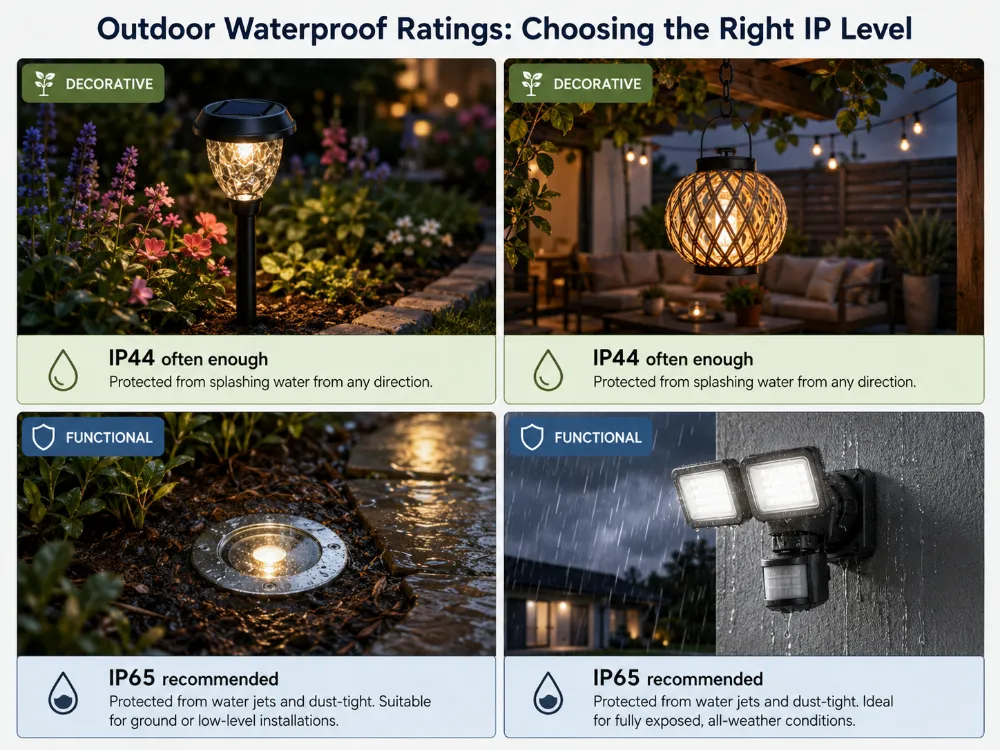
Decorative solar garden lights are mainly used for atmosphere, seasonal decoration, pathway accents, patio styling, and garden retail displays. They are usually low-voltage, low-power products. Many of them are stake lights, hanging lights, tabletop lights, lanterns, animal lights, flower lights, or garden sculptures.
These products are not designed to illuminate a parking lot or survive underwater. Their purpose is to create ambience at a reasonable retail price.
That is why many decorative garden solar lights use IP44 as a practical waterproof level.
IP44 Is Designed for Real Garden Splash Conditions
In normal garden use, decorative solar lights usually face three main types of moisture:
- Rain falling from above;
- Dew and condensation during the night;
- Splashing from wet grass, soil, or nearby watering.
These are different from high-pressure water jets or long-term immersion.
Most decorative solar garden lights are placed in:
- flower beds;
- lawns;
- patios;
- balconies;
- garden borders;
- planters;
- pathways;
- seasonal display areas;
- retail garden decoration zones.
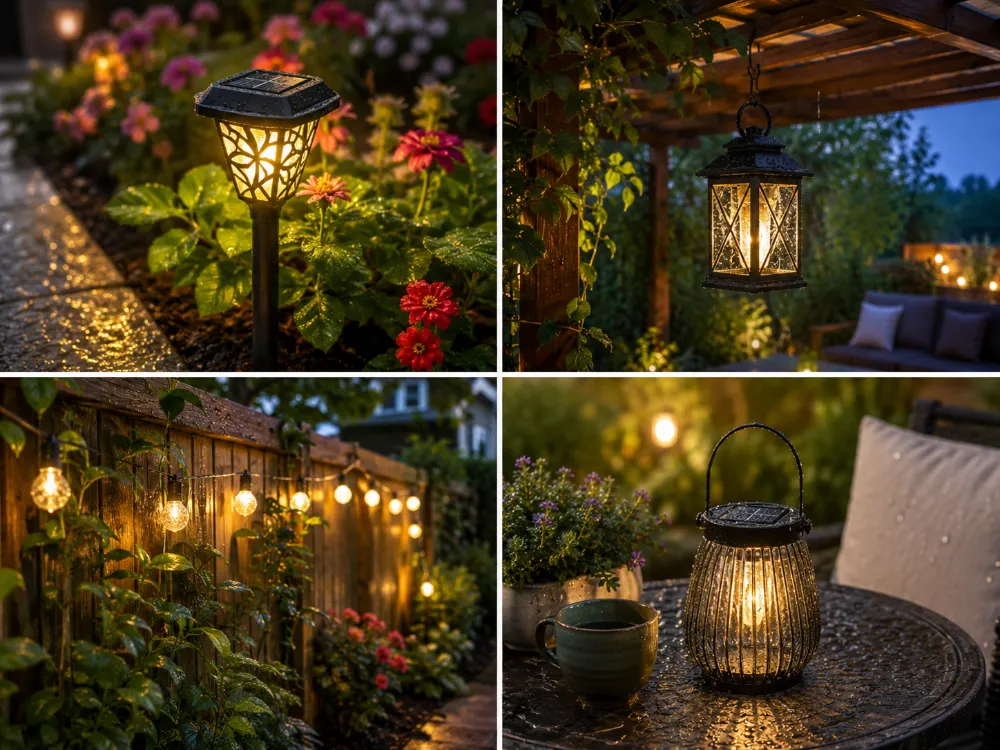
In these locations, the product usually needs to resist splashing water and outdoor humidity. It does not usually need to resist being sprayed directly by a strong hose at close range or submerged after flooding.
That is why IP44 can be a very reasonable standard for many decorative solar light collections.
The real outdoor performance depends not only on the printed IP number, but also on how the product is designed. For example, a well-designed IP44 solar garden light should allow water to run away from sensitive parts instead of collecting around the battery box or switch.
Why Many Decorative Solar Lights Use IP44
Buyers sometimes believe that “outdoor” automatically means IP65 because they have seen this statement in general online guides. But in the real decorative lighting market, IP44 outdoor products are not unusual.
This is especially common for products designed for decoration rather than heavy-duty functional lighting.
That does not mean every IP44 product is automatically reliable. It means IP44 is widely accepted for suitable outdoor decorative applications when the structure, materials, and electronic module are properly designed.
For B2B buyers, the lesson is simple:
IP44 is not unusual for decorative garden lighting. The key is whether the product design matches the real use environment.
If the product is a decorative solar stake light for flower beds, a hanging lantern under a tree, a solar bee string light around a fence, or a resin animal light for garden decoration, IP44 may be enough.
If the product is a powerful wall light, commercial floodlight, in-ground light, or water-feature light, IP65 or higher may be more appropriate.
Why IP65 Is Not Always the Best Choice for Decorative Solar Lights
IP65 is a stronger waterproof rating than IP44. It usually offers better dust protection and stronger protection against water jets.
But stronger does not always mean more suitable.
For decorative solar garden lights, IP65 can bring several trade-offs:
- higher tooling cost;
- more complex sealing structure;
- extra rubber gaskets or sealing parts;
- slower assembly process;
- higher testing cost;
- more restrictions on appearance design;
- higher finished product price.
For functional lighting products, these extra costs may be necessary. For example, a wall-mounted security light or a commercial landscape spotlight may justify IP65 because the product is more exposed and customers expect stronger weather protection.
But for decorative solar garden lights, the buyer often needs to control retail price, maintain attractive appearance, and build a broad product range with many shapes and styles.
In that case, forcing every product to IP65 may create over-specification.
Over-specification means buyers pay for a protection level that the product may not actually need in normal use.
That cost could have been used for more valuable improvements, such as:
- better solar panel quality;
- better battery selection;
- stronger material;
- improved UV resistance;
- better packaging;
- more attractive surface finishing;
- more stable LED color consistency.
This is why many importers and retailers choose IP44 for decorative solar garden lights and reserve IP65 for more exposed or functional product lines.
The Real Key Is Structure, Not Only the IP Number
Waterproof reliability is not only about the label.
Two products may both claim IP44, but their real outdoor performance can be very different.
A good decorative solar garden light should be designed as a complete outdoor system. Important details include:
- solar panel sealing;
- battery box placement;
- switch protection;
- wire connection protection;
- drainage path inside the housing;
- material resistance to UV and temperature changes;
- structural fit between decorative housing and solar module;
- packaging protection during shipment.
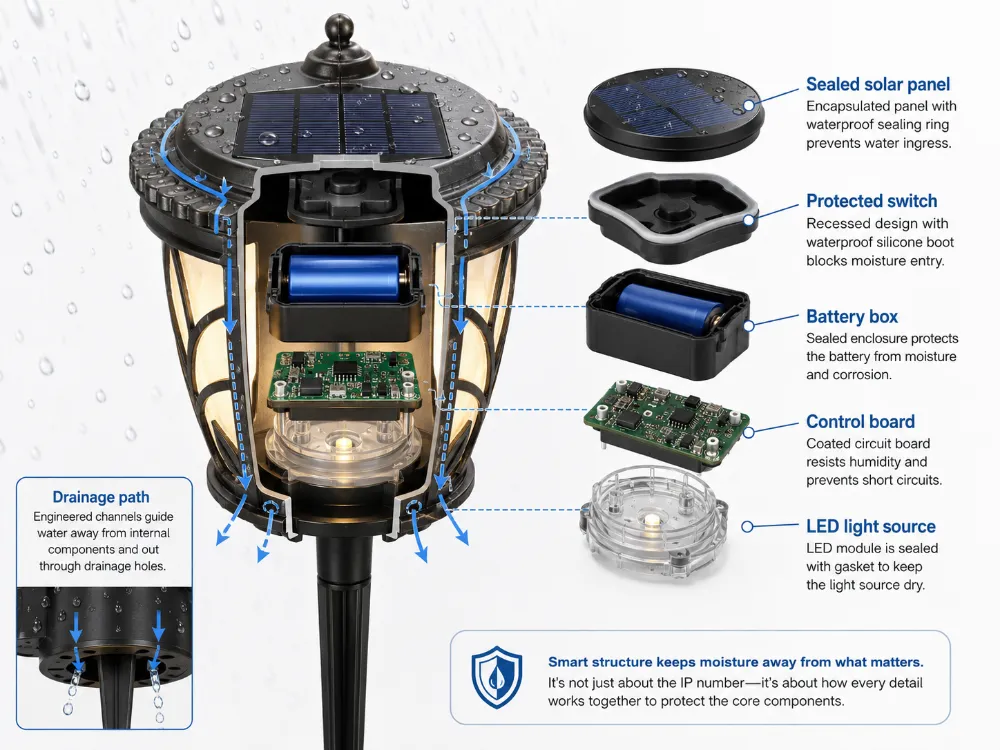
For solar lights, the electronic module is especially important. The solar panel, rechargeable battery, control board, light sensor, LED, and battery box need to work together as a system.
That is why Glowyard pays attention to solar power module assembly instead of treating the solar top as a simple accessory.
A product can have a higher IP rating on paper, but still fail early if:
- the battery box is poorly designed;
- the switch is exposed directly to water;
- the housing traps moisture inside;
- the seal ages quickly under sunlight;
- the panel and battery are not matched properly;
- the material cracks or deforms outdoors.
This is why buyers should not judge outdoor reliability by IP rating alone.
Why IP44 Is Often the Cost-Performance Sweet Spot
For most decorative solar garden lights, IP44 is attractive because it offers a practical balance.
It gives enough splash resistance for normal garden use while keeping the product cost, design freedom, and retail price under control.
This is especially important for:
- seasonal garden decorations;
- flower solar lights;
- animal solar lights;
- mushroom solar lights;
- butterfly solar lights;
- hanging lanterns;
- solar string lights;
- tabletop garden lights;
- low-voltage decorative stake lights.
These products usually compete through appearance, novelty, price, ambience, and shelf appeal. If the waterproof specification is pushed too high for every model, the product may lose its price advantage.
For importers and wholesalers, that matters.
A slightly higher cost may not look serious on one sample. But across a container order, a retail program, or a seasonal product line, the difference can affect margin, assortment size, and final selling price.
A well-designed IP44 product can help buyers achieve:
- better price competitiveness;
- wider product selection;
- more flexible design options;
- lower retail risk;
- better margin control;
- faster development for seasonal collections.
That is why IP44 is often the cost-performance sweet spot for decorative solar garden lights.
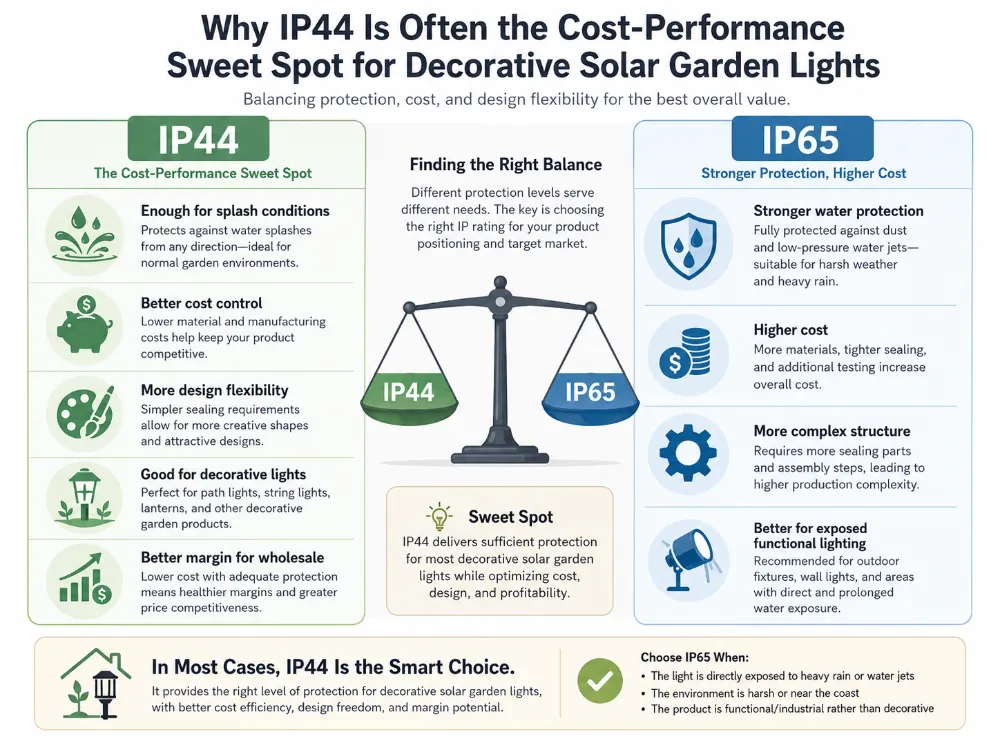
It is not about choosing the cheapest specification. It is about choosing the right specification for the right product category.
When Should You Choose IP65 Instead?
IP65 is still valuable. The point is not to reject IP65, but to use it where it makes sense.
Buyers should consider IP65 when the product will be used in:
- fully exposed open areas with heavy rain;
- coastal or high-humidity environments;
- commercial landscape projects;
- wall-mounted functional lighting;
- high-pressure cleaning environments;
- low-position installations where water may collect;
- in-ground or near-ground lighting;
- projects with stricter durability expectations.
For example, landscape lighting projects often have different requirements from decorative garden retail products. Commercial buyers may care more about long-term exposure, public-space use, maintenance cost, and project warranty risk.
In these cases, IP65 may be a safer choice.
But if the product is a decorative solar garden light used mainly in flower beds, lawns, patios, or seasonal retail displays, IP44 is often more practical.
A Practical Buyer Rule: Match IP Rating to Use Scenario
Instead of asking every supplier for IP65, buyers can use a more practical rule:
Choose the waterproof rating based on where the product will be installed, how water will reach it, and whether the customer expects decoration or functional lighting.
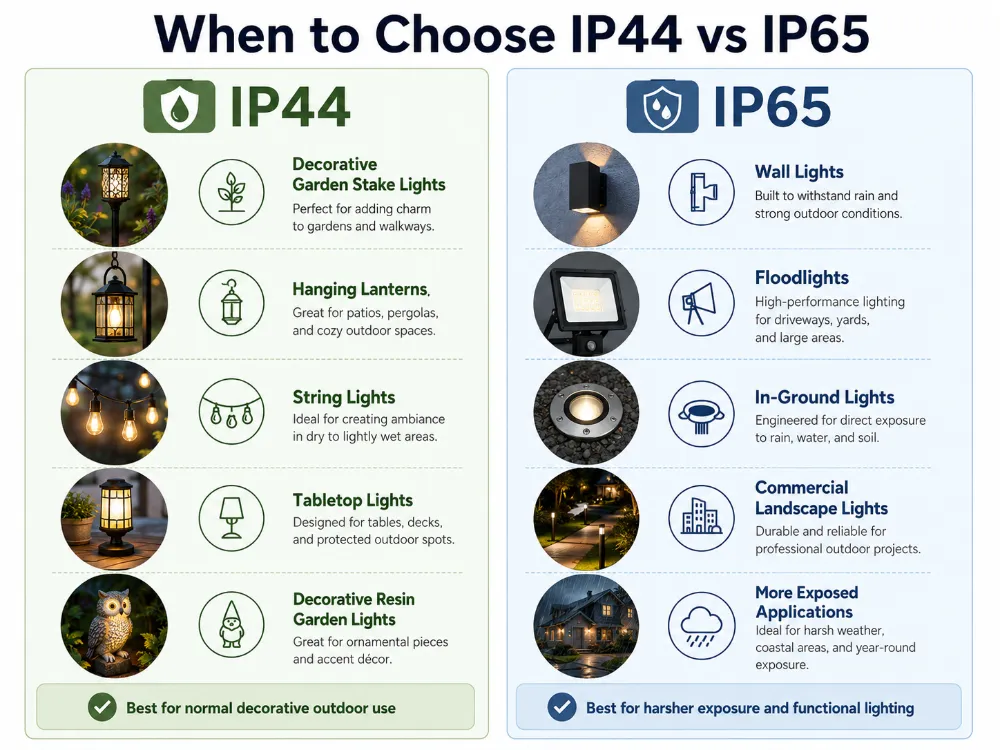
Here is a simple decision table.
| Use Scenario | Recommended Direction |
|---|---|
| Covered patio decoration | IP44 is usually enough |
| Flower bed decorative solar stake lights | IP44 is often enough |
| Hanging solar lantern under tree or pergola | IP44 is usually practical |
| Solar string lights for seasonal decoration | IP44 is commonly used |
| Decorative garden statues with solar light | IP44 can work if module design is good |
| Fully exposed wall light | IP65 is usually better |
| Floodlight or security light | IP65 recommended |
| In-ground or deck-level light | IP65 or higher may be safer |
| Poolside or water-feature light | Higher waterproof design required |
| Commercial landscape project | IP65 is often preferred |
This approach helps buyers avoid two common mistakes:
- Under-specifying products used in harsh environments;
- Over-specifying decorative products that do not need heavy-duty waterproofing.
Both mistakes can create business problems.
Why Many Users Do Not Experience Water Ingress in Normal Garden Use
Some buyers ask: “If IP44 is only splash-resistant, why do many users use these lights outdoors for years without water problems?”
The answer is simple: most decorative solar garden lights are not used in extreme water conditions every day.
In normal use, the product is usually exposed to rain, dew, and humidity—not immersion or strong water jets.
If the product has good structural design, water should not stay around sensitive electronic parts for long periods. The solar panel should be sealed properly, the battery box should be positioned reasonably, and the housing should not trap water.
In many real garden applications, the more common long-term risks are not always water ingress first. They can also include:
- battery aging;
- poor charging due to shade;
- UV fading;
- material cracking;
- weak stakes;
- poor packaging damage;
- low-quality switches;
- unstable LED brightness.
That is why a balanced product specification often works better than simply chasing the highest waterproof number.
Glowyard’s quality control and reliability testing system focuses on finished-product reliability, including waterproof inspection, aging tests, electrical checks, and material-related risks.
For buyers, this matters more than a single waterproof claim.
What Buyers Should Check Besides IP Rating
Before placing a bulk order, buyers should ask suppliers more specific questions.
Instead of only asking:
“Is this product IP65?”
Ask:
- Where is the battery box located?
- Is the solar panel sealed properly?
- Is the switch protected from direct water exposure?
- Does the product have a drainage path?
- What material is used for the outer housing?
- Has the finished product passed waterproof inspection?
- Is the product designed for decoration or functional lighting?
- What is the expected retail price range?
- What is the target product lifespan?
- Will the product be used in covered, semi-covered, or fully exposed areas?
For many buyers, material selection is just as important as waterproof rating. Resin, plastic, glass, and metal all behave differently under sunlight, rain, humidity, and temperature changes.
A plastic solar light may need UV-stabilized material. A metal solar light may need better coating. A resin solar statue may need good wall thickness and surface protection. A glass lantern may need strong packaging and careful sealing around joints.
Waterproof rating is only one part of outdoor durability.
How Glowyard Recommends IP44 and IP65 for B2B Projects
For most decorative solar garden light collections, Glowyard usually recommends IP44 as a practical standard when the product is designed for normal outdoor decorative use.
This includes many:
- stake lights;
- flower lights;
- animal lights;
- resin statue lights;
- hanging lanterns;
- string lights;
- tabletop solar lights;
- seasonal garden decorations.
For special projects, fully exposed installations, functional lighting, or customer markets with stricter requirements, IP65 can be developed as an upgraded option.
Through our OEM and ODM solar garden lighting solutions, buyers can define the waterproof level, material, solar panel size, battery capacity, lighting effect, packaging, and target cost together at the development stage.
This is the best way to avoid both under-specification and over-specification.
A good supplier should not simply answer “yes” or “no” to IP65. A good supplier should help the buyer understand which waterproof level is suitable for the product’s real use scenario.
Final Takeaway: IP44 Is Not Weak — It Is Often the Right Fit
IP65 is stronger than IP44, but that does not mean every outdoor decorative solar light must use IP65.
For most decorative solar garden lights, IP44 is often enough because the real use scenario usually involves splash, rain, dew, and garden moisture—not immersion, pressure washing, or long-term water pooling.
The better purchasing logic is:
Use IP44 for most decorative garden solar lights where splash resistance, cost control, and design flexibility matter. Use IP65 for more exposed, functional, or project-based outdoor lighting.
In other words, IP44 is not a compromise when it matches the application.
It is often the smartest balance between outdoor usability, product cost, design freedom, and wholesale margin.
For buyers developing new decorative solar garden light programs, Glowyard can help review the application, product structure, material, solar module, and waterproof requirement before mass production.
Explore our custom decorative solar garden lights manufacturing service or contact Glowyard to discuss the right waterproof solution for your next product line.
FAQ
Is IP44 enough for outdoor solar garden lights?
Yes, IP44 is often enough for decorative solar garden lights used in normal outdoor conditions such as gardens, patios, flower beds, balconies, and seasonal displays. It is designed for splash resistance, but it is not suitable for immersion or high-pressure water jets.
Is IP65 better than IP44?
IP65 provides stronger protection, especially against dust and water jets. However, it is not always necessary for decorative solar lights. For many garden decoration products, IP44 offers a better balance of cost, appearance, and practical outdoor performance.
Can IP44 lights be used in rain?
IP44 lights can usually handle normal rain and splashing water when the product structure is well designed. They should not be placed in standing water, submerged, or cleaned with high-pressure water.
When should buyers choose IP65 solar lights?
Buyers should choose IP65 for fully exposed wall lights, commercial landscape lighting, floodlights, security lights, in-ground lights, coastal environments, or applications where the product may face stronger water exposure.
Why do many decorative solar lights use IP44?
Many decorative solar lights use IP44 because they are designed for ambience and normal garden decoration, not heavy-duty functional lighting. IP44 helps maintain good splash protection while keeping product cost, design flexibility, and retail pricing more competitive.
Does waterproof rating guarantee long product life?
No. Waterproof rating is only one part of outdoor durability. Battery quality, solar panel design, material selection, UV resistance, switch protection, drainage structure, packaging, and factory quality control also affect long-term product performance.

![do solar lights work in winter at cemeteries [2026 guide]](https://glowyard.com/wp-content/uploads/2026/03/Do-Solar-Lights-Work-in-Winter-at-Cemeteries-2026-Guide.webp)