
What Certifications Should You Check Before Importing Outdoor Lights?
If you import outdoor lights, the certifications and compliance documents you should check usually depend on three factors:
- your target market
- the product type
- the electrical design behind the product
In many cases, buyers should review CE, RoHS, and UKCA where relevant, along with supporting files such as Declarations of Conformity, test reports, product labels, manuals, and basic supplier quality documents.
The key principle is simple:
Do not rely on a logo alone. Check the full document set behind the product you are actually buying.
For importers, distributors, wholesalers, and private-label buyers, certifications are not just paperwork. They help reduce customs problems, lower compliance risk, support retailer or marketplace approval, and show whether a supplier is really prepared for your market.
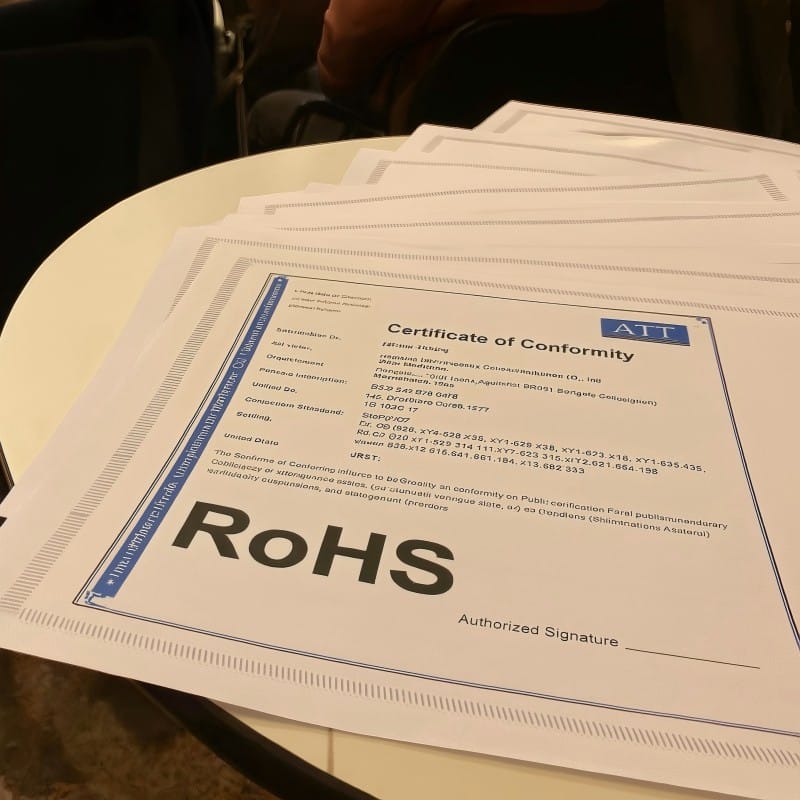
For B2B buyers, the real question is not “Do you have a certificate?” but “Can you show the right file set for this exact product and market?”
Why Buyers Should Check Certifications Before Importing Outdoor Lights
Many outdoor lights look similar in product photos, but compliance problems usually appear after the order is placed rather than before it.
A supplier may show a CE icon in the artwork, but the supporting file may belong to another model. A report may exist, but only for an older version. In other cases, the product may be suitable for one market but not fully documented for another.
These gaps can lead to:
- customs delays
- relabeling work
- retailer rejection
- marketplace listing problems
- after-sales claims
- brand risk for private-label buyers
What buyers are really trying to avoid
- Wrong market marking for the EU, Great Britain, or the US
- Unclear or mismatched documents that do not match the ordered model
- Weak support for outdoor claims such as waterproofing or battery performance
- Supplier confusion when asked to explain labels, manuals, or declarations
- Sample-to-mass-production mismatch between the approved version and the shipment
For serious buyers, certification review is not only about market access. It is also a fast way to judge whether a supplier has real documentation discipline.
Quick Answer: Which Certifications Usually Matter Most?
For many outdoor lighting projects, the most important topics are:
| Type | Common Examples | Why Buyers Check It |
|---|---|---|
| Market-access compliance | CE, UKCA | To confirm the product is being prepared for the intended market |
| Material / electronics compliance | RoHS | To check whether restricted substances in electrical or electronic parts are being controlled |
| US electronics-related review | FCC, where relevant | To confirm whether US-facing electronic authorization review applies to the exact model |
| Performance and durability evidence | IP test reports, battery tests, runtime checks, salt spray or UV-related reports where relevant | To verify outdoor-use claims |
| Supplier system signals | ISO9001, inspection records, traceability files | To understand whether the factory has process and documentation control |
This is why experienced buyers usually treat compliance as a document system, not as a single certificate topic.
1. CE: Usually the First EU-Facing Check
For EU-bound outdoor lights, CE is often one of the first compliance topics buyers review.
The European Commission’s CE marking guidance explains that CE marking applies to products covered by relevant EU legislation and indicates they have been assessed against the applicable framework.
For buyers, the practical meaning is simple:
- CE is not a quality trophy
- CE is not proof that the product is premium
- CE is part of the product’s EU market-entry logic
That is why experienced buyers do not only ask, “Do you have CE?”
They ask:
- Which EU rules apply to this model?
- Does the declaration match the exact product?
- Do the label, manual, and product version line up?
- Are the support files clearly connected to the order?
If you want the full buyer-side breakdown, read Do Outdoor Lights Need CE Certification? What Buyers Should Check.
2. RoHS: Important for Products with Electronic Components
If an outdoor light contains LEDs, batteries, PCBs, wires, controllers, connectors, or charging parts, RoHS often becomes relevant.
The European Commission’s RoHS Directive page explains the EU rules restricting hazardous substances in electrical and electronic equipment. For Great Britain, buyers can also review GOV.UK’s RoHS regulations guidance.
For buyers, RoHS is usually less about a decorative “green” label and more about:
- component control
- BOM discipline
- supplier declarations
- document consistency
- change management
That is why RoHS is often especially important for:
- solar lights
- battery-operated outdoor lights
- memorial or cemetery lights with electronics
- seasonal decorative lights with powered components
If you want the deeper component-level view, read Do Outdoor Lights Need RoHS Compliance? A Buyer’s Guide.
3. UKCA: Important for Great Britain, But Check the Current Route Carefully
For outdoor lights going to Great Britain (England, Scotland, and Wales), buyers should review the current product route under GOV.UK’s UKCA and CE guidance for Great Britain.
The important buyer takeaway is this:
Do not assume that EU-facing and GB-facing documentation are automatically interchangeable.
For UK-bound projects, buyers should check:
- which market version the supplier is preparing
- whether the chosen route is correct for the product sector
- whether the declaration, label, and manual match that route
- whether the supplier can clearly explain the GB document set
In practice, this often matters less as a “logo question” and more as a market-version question.
If you want the full GB-focused guide, read UKCA for Outdoor Lights: What Importers Need to Know.
4. FCC: Sometimes Relevant for the US Market
For certain outdoor lighting products sold into the US, buyers may also need to ask whether FCC-related review applies.
This is especially worth checking when the product includes electronics that may fall into FCC authorization logic. The FCC’s official Equipment Authorization page is a useful starting point.
This does not mean every outdoor light should be treated the same way.
It means buyers should ask a more precise question:
“For the exact US-bound version we are importing, is any FCC-related authorization or review relevant?”
That question is often much more useful than simply asking, “Do you have FCC?”
Certifications Alone Are Not Enough
Headline certifications matter, but they are not the whole picture.
Outdoor lights are exposed to:
- rain
- dust
- UV exposure
- temperature change
- packaging claims
- long-term field use
So experienced buyers usually review two layers at the same time:
Layer 1: Market-entry and compliance logic
This includes:
- CE
- RoHS
- UKCA
- FCC, where relevant
- Declarations and basic conformity files
Layer 2: Outdoor-use performance evidence
This includes:
- IP-related support
- battery runtime checks
- charge-discharge performance
- durability testing
- material suitability
- product labeling consistency
That is why the strongest suppliers do not just show one certificate.
They can support a coherent document pack.
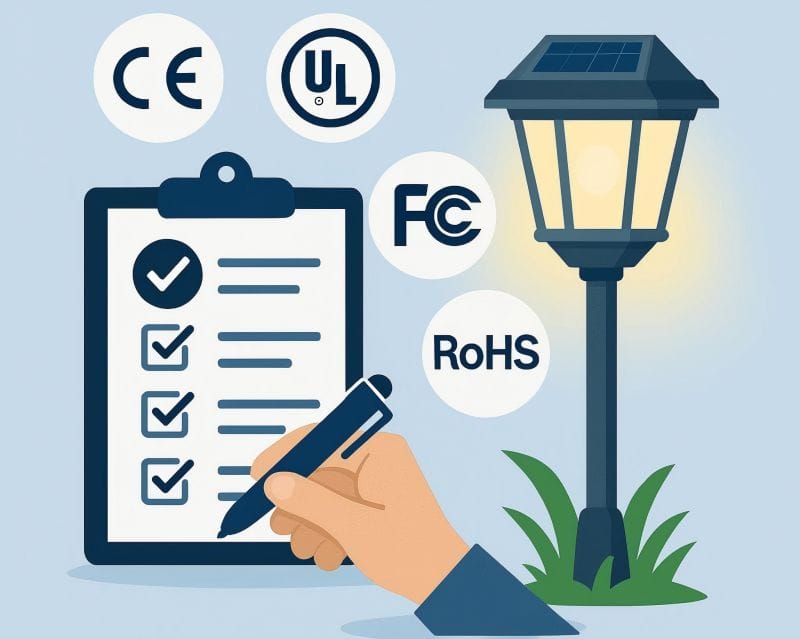
The strongest compliance review looks at the full document pack, not just one mark.
What Documents Should Buyers Ask Suppliers to Provide?
In many sourcing projects, these are the most useful files to ask for first:
| Document | Why It Matters |
|---|---|
| Declaration of Conformity | Shows how the supplier is declaring conformity for the product and market |
| Relevant test reports | Provide technical support behind the conformity claim |
| Product label photos | Help confirm that marking, model name, and product identity match |
| Manual / instruction sheet | Useful for warning language, intended use, and market consistency |
| Packaging artwork or carton files | Important when labels or claims vary by market |
| QC or inspection records | Help reduce mismatch risk between approved sample and shipment |
| Basic supplier quality documents | Help buyers judge process control and documentation discipline |
Five practical questions buyers should ask
- Does the file match the exact model I am buying?
- Is it prepared for the correct market?
- Do the label, manual, and packaging match the declaration?
- Are the report dates and product details still relevant to the current version?
- Can the supplier explain the file set clearly without guessing?
If the supplier can answer those questions cleanly, risk is usually much lower.
Other Outdoor Checks Buyers Should Not Ignore
A certification file may help with compliance, but it does not automatically prove the product is durable outdoors.
IP ratings and enclosure protection
For outdoor lights, waterproofing and enclosure protection are often just as important as headline certification.
The IEC’s IP ratings overview is a useful official reference for understanding enclosure protection logic.
If waterproof performance is a key buying factor, read IP44 vs IP65 vs IP67.
Battery and runtime support
For solar or battery-operated products, buyers should also review:
- runtime claims
- battery specifications
- charge performance
- replacement expectations
- whether the claim is realistic for the product size
Material durability
Outdoor lighting performance is also shaped by:
- plastic durability under sun exposure
- corrosion risk in metal parts
- seal quality
- housing construction
- real weather suitability
For technical durability support, your supporting content such as How to Improve the Durability of Plastic in Solar Garden Lights Under Outdoor Sun Exposure can help strengthen the buying logic.
How to Spot Fake, Outdated, or Irrelevant Certificates
One of the most valuable sourcing habits is learning how to identify a file that looks official but does not really support the goods being purchased.
A logo, a stamp, or a nice-looking PDF is not enough.
Common red flags
| Red Flag | What It Often Means |
|---|---|
| No clear certificate or report number | The file may be difficult to trace or verify |
| No issuing body information | Buyers cannot confirm who created the file |
| Wrong product name or vague model description | The file may belong to another product |
| Very old date with no update history | The report may not reflect the current design |
| Only a logo image, no supporting report | The claim is weak and may not survive buyer review |
| Wrong market focus | The supplier may be sending EU-facing files for a GB project, or vice versa |
| File and packaging do not match | A common sign of poor version control |
A simple rule
A real compliance file should be traceable, relevant, current enough, and clearly connected to the actual product being imported.
If the supplier cannot make that connection clearly, the risk is higher.
How Glowyard Helps Buyers Handle Certification Review
For importers, distributors, and private-label buyers, the biggest problems often come from small mismatches:
- the sample differs from the shipment
- the document exists, but not for the exact model
- the market changes, but the file pack does not
- the packaging claim is stronger than the technical support behind it
That is why we treat certification review as part of a broader sourcing workflow, not as a decorative selling point.
What we help coordinate
- product-related compliance files for the intended market
- model and file matching during sampling and order confirmation
- basic label and packaging coordination for OEM orders
- document review before mass production
- support for technical and inspection files where needed
If you are developing a custom or private-label program, our OEM/ODM Solutions page explains how we support product development, documentation coordination, and scalable production.
If your focus is broader sourcing control, you can also read 15 Tips for Bulk Purchasing Solar Garden Lights from China.
FAQ
Is one certificate enough for all outdoor lights?
No. Different outdoor lights may require different priorities depending on the target market, the product structure, and the claims made for the item. In many cases, buyers should review a combination of market-related compliance, technical support files, and product-specific documentation rather than relying on one file alone.
What is the difference between a certificate, a test report, and a Declaration of Conformity?
They are related, but they do not do the same job.
- A certificate is often used as a broad buyer term for a compliance-related file.
- A test report shows the result of a technical evaluation on a sample or material.
- A Declaration of Conformity connects the product to the relevant framework and identifies the model and declared basis.
For buyers, the key point is whether the files work together and match the actual product being ordered.
Can the same outdoor light need different files for the EU and Great Britain?
Yes. Buyers should not automatically assume EU-facing and GB-facing documents are interchangeable. Review each target market separately and confirm which file set, label, and manual version the supplier is preparing.
Are IP ratings and battery tests as important as formal certifications?
In many outdoor lighting projects, yes. Formal compliance matters, but outdoor-use claims such as waterproofing, runtime, and durability often need their own supporting evidence. These checks are often just as important in preventing returns and complaints.
Should I ask for ISO9001 when reviewing an outdoor lighting supplier?
It can be useful because it helps buyers understand whether the factory has a structured quality system. But it should not replace product-level compliance documents and model-specific technical support.
Conclusion
If you are importing outdoor lights, the right certification review usually depends on market, product type, and electrical design.
In many projects, the most important topics are:
- CE for EU-facing conformity logic
- RoHS for electronics and restricted-substance control
- UKCA for Great Britain, where relevant
- FCC-related review for certain US-bound products
- supporting documents and performance evidence that prove the product matches the claim
The most important lesson is simple:
A trustworthy outdoor lighting supplier should be able to explain the right document set for the right product in the right market — not just show a logo.


![do solar lights work in winter at cemeteries [2026 guide]](https://glowyard.com/wp-content/uploads/2026/03/Do-Solar-Lights-Work-in-Winter-at-Cemeteries-2026-Guide.webp)