UV-Stabilized vs Regular Plastic: What B2B Buyers Must Know Before Sourcing Outdoor Products
For B2B buyers sourcing outdoor products — from solar garden lights and landscape fixtures to decorative housings and structural components — plastic material selection is not just a cost decision.
It is a risk management decision.
In outdoor environments, sunlight is one of the most aggressive degradation factors affecting plastic components. Products that look stable in factory testing or short-term inspections may begin to:
- Fade within months
- Turn yellow
- Become brittle
- Crack under minor impact
- Lose structural strength
When this happens, the issue is rarely “manufacturing quality.”
In most cases, it is UV degradation.
Understanding the difference between regular plastic and UV-stabilized plastic can significantly reduce:
- Warranty claims
- Seasonal return spikes
- Brand reputation damage
- Long-term inventory loss
For buyers working with outdoor lighting manufacturers, material selection becomes a critical quality control checkpoint.
Before deciding whether UV stabilization is an upgrade or a necessity, B2B buyers must understand why plastic fails under sunlight in the first place.
Why Plastic Fails Under Sunlight
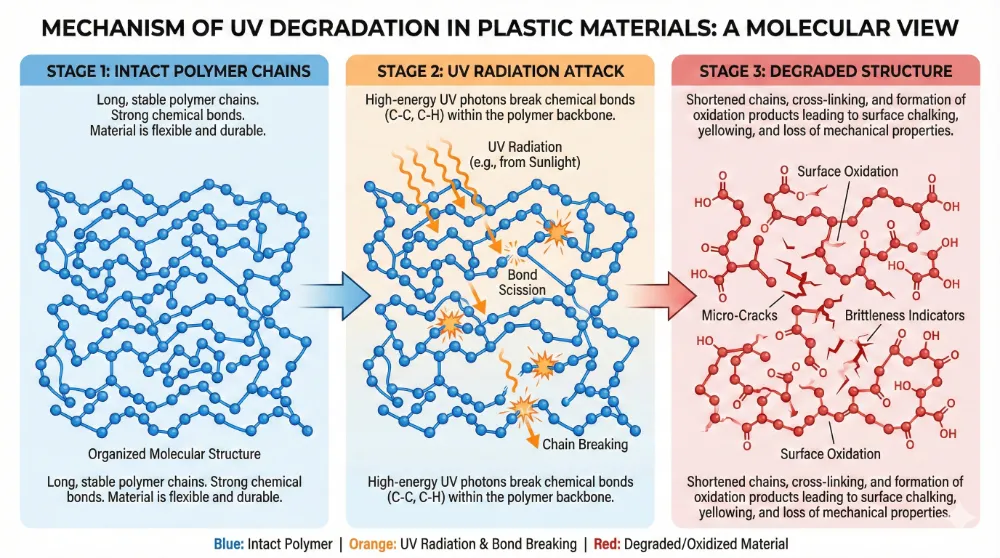
Plastic does not fail because of heat alone.
It fails primarily due to ultraviolet (UV) radiation.
Sunlight contains UV-A and UV-B radiation. These high-energy wavelengths penetrate plastic surfaces and trigger a chemical reaction known as photo-oxidative degradation.
1. Molecular Chain Breakdown
Most plastics (PP, ABS, PS, PC) are composed of long polymer chains.
UV radiation breaks these molecular chains apart.
As the chains shorten:
- Impact resistance decreases
- Flexibility drops
- Surface chalking appears
- Cracking risk increases
The material gradually becomes brittle — even if it looks visually acceptable at first.
2. Color Fading & Yellowing
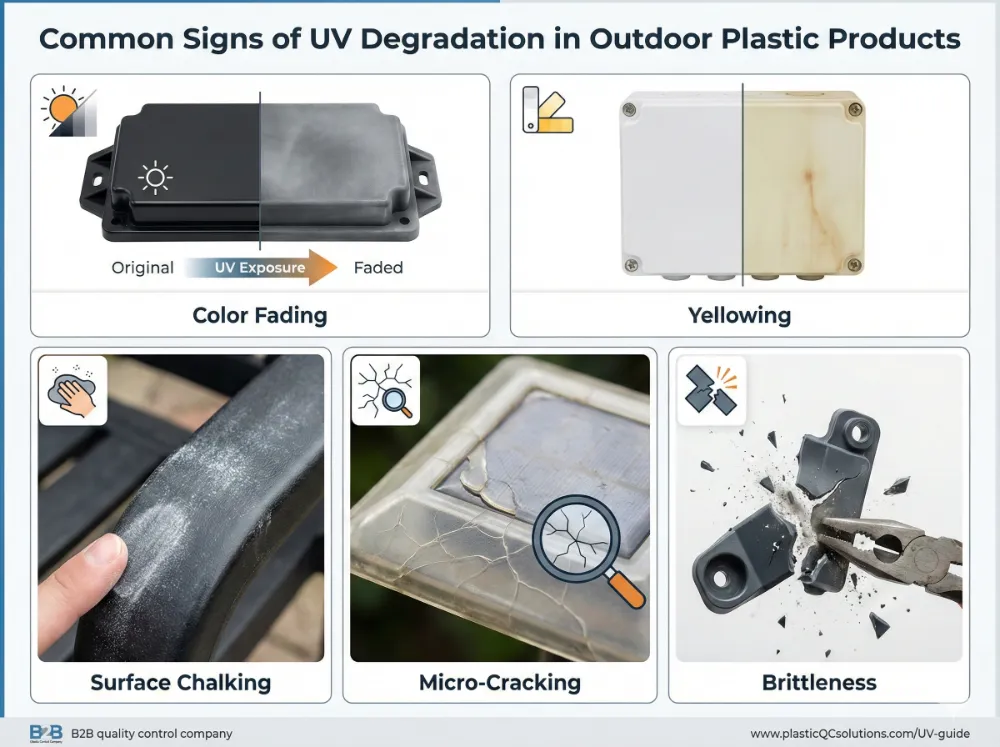
UV exposure alters the chemical structure of pigments and resin bases.
Common symptoms include:
- Black plastic turning gray
- White plastic turning yellow
- Colored housings fading unevenly
- Surface gloss reduction
For B2B buyers, this is not just cosmetic.
Color instability directly affects:
- Retail presentation
- Perceived product quality
- Repeat purchase rates
- Distributor confidence
In high-UV markets, visible fading can occur within 3–6 months using regular plastic.
3. Surface Oxidation & Powdering
As UV exposure continues, oxidation accelerates.
The surface may begin to:
- Develop micro-cracks
- Show chalk-like residue
- Lose structural density
- Fail at screw joints or stress points
This is especially critical for:
- Outdoor lighting housings
- Mounting brackets
- Thin-wall decorative shells
- Injection-molded garden products
Once surface degradation begins, mechanical strength declines rapidly. Understanding how professional factories manufacture plastic solar lights helps buyers appreciate the importance of material selection.
4. Heat + UV = Accelerated Failure
UV damage becomes significantly worse when combined with:
- High ambient temperature
- High humidity
- Daily temperature fluctuations
Regions with strong solar intensity — such as:
- Southern United States
- Australia
- Middle East
- Southeast Asia
— experience much faster plastic degradation cycles.
In these environments, regular plastic components can show structural weakening within 6–12 months.
5. Why Factory Inspection Often Misses the Risk
Many sourcing decisions are made based on:
- Initial appearance
- Short-term sample testing
- Indoor showroom performance
However, UV degradation is cumulative and time-based.
A product that passes:
- Drop tests
- Assembly inspection
- 30-day aging
may still fail under 12 months of direct sunlight exposure.
For B2B buyers, this creates a hidden liability:
The failure does not occur during factory inspection —
It occurs in the customer’s backyard.
Key Takeaway for B2B Buyers
Plastic failure under sunlight is predictable, not accidental.
If your target market has:
- High UV index
- Long summer exposure
- Outdoor year-round usage
then material selection becomes a strategic durability decision, not just a cost-saving choice.
In the next section, we will compare real-world lifespan differences between regular plastic and UV-stabilized plastic in outdoor environments.
Real Lifespan Comparison in Outdoor Markets
For B2B buyers, the most important question is not:
“What is UV-stabilized plastic?”
The real question is:
How long will this product survive in my target market — without triggering returns or warranty claims?
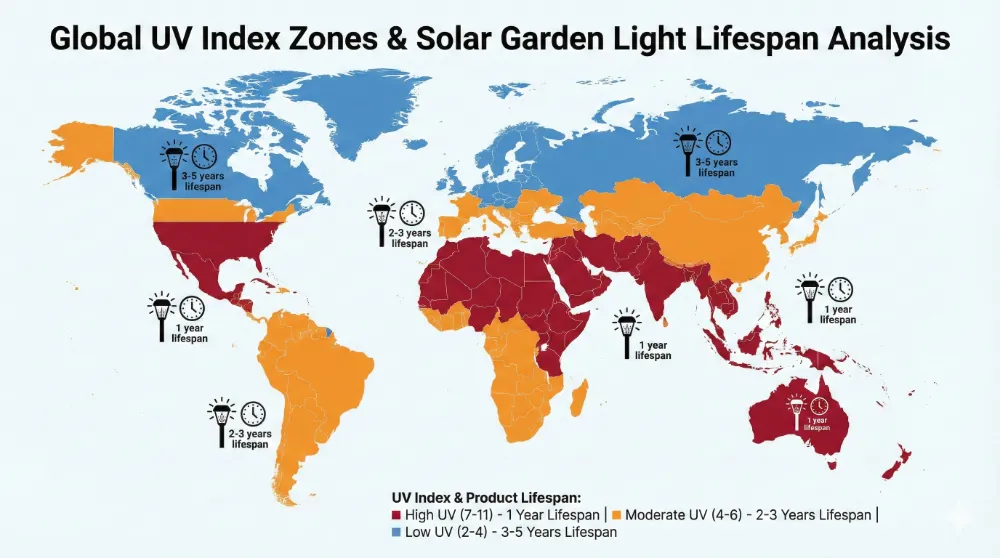
Outdoor lifespan varies dramatically depending on UV intensity, temperature fluctuation, and humidity levels. A plastic housing that performs acceptably in Northern Europe may fail within months in Arizona or Dubai.
Below is a practical comparison based on field feedback, accelerated aging simulations (QUV 500–1000h), and typical outdoor exposure patterns.
1. High-UV Markets (UV Index 7–11)
Examples:
- Southern United States (Florida, Texas, Arizona)
- Australia
- Middle East
- Mexico
- Southeast Asia
Regular Plastic Performance:
- Visible color fading: 3–6 months
- Surface chalking: 6–9 months
- Brittleness / cracking risk: 6–12 months
- Screw joint stress failure: within 1 year
UV-Stabilized Plastic Performance:
- Color stability: 18–36 months
- Structural stability: 2–5 years
- Reduced brittleness under heat cycling
- Lower surface oxidation rate
In high-UV environments, regular plastic is not a cost-saving option — it is a short lifecycle product.
For year-round outdoor products, UV stabilization is often a minimum durability requirement, not an upgrade.
2. Moderate-UV Markets (UV Index 4–6)
Examples:
- Southern Europe
- India
- Parts of South America
- Coastal regions with strong summer exposure
Regular Plastic Performance:
- Slight fading after 6–12 months
- Brittleness beginning around 12–18 months
- Noticeable cosmetic aging after 1 year
UV-Stabilized Plastic Performance:
- Minimal visible fading for 2+ years
- Stable mechanical properties
- Lower warranty exposure
In these regions, regular plastic may survive longer than in high-UV markets, but cosmetic degradation still affects retail perception.
If your customers sell through premium retail channels, visual stability becomes commercially important.
3. Low-UV Markets (UV Index 2–4)
Examples:
- Northern Europe
- Canada (northern regions)
- Scandinavian countries
Regular Plastic Performance:
- Cosmetic fading slower (12–24 months)
- Structural failure risk significantly lower
- Acceptable for lower-cost seasonal products
UV-Stabilized Plastic Performance:
- Long-term durability (3–5+ years)
- Better color retention
- Stronger resale / repeat order stability
In low-UV markets, UV stabilization becomes a strategic positioning choice rather than a survival requirement.
4. Accelerated Aging Insight (How Testing Translates to Real Use)
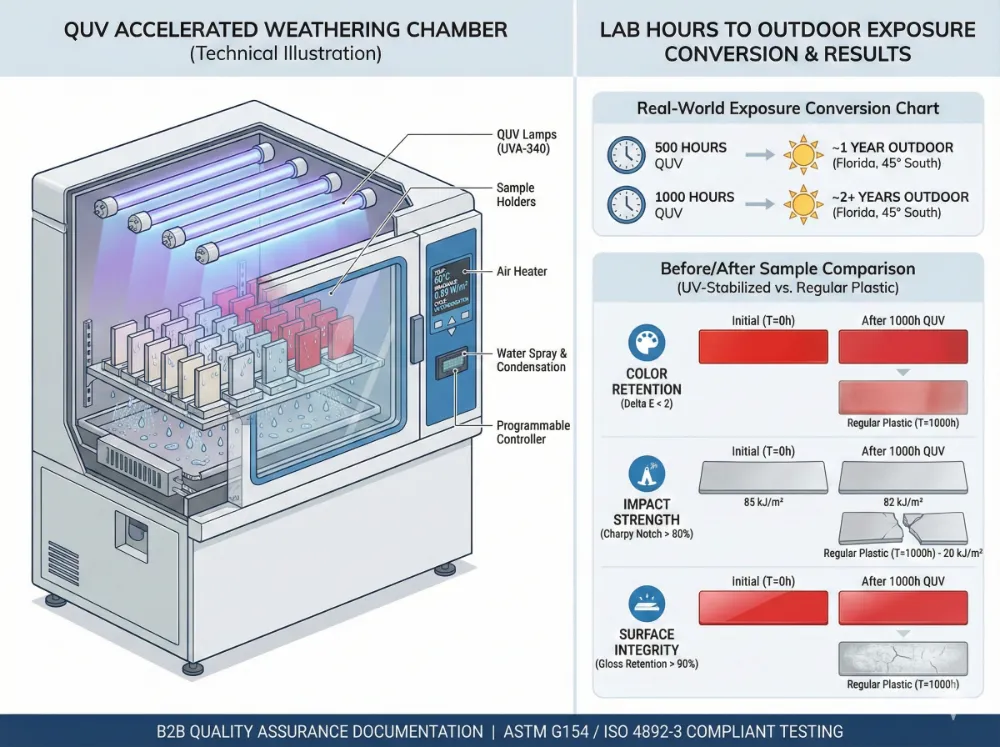
In laboratory testing:
- QUV 500 hours ≈ approximately 1 year of moderate outdoor exposure
- QUV 1000 hours ≈ 2+ years of strong sunlight exposure
Typical results:
| Test Result | Regular Plastic | UV-Stabilized Plastic |
|---|---|---|
| Color retention | Significant fading | Minor change |
| Impact strength | Drops 30–50% | Stable or slight drop |
| Surface cracking | Possible | Rare |
| Structural integrity | Degrades | Maintained |
For B2B buyers, this means:
A product may look identical at delivery,
but diverge significantly after 12–24 months in the field.
5. What This Means for Your Product Category
Different product types face different exposure levels:
- Solar garden lights: Constant top-side sun exposure
- Pathway lights: Moderate vertical exposure
- Wall-mounted fixtures: Directional UV impact
- Decorative seasonal lights: Short exposure cycle
If your product:
- Is sold with 2-year warranty
- Targets warm-climate distributors
- Is marketed as “durable outdoor solution”
then regular plastic may create lifecycle mismatch. For more insights on material durability, see our comparison of Resin vs Iron vs Plastic vs Glass.
Practical Buyer Insight
Choosing regular plastic in a high-UV region may reduce product cost by 3–7%.
But if lifespan shortens from 3 years to 1 year, the long-term impact includes:
- Distributor dissatisfaction
- Lower reorder rate
- Brand credibility erosion
- Increased support workload
From a B2B perspective, lifespan is not just a technical metric —
it is a profitability multiplier.
In the next section, we will break down the actual cost difference between UV-stabilized and regular plastic — and evaluate whether the upgrade truly makes financial sense.
Cost Difference Breakdown
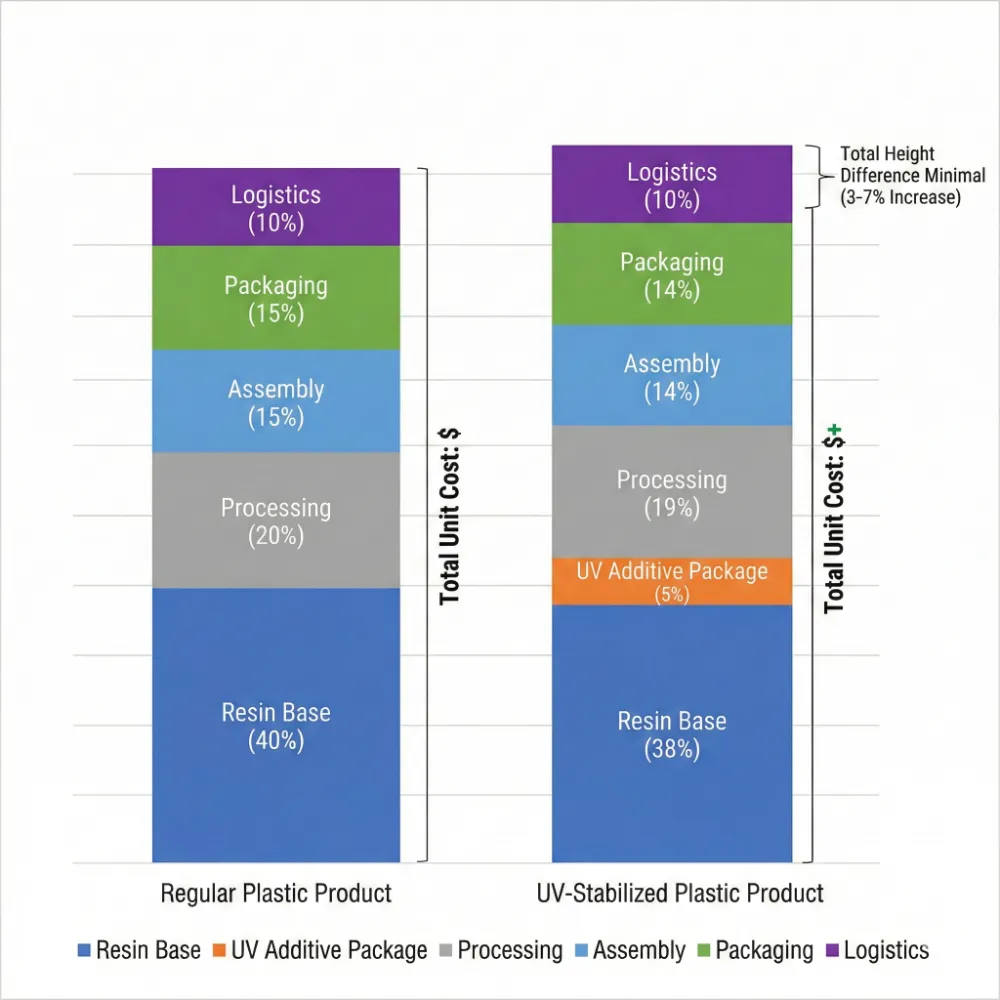
For most B2B buyers, the discussion eventually comes down to one question:
Is UV-stabilized plastic worth the additional cost?
The key is to evaluate cost not as a single line item — but as a lifecycle-adjusted investment.
Below is a relative cost comparison to help clarify how UV stabilization impacts overall product economics.
1. Raw Material Cost Comparison (Relative)
| Component Level | Regular Plastic | UV-Stabilized Plastic |
|---|---|---|
| Resin Base | $ | $ |
| UV Additive Package | – | $ |
| Compounding / Processing | $ | $$ |
| Total Material Cost | $ | $$ |
Relative Difference:
UV-stabilized plastic typically increases material cost from $ → $$
The increase is driven by:
- UV absorbers
- HALS (Hindered Amine Light Stabilizers)
- Antioxidant stabilizer systems
- Additional compounding control
However, the difference remains incremental at material level.
2. Finished Product Cost Impact
When translated to finished goods:
| Product Cost Layer | Regular Plastic | UV-Stabilized Plastic |
|---|---|---|
| Housing Cost | $ | $$ |
| Assembly Cost | $ | $ |
| Packaging | $ | $ |
| Logistics | $ | $ |
| Total Unit Cost | $$ | $$+ |
Because plastic housing is only part of the total product cost,
the overall finished product typically moves from:
$$ → $$+
—not from $$ to $$$.
For many outdoor products, UV stabilization affects total cost less than most buyers initially assume.
3. Hidden Cost Risk (Without UV)
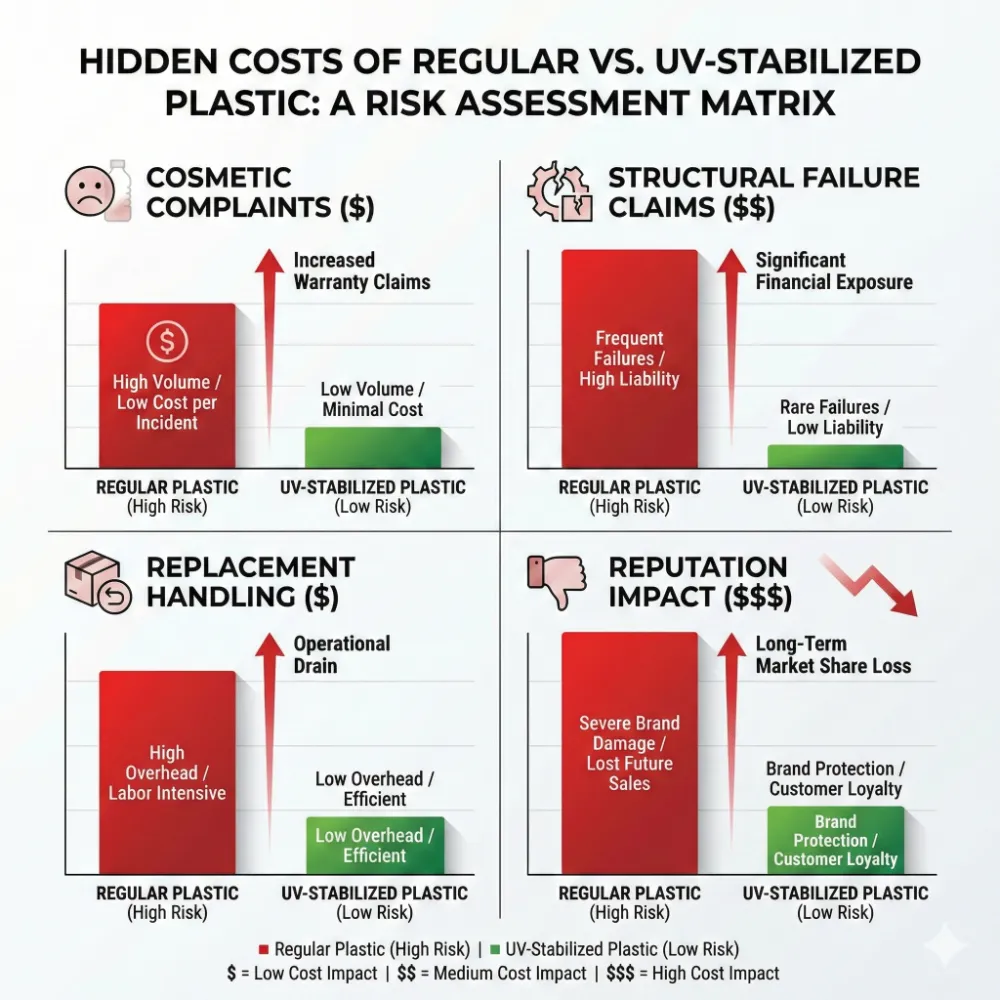
Cost should also be evaluated against potential exposure:
| Risk Factor | Regular Plastic | UV-Stabilized Plastic |
|---|---|---|
| Cosmetic complaints | $$ | $ |
| Structural failure claims | $$ | $ |
| Replacement handling | $$ | $ |
| Reputation impact | $$$ | $ |
Even if initial cost is lower with regular plastic, downstream cost exposure can multiply over time.
A 3–7% material saving can become:
- Increased after-sales workload
- Higher return ratio
- Slower distributor reorder cycles
4. Lifecycle Value Perspective
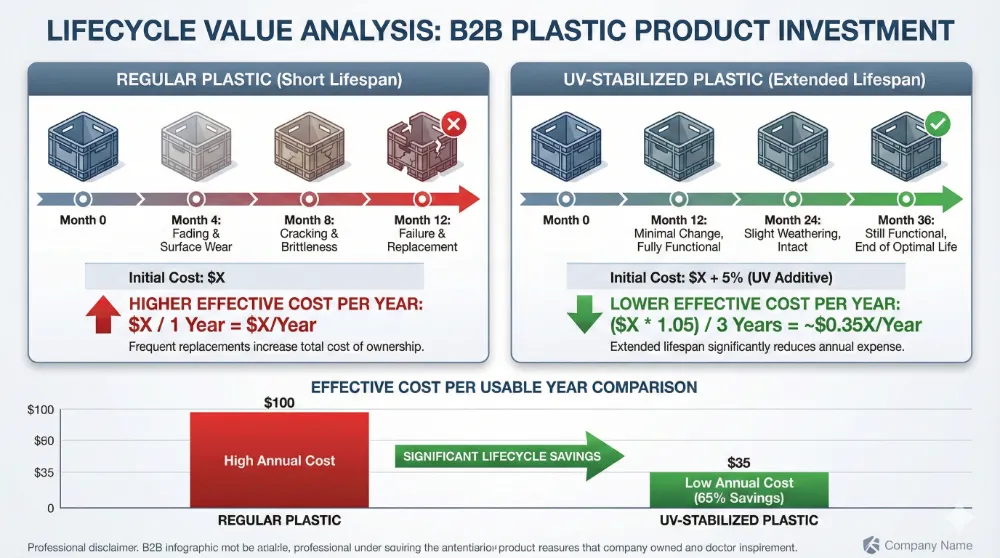
If regular plastic lifespan in your market is:
- 12 months
and UV-stabilized plastic lifespan is: - 36 months
Then effective cost per usable year becomes:
| Option | Effective Cost Per Year |
|---|---|
| Regular Plastic | $$ |
| UV-Stabilized Plastic | $ |
From a lifecycle efficiency standpoint, UV stabilization often reduces cost per year of use.
5. When Cost Sensitivity Justifies Regular Plastic
There are scenarios where regular plastic may still be commercially reasonable:
- Short lifecycle products (< 6 months exposure)
- Seasonal decorative items
- Indoor / semi-covered installations
- Price-sensitive retail campaigns
- One-time promotional orders
In these cases, minimizing initial cost may align with product positioning.
Strategic Cost Insight for B2B Buyers
The question should not be:
“Is UV-stabilized plastic more expensive?”
The better question is:
“Is my target market harsh enough that not using UV will create hidden liability?”
If your product:
- Targets strong sunlight regions
- Carries multi-season warranty
- Sells under a durability promise
Then UV stabilization shifts from optional upgrade
to risk-control investment.
In the next section, we will analyze how UV material choice directly affects warranty exposure and return rates in wholesale environments.
Warranty & Return Risk Analysis
For B2B buyers, material selection is directly tied to one critical metric:
Post-sale risk exposure.
Most warranty claims for outdoor plastic products are not caused by electrical failure or assembly defects.
They are caused by:
- Housing cracking
- Surface discoloration
- Brittleness at mounting points
- Deformation under prolonged heat
These issues are often traced back to UV degradation, not manufacturing error.
1. The Timeline of UV-Related Complaints
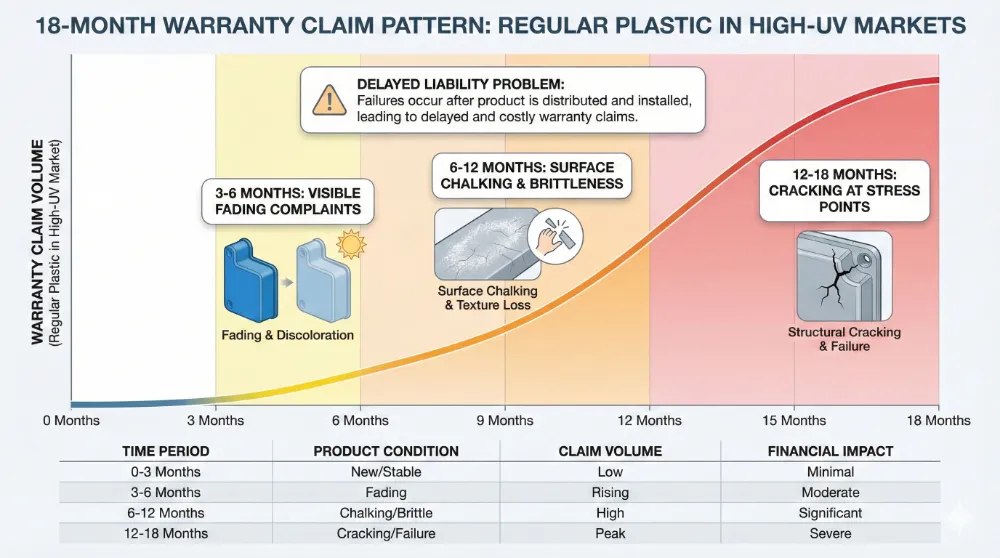
In high-UV markets, return patterns typically follow this curve:
| Time After Sale | Common Issue (Regular Plastic) |
|---|---|
| 3–6 months | Visible fading / gloss loss |
| 6–12 months | Surface chalking / brittleness |
| 12–18 months | Cracking at stress points |
| 18+ months | Structural instability |
This creates a delayed liability problem.
The product performs well during:
- Initial inspection
- Retail display
- First installation period
Failures occur after distribution — when replacing units becomes logistically expensive.
2. Cosmetic vs Structural Claims
UV degradation leads to two different types of warranty exposure:
A. Cosmetic Complaints
- Yellowing white housings
- Faded black components
- Uneven color change
- Surface powdering
These issues may not affect functionality,
but they directly affect brand perception.
Retailers often treat cosmetic instability as quality failure.
B. Structural Failures
- Screw joint cracking
- Mount bracket breakage
- Snap-fit housing fracture
- Impact resistance drop
These trigger:
- Full replacement requests
- Shipping reimbursement
- Bulk return negotiation
Structural failures carry significantly higher cost impact than cosmetic complaints.
3. Return Rate Sensitivity by Market
Return sensitivity varies by region:
| Market Type | Return Tolerance |
|---|---|
| Premium Retail Chains | Low tolerance |
| Online Marketplaces | Review-driven risk |
| Discount Channels | Moderate tolerance |
| Project-Based Supply | Contract-bound durability |
If you supply:
- Amazon sellers
- Branded distributors
- Commercial contractors
UV-related degradation can quickly impact reorder stability. Working with manufacturers who understand quality control processes helps mitigate these risks.
4. Warranty Mismatch Risk
A common sourcing mistake is this:
Offering a 2-year warranty on a product built with regular plastic in a high-UV region.
This creates a structural mismatch between:
- Promised lifespan
- Material capability
UV-stabilized plastic reduces this mismatch by extending mechanical and cosmetic stability to align with warranty terms.
5. Financial Exposure Multiplier
Return cost is not just unit replacement.
It includes:
- Reverse logistics
- Warehouse handling
- Repackaging
- Customer support time
- Distributor negotiation
- Brand credibility damage
Even a small increase in UV-related failure can produce a disproportionate impact on operational workload.
In many cases, reducing material cost by one level ($ → $$ savings) may introduce:
- $$ in return handling
- $$$ in lost future orders
6. Risk Control vs Cost Reduction
From a B2B strategy perspective:
- Regular plastic = lower upfront cost, higher volatility
- UV-stabilized plastic = slightly higher upfront cost, lower warranty uncertainty
If your product:
- Targets strong sunlight regions
- Remains installed year-round
- Carries a multi-season warranty
- Is sold under a durability positioning
then UV protection becomes part of your risk management framework, not just a material upgrade.
Key B2B Takeaway
Warranty stability directly influences:
- Distributor trust
- Contract renewals
- Repeat orders
- Long-term margin sustainability
Choosing between regular and UV-stabilized plastic is ultimately a decision about:
Whether you prefer lower initial cost
or lower long-term volatility.
In the next section, we will provide a market-based decision guide to help buyers determine when UV stabilization is essential — and when it is optional.
Market-Based Decision Guide
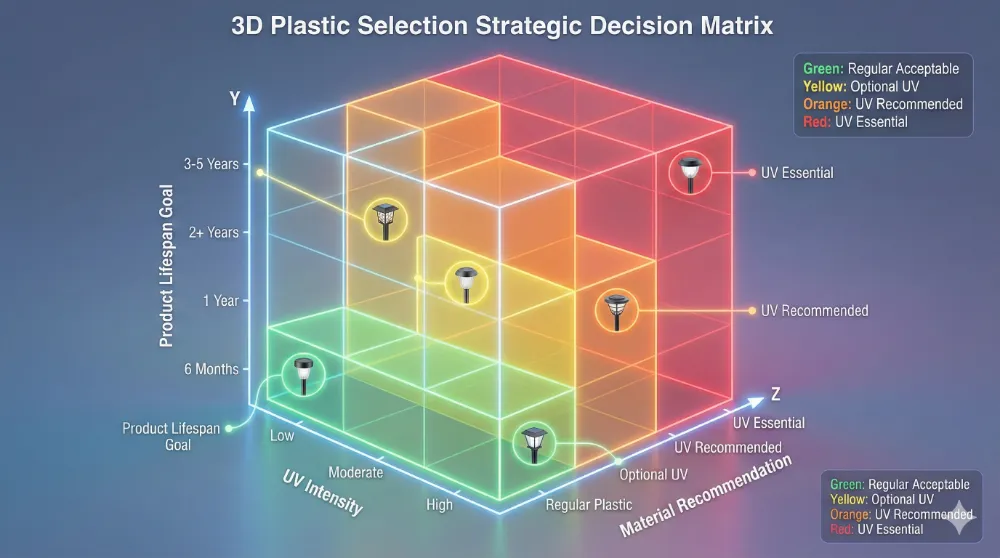
Not every product requires UV-stabilized plastic.
But not every market tolerates regular plastic either.
For B2B buyers, the correct decision depends on three variables:
- UV intensity in your target region
- Expected product lifespan
- Your warranty and brand positioning
Below is a practical decision framework to help you evaluate whether UV stabilization is necessary for your specific market.
1. Step One: Identify Your UV Exposure Level
UV Index is a more important metric than temperature alone.
| UV Index Level | Typical Regions | Material Risk Level |
|---|---|---|
| 7–11 (High) | Southern US, Australia, Middle East, Mexico, Southeast Asia | Very High |
| 4–6 (Moderate) | Southern Europe, India, Coastal South America | Medium |
| 2–4 (Low) | Northern Europe, Canada North, Scandinavia | Low |
If your primary distribution region has prolonged UV index above 6 for multiple months annually, regular plastic faces accelerated degradation.
2. Step Two: Evaluate Product Usage Pattern
Not all outdoor products experience the same sun exposure.
| Product Type | Exposure Intensity |
|---|---|
| Solar garden lights (top-mounted panel) | Direct daily exposure |
| Pathway bollards | Partial exposure |
| Wall lights under eaves | Reduced exposure |
| Seasonal decorations | Short-term exposure |
Products with constant top-surface sun exposure should be evaluated more conservatively.
3. Step Three: Match Warranty Duration to Material Capability
| Warranty Period | Recommended Plastic Strategy |
|---|---|
| < 6 months | Regular plastic acceptable |
| 1 year | Moderate-UV: optional UV stabilization |
| 2+ years | Strongly recommend UV stabilization |
| 3–5 years | UV stabilization essential |
A warranty longer than the realistic outdoor lifespan of regular plastic creates structural risk.
4. Market Positioning Consideration
Your channel positioning also influences the decision:
Budget Channel Strategy
- Short lifecycle
- Low price sensitivity
- Minimal warranty support
- Regular plastic may be acceptable
Mid-Market Retail Strategy
- Seasonal repeat customers
- Moderate warranty expectation
- UV stabilization recommended in moderate/high UV regions
Premium Brand Strategy
- Durability positioning
- Multi-season warranty
- Reputation-sensitive
- UV stabilization strongly recommended
5. Decision Matrix (Quick Reference)
| Market UV | Product Lifespan Goal | Recommendation |
|---|---|---|
| High | 1+ year | Use UV-stabilized |
| High | < 6 months | Conditional |
| Moderate | 2+ years | Use UV-stabilized |
| Moderate | 1 year | Optional but advised |
| Low | 1 year | Regular acceptable |
| Low | 3+ years | UV recommended |
6. When UV Stabilization Becomes Non-Negotiable
UV-stabilized plastic becomes a strategic necessity when:
- Product is installed permanently
- Market has high UV index
- Warranty ≥ 2 years
- Brand positioning emphasizes durability
- Replacement logistics are costly
- After-sales handling capacity is limited
In these cases, UV stabilization reduces operational volatility.
Strategic Insight for B2B Buyers
UV stabilization is not a universal requirement.
But it is highly market-dependent.
The safest sourcing decision comes from aligning:
- Regional UV intensity
- Expected product lifecycle
- Warranty promise
- Brand positioning
- Risk tolerance
When these factors are evaluated together, the correct material choice becomes clearer — and more defensible in long-term commercial planning.
In the next section, we will examine how different base plastic types (PP, ABS, PC, etc.) influence UV resistance performance.
Material Type Impact (PP, ABS, PC)
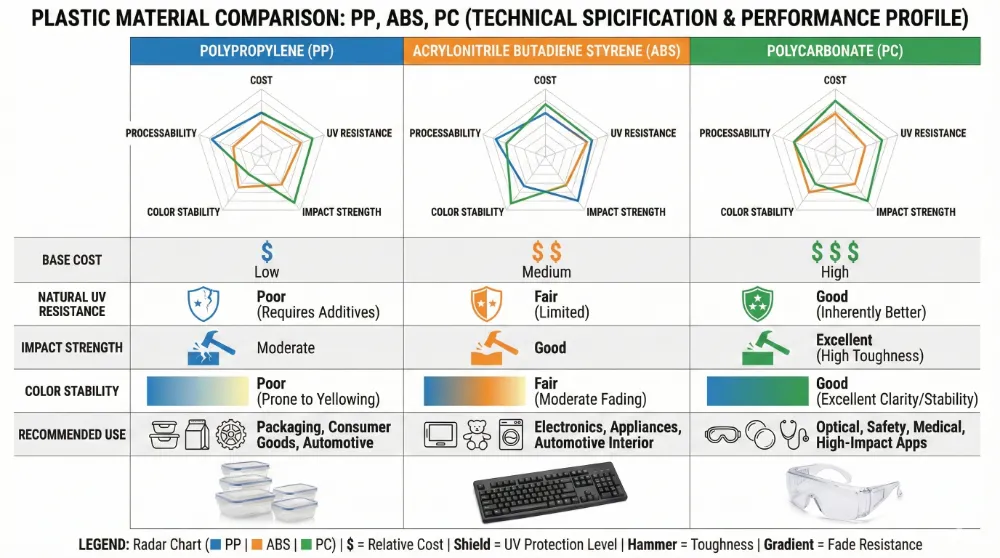
UV stabilization does not work in isolation.
The base plastic resin you choose — PP, ABS, PC, or others — significantly influences how well the material performs under sunlight.
For B2B buyers, this means:
UV additive level alone does not determine durability.
The resin + additive combination determines real-world performance.
Below is a practical comparison of commonly used plastics in outdoor products.
1. Polypropylene (PP)
Typical Use Cases:
- Solar garden light housings
- Decorative outdoor shells
- Thin-wall injection parts
- Budget product lines
Natural UV Resistance: Low
Cost Level: $
PP is widely used because it is:
- Lightweight
- Easy to mold
- Cost-efficient
However, PP has weak natural UV resistance. Without stabilization, it can:
- Fade quickly
- Become brittle
- Develop surface chalking
In high-UV markets, regular PP may degrade within one season. For detailed insights on plastic durability, see our guide on improving plastic durability under outdoor sun exposure.
With UV stabilization, PP performance improves significantly — but it still requires proper additive balance and thickness control.
Best for:
Cost-sensitive products with UV additive support.
2. Acrylonitrile Butadiene Styrene (ABS)
Typical Use Cases:
- Mid-range housings
- Structural plastic frames
- Mounting brackets
- Decorative enclosures
Natural UV Resistance: Medium–Low
Cost Level: $$
ABS offers:
- Better impact strength than PP
- Improved rigidity
- Good molding precision
However, ABS is also vulnerable to UV-induced discoloration and brittleness.
Common UV-related ABS issues:
- Yellowing
- Surface cracking
- Loss of impact resistance over time
UV-stabilized ABS performs much better than regular ABS, especially in moderate-UV markets.
Best for:
Mid-range products requiring structural strength, with UV additive reinforcement.
3. Polycarbonate (PC)
Typical Use Cases:
- Transparent light covers
- Optical lenses
- Premium housing components
Natural UV Resistance: Moderate–High
Cost Level: $$$
PC naturally offers:
- High impact resistance
- Good thermal stability
- Strong mechanical properties
However, even PC can yellow under prolonged UV exposure if not stabilized.
For transparent components, UV protection is critical to prevent:
- Yellowing
- Light transmission reduction
- Micro-cracking
UV-stabilized PC is commonly used in higher-end outdoor lighting products.
Best for:
Premium products, clear lenses, long-term outdoor installations.
4. Material Comparison Overview
| Property | PP | ABS | PC |
|---|---|---|---|
| Base Cost | $ | $$ | $$$ |
| Natural UV Resistance | Low | Medium–Low | Moderate |
| Impact Strength | Medium | High | Very High |
| Color Stability (No UV Additive) | Poor | Fair | Better |
| Recommended for High-UV Regions | Only with UV | With UV | With UV |
5. Additives Do Not Fully Equalize Materials
Even with UV additives:
- UV-stabilized PP ≠ UV-stabilized PC
- Resin thickness affects longevity
- Pigment quality affects color retention
- Processing quality affects oxidation resistance
In other words:
Two products labeled “UV-stabilized” may still perform very differently.
For B2B buyers, it is important to evaluate:
- Resin type
- Additive formulation
- Wall thickness
- Intended market UV level
—not just a marketing label.
6. Strategic Material Selection Insight
If your priority is:
- Lowest upfront cost → UV-stabilized PP
- Balanced cost and strength → UV-stabilized ABS
- Longest lifespan and optical clarity → UV-stabilized PC
The optimal choice depends on your:
- Market UV intensity
- Target price positioning
- Warranty duration
- Brand durability promise
In the next section, we will break down how UV testing data (such as QUV aging) translates into real-world outdoor performance.
UV Testing Data Explained
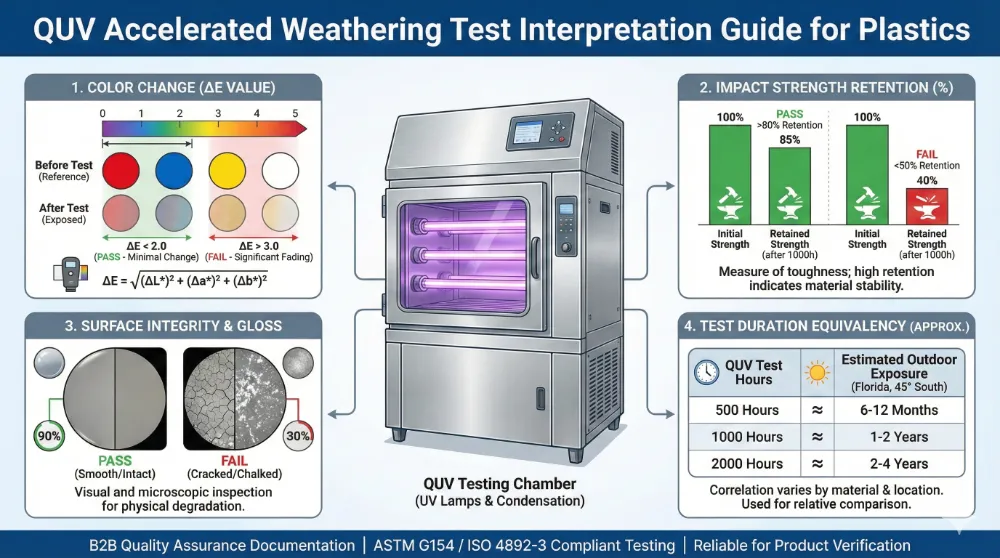
Many suppliers claim their products are “UV-resistant” or “UV-stabilized.”
But for B2B buyers, the real question is:
What does that claim actually mean in measurable terms?
Understanding UV testing data allows you to evaluate durability based on evidence — not marketing language.
1. What Is QUV Accelerated Weathering?
The most common UV durability test for plastics is QUV accelerated weathering testing.
This method uses:
- UV-A or UV-B lamps
- Controlled humidity cycles
- Condensation simulation
- Elevated temperature exposure
The goal is to simulate long-term outdoor sunlight exposure in a compressed time frame.
Typical test durations:
- QUV 300 hours
- QUV 500 hours
- QUV 1000 hours
- QUV 1500+ hours
2. How Test Hours Translate to Outdoor Exposure
Although exact equivalency varies by region, industry approximations are often:
| QUV Hours | Approximate Outdoor Exposure Equivalent* |
|---|---|
| 300h | ~6 months moderate exposure |
| 500h | ~1 year outdoor exposure |
| 1000h | ~2+ years strong exposure |
| 1500h | Multi-season durability |
*Actual performance depends on UV index, humidity, and installation angle.
This is why a product tested at only 200–300 hours may not be suitable for multi-year outdoor use in high-UV regions.
3. What Should Be Measured After UV Testing?
QUV hours alone are not enough.
B2B buyers should evaluate post-test performance metrics, including:
A. Color Change (ΔE Value)
- Measures visible color difference
- Lower ΔE = better color retention
- Important for white, black, and colored housings
High color shift indicates pigment breakdown or resin degradation.
B. Impact Strength Retention
Tests whether the material maintains mechanical strength after UV exposure.
For example:
| Material Condition | Impact Strength Retention |
|---|---|
| Regular Plastic | ↓ Significant drop |
| UV-Stabilized Plastic | Slight or minimal reduction |
Loss of impact strength is often the root cause of cracking.
C. Surface Integrity
Inspection for:
- Micro-cracks
- Surface chalking
- Gloss reduction
- Oxidation marks
Surface degradation often appears before full structural failure.
4. Why Some “UV-Resistant” Claims Are Misleading
Common issues in sourcing include:
- Minimal additive levels labeled as “UV resistant”
- Testing done only at 200–300h
- No post-aging mechanical verification
- No documentation of pigment stability
Without documented test data, “UV-stabilized” becomes a vague claim.
For serious B2B sourcing, request:
- Test duration (QUV hours)
- UV lamp type used (UV-A preferred for outdoor simulation)
- Before/after mechanical data
- Color retention results
5. Real-World Relevance for Outdoor Products
In products such as:
- Solar garden light housings
- Pathway fixtures
- Mounting brackets
- Outdoor decorative shells
UV degradation typically begins at the surface and gradually reduces structural stability.
If QUV testing shows:
- Strong color retention
- Minimal mechanical loss
- Stable surface integrity
then the material is more likely to survive multi-season exposure.
6. Strategic Insight for B2B Buyers
UV testing data should be interpreted as a risk forecast tool.
It helps you answer:
- Will this product survive my warranty period?
- Will cosmetic quality remain stable?
- Will mounting points remain structurally safe?
- Will customer complaints spike after 12 months?
Rather than focusing solely on whether UV stabilization is included,
evaluate:
How many hours tested — and what changed after testing?
In the next section, we will analyze when UV stabilization may not be necessary — and how to identify those lower-risk scenarios.
When UV Is NOT Necessary
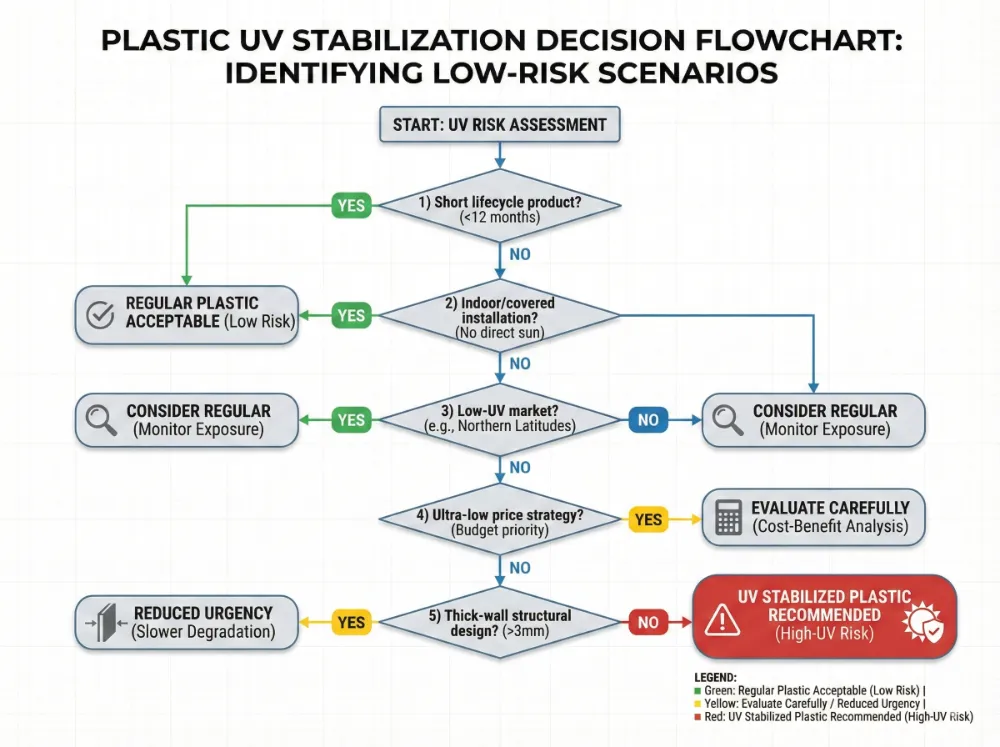
UV stabilization is a powerful durability tool — but it is not mandatory for every product.
For B2B buyers, over-specifying materials can:
- Increase cost unnecessarily
- Reduce price competitiveness
- Misalign with product lifecycle goals
The key is matching material capability to real exposure conditions.
Below are situations where UV stabilization may not be commercially necessary.
1. Short Lifecycle or Seasonal Products
If your product:
- Is used for less than 6 months
- Is installed temporarily
- Is sold for single-season decoration
- Has no long-term warranty commitment
Then regular plastic may be sufficient.
Examples:
- Holiday decorative lights
- Promotional outdoor items
- Temporary event lighting
- Limited-time retail campaigns
In these cases, UV-related degradation may not occur within the product’s intended usage window.
2. Indoor or Semi-Covered Installations
UV exposure depends heavily on installation location.
Products installed:
- Under roof eaves
- In covered patios
- On shaded balconies
- Inside decorative enclosures
receive significantly lower UV radiation.
If direct sunlight exposure is limited, regular plastic may maintain acceptable performance for 1–2 years in moderate-UV regions.
3. Low-UV Geographic Markets
Regions with:
- Long winters
- Lower annual UV index
- Limited direct summer intensity
place less stress on plastic components.
In these markets, regular plastic may offer:
- Acceptable cosmetic stability
- Adequate mechanical durability
- Reduced material cost
However, even in low-UV regions, products exposed year-round should still be evaluated carefully.
4. Ultra-Low Price Strategy
If your business model is based on:
- High-volume discount sales
- Short product turnover
- Minimal warranty service
- No durability positioning
Then material optimization may prioritize cost control over long-term resilience.
In such cases, UV stabilization may reduce competitiveness if the market does not demand extended lifespan.
5. Thick-Wall Structural Advantage
Thicker plastic components naturally resist UV-related brittleness longer than thin-wall decorative parts.
If the product design includes:
- Reinforced wall thickness
- Minimal stress concentration points
- Protected mounting structure
then the urgency for UV stabilization decreases — especially in moderate or low UV regions.
6. Risk Evaluation Checklist
Before deciding against UV stabilization, B2B buyers should confirm:
- Target market UV index is moderate or low
- Product lifespan expectation is under 1 year
- Warranty terms align with material durability
- Installation environment limits direct exposure
- Brand positioning does not emphasize long-term durability
If all five conditions align, regular plastic may be commercially reasonable.
Strategic Insight
UV stabilization is not about upgrading every product.
It is about avoiding mismatch between:
- Environmental exposure
- Customer expectation
- Warranty commitment
- Material capability
When these factors are aligned properly, skipping UV stabilization can be a rational cost decision.
When they are not aligned, it becomes a hidden liability.
In the next section, we will summarize the overall decision logic and provide practical sourcing recommendations for B2B buyers.
FAQ for Wholesale Buyers
Below are the most common questions B2B buyers ask when evaluating UV-stabilized vs regular plastic for outdoor products.
1. How can I verify if a product is truly UV-stabilized?
Do not rely solely on a product label.
Request:
- QUV test report (with test hours clearly stated)
- UV lamp type used (UV-A preferred for outdoor simulation)
- Before/after mechanical performance data
- Color retention results (ΔE value if available)
Also confirm whether UV stabilization is:
- Added to the resin compound
or - Only surface-treated (surface treatment is generally less durable)
Documentation matters more than marketing claims. Reputable solar garden light manufacturers should be able to provide comprehensive testing documentation.
2. Is UV-stabilized plastic required for all outdoor products?
No.
It depends on:
- Market UV intensity
- Expected product lifespan
- Warranty duration
- Installation environment
For short-term seasonal products or shaded installations, regular plastic may be commercially acceptable.
For permanent installations in high-UV regions, UV stabilization is strongly recommended.
3. Does UV stabilization affect product color?
It can improve color retention significantly.
Without UV protection:
- Black may turn gray
- White may yellow
- Bright colors may fade unevenly
With proper UV formulation:
- Color stability improves
- Gloss retention is higher
- Retail presentation lasts longer
For brands selling through visual-driven channels (retail stores, online marketplaces), color stability directly affects perceived quality. Learn more about material comparisons for outdoor lighting.
4. How much longer does UV-stabilized plastic last?
Actual lifespan depends on environment, but generally:
- In high-UV markets, regular plastic may show degradation within 6–12 months
- UV-stabilized plastic can extend structural and cosmetic stability to multiple seasons
The key is not just total lifespan —
it is whether performance remains stable during your warranty period.
5. Can all plastics be UV-stabilized?
Most common plastics (PP, ABS, PC) can be enhanced with UV stabilizers.
However:
- Base resin quality matters
- Additive formulation matters
- Wall thickness matters
- Processing quality matters
Two products both labeled “UV-stabilized” may perform differently depending on formulation and production control.
6. If my market is moderate UV, should I still upgrade?
If your product:
- Has a 2-year warranty
- Is positioned as durable
- Targets repeat retail buyers
then UV stabilization provides risk protection even in moderate UV markets.
If your product lifecycle is short and price-sensitive, the upgrade may not be necessary.
7. Is UV stabilization more important for structural parts or decorative parts?
Both matter — but for different reasons.
- Structural parts: UV prevents brittleness and cracking
- Decorative parts: UV prevents fading and visual aging
Failure in structural components creates higher warranty cost.
Failure in decorative components affects brand perception.
Evaluate both according to product role.
Conclusion: Material Choice Is a Risk Strategy
Choosing between UV-stabilized and regular plastic is not simply a material upgrade decision.
It is a strategic alignment between:
- Environmental exposure
- Expected product lifespan
- Warranty commitment
- Brand positioning
- Cost control priorities
Regular plastic may reduce initial cost.
UV-stabilized plastic may reduce long-term volatility.
For B2B buyers, the smartest sourcing decision is not the lowest material cost —
it is the option that aligns durability with your market reality.
When your product is installed outdoors, under real sunlight,
plastic behavior becomes predictable.
The only question is whether your material choice anticipates that reality —
or reacts to it after returns begin.
If you evaluate UV exposure, product lifecycle, and warranty structure together,
the correct decision becomes clearer — and commercially defensible.
For buyers seeking reliable manufacturing partners who understand material science and outdoor durability, partnering with experienced solar lighting manufacturers ensures proper material selection from the start.