
Warm White vs Cool White vs RGB Solar Lights: Color Selection Guide for Wholesale Buyers
For wholesale buyers, solar light color is not only a design choice. It affects how customers perceive brightness, how well the product fits a garden or patio, and whether repeat orders stay visually consistent.
In most decorative solar garden lights, warm white, cool white and RGB should not be treated as interchangeable options. Each color type fits a different sales channel, customer expectation and inventory strategy.
Quick answer:
For most residential garden and patio markets, warm white is the safest core SKU. Cool white works better for modern, commercial or region-specific projects. RGB is best treated as a seasonal or event-driven add-on, not as the main year-round inventory.
This guide compares warm white, cool white, amber and RGB solar lights from a B2B sourcing perspective, including color temperature, customer complaints, inventory risk, LED bin control and OEM production consistency.
For broader product sourcing decisions, you can also read our purchasing tips for wholesale solar garden lights.
Quick Color Selection Table for Wholesale Buyers
| Light Color | Typical Range | Best Use Case | Inventory Risk | Buyer Recommendation |
|---|---|---|---|---|
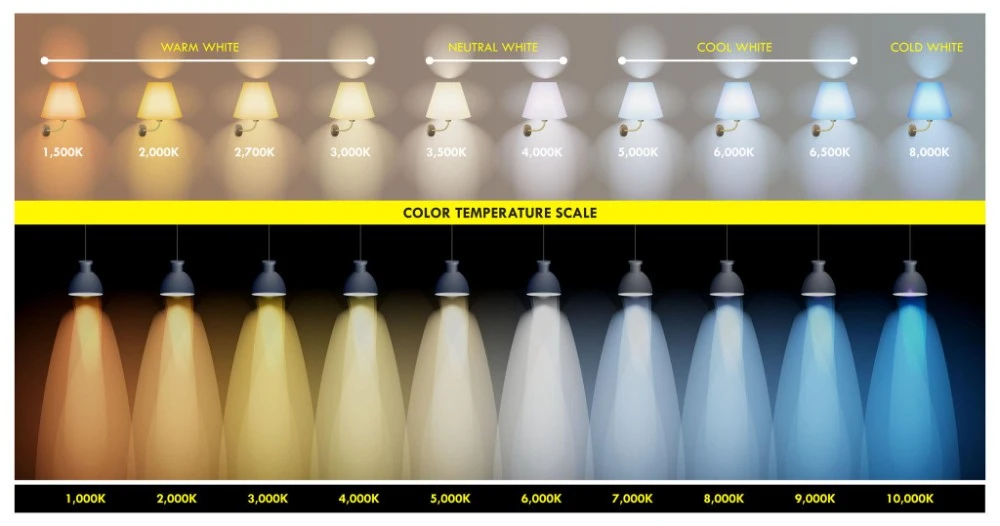
| Warm White | 2700K–3000K | Residential gardens, patios, cozy outdoor spaces | Low | Best core SKU |
| Neutral White | 3500K–4500K | General outdoor use, mixed markets | Medium | Useful secondary option |
| Cool White | 5000K–6500K | Modern architecture, commercial areas, some regional markets | Medium | Use with clear positioning |
| Amber / Vintage | 1800K–2400K | Rustic, vintage, hospitality, decorative niches | Medium-low | Niche differentiation |
| RGB / Multi-color | Multi-color modes | Holidays, parties, events, novelty products | High | Seasonal add-on only |
The key is not to ask, “Which color is best?”
The better question is:
Which color fits the buyer’s channel, customer expectation, regional preference and reorder plan?
Why Light Color Matters in Solar Garden Light Sourcing
Color choice affects more than appearance.
For importers, distributors and private-label brands, the wrong color decision can create several hidden problems:
- Slow-moving inventory
- Higher return requests
- More “not as expected” complaints
- Inconsistent repeat orders
- Weak product positioning
- Poor review stability on online marketplaces
A product may pass all technical tests and still disappoint customers if the color does not match the environment or the way it was marketed.
For example:
- A cool white light may look bright in product photos but feel harsh in a cozy backyard.
- A warm white light may create a pleasant atmosphere but seem “not bright enough” if the listing promises super-bright illumination.
- An RGB light may attract clicks but create after-sales questions if the mode sequence is confusing.
- A repeat order may look different from the first batch if LED bin control is weak.
That is why light color should be discussed early in the OEM process, not after the product is already in production.
Warm White Solar Lights: The Safest Core SKU for Residential Markets
Warm white usually refers to a color temperature around 2700K–3000K. It creates a soft, yellowish-white glow similar to traditional residential outdoor lighting.
For most garden, patio and pathway decoration products, warm white is the safest default choice.
Why Warm White Works Well
Warm white fits the emotional expectation of residential outdoor spaces:
- Cozy
- Relaxing
- Familiar
- Decorative
- Less harsh at night
- Easier to match with existing outdoor fixtures
For products such as solar lanterns, pathway lights, stake lights, garden ornaments, resin statues and hanging lights, warm white usually supports the product’s decorative value better than cool white.
Best-Fit Products
Warm white works especially well for:
- Solar garden lanterns
- Solar pathway lights
- Resin statue solar lights
- Hanging solar lights
- Decorative solar stake lights
- Patio and backyard lights
- Memorial and cemetery-related decorative lights
- Seasonal garden decorations with a soft glow
If your buyer serves residential customers, garden centers, home improvement channels or online decorative lighting categories, warm white should normally form the foundation of the assortment.
Wholesale Recommendation
For a residential-focused product line, a practical starting mix is:
| Color Type | Suggested Role |
|---|---|
| Warm White | Core year-round SKU |
| Cool White / Amber | Controlled secondary option |
| RGB | Seasonal or test SKU |
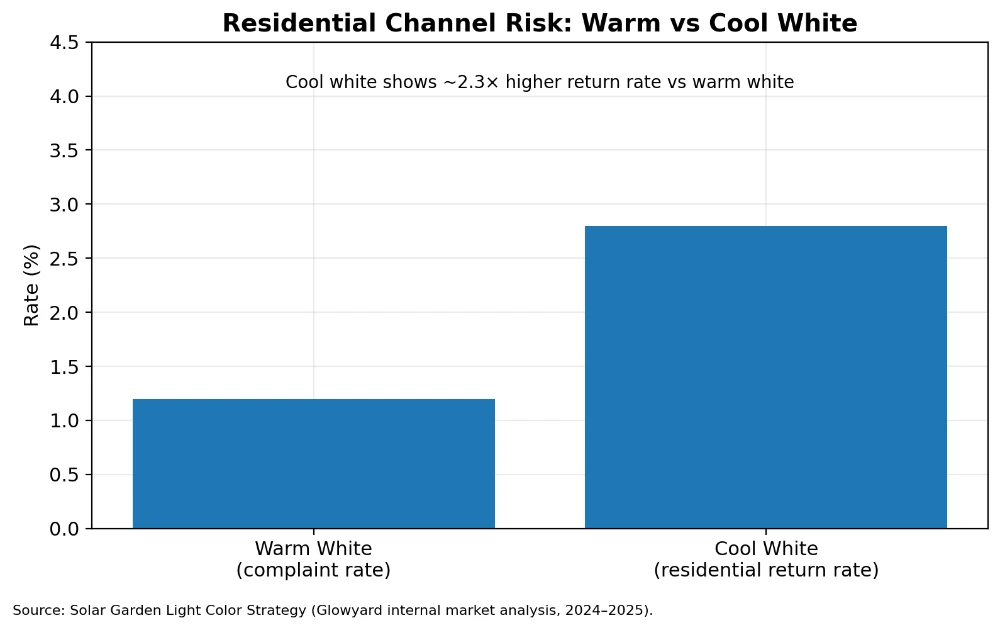
Warm white may not always look the most eye-catching in a product thumbnail, but it often creates fewer complaints after installation.
That matters for distributors because review stability, low return rates and repeat orders are usually more valuable than short-term clicks.
Cool White Solar Lights: Better for Modern, Commercial and Regional Uses
Cool white usually refers to 5000K–6500K. It looks whiter, sharper and more modern than warm white.
It can work very well, but only when the application is right.
Where Cool White Performs Better
Cool white is more suitable for:
- Modern architectural exteriors
- Commercial pathways
- Contemporary landscape projects
- Security-feeling outdoor areas
- Some Middle East and Asia-Pacific markets
- Customers who associate bright white light with modern quality
Cool white also appears brighter to many users, even when lumen output is similar. This can help in product categories where the buyer wants a cleaner, stronger visual impression.
Where Cool White Creates Risk
Cool white can underperform in traditional residential garden settings.
Common complaints include:
- “Too blue”
- “Too cold”
- “Too harsh”
- “Feels like a parking lot”
- “Doesn’t match my other garden lights”
This does not always mean the product is defective. In many cases, it means the product was positioned for the wrong environment.
Wholesale Recommendation
Cool white should be treated as a targeted SKU, not a universal replacement for warm white.
Use cool white when:
- The product is positioned as modern or commercial
- The sales market prefers bright white light
- The installation photos clearly show a cool white effect
- The buyer understands the difference between brightness perception and color warmth
Avoid cool white when the product is marketed around words like:
- Cozy
- Romantic
- Warm glow
- Relaxing patio
- Traditional garden atmosphere
For B2B buyers, the most important point is simple:
Cool white is not “better warm white.” It is a different product experience.
RGB Solar Lights: High Appeal, Higher Operational Risk
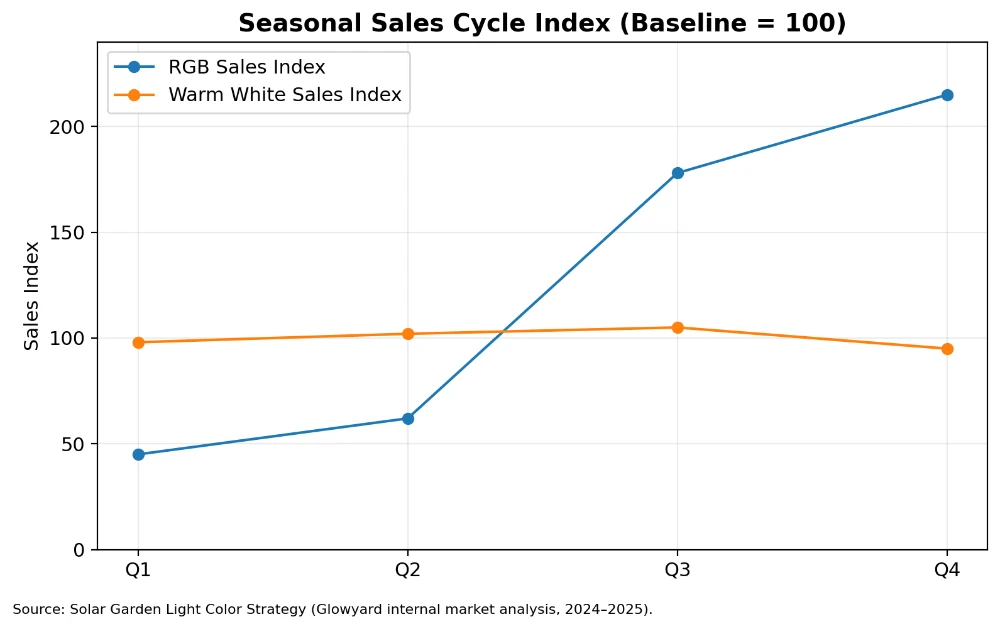
RGB and multi-color solar lights can be attractive in product photos and videos. They are useful for holidays, parties, events and novelty displays.
But for wholesale buyers, RGB models also bring more risk.
Why RGB Looks Attractive
RGB products can help buyers create a more eye-catching product line:
- More color modes
- Stronger visual effect in listings
- Good fit for Halloween, Christmas and party seasons
- Higher perceived feature value
- More promotional angles
For seasonal campaigns, RGB can be useful.
Why RGB Creates More After-Sales Pressure
RGB models are more complex than single-color models. They may include:
- Multi-color LED chips
- Control ICs
- Mode switching circuits
- Remote control systems
- Memory functions
- More complex user instructions
- Higher battery consumption in certain modes
This increases the chance of customer confusion.
Common RGB complaints include:
- “The light keeps changing color.”
- “I cannot make it stay on one color.”
- “The remote does not work.”
- “The color mode is not bright enough.”
- “The battery drains faster than expected.”
- “It is too complicated to use.”
Many of these complaints are not manufacturing defects. They are expectation and usability problems.
How to Reduce RGB Risk
For RGB solar lights, buyers should ask suppliers about:
- Whether the light has memory function
- How many modes are included
- Whether the mode order is easy to understand
- Whether solid-color mode is available
- Whether the battery is sized for RGB power consumption
- Whether packaging includes clear instructions
- Whether a video guide can be provided
A simpler RGB model is often better than a feature-heavy one.
For example, a model with 3–5 clear modes may create fewer complaints than a model with 10+ confusing modes.
Wholesale Recommendation
Treat RGB as a controlled seasonal SKU.
A safer approach is:
| Role | Recommendation |
|---|---|
| Inventory type | Seasonal, event-driven |
| Best launch window | Before holiday or party season |
| Product positioning | Holiday, party, novelty, decorative effect |
| Risk control | Small batch first, clear instructions, strong QC |
| Avoid | Year-round core inventory unless proven by sales data |
RGB can add value, but it should not dominate a stable wholesale assortment.
Amber and Vintage Tones: Small Volume, Clear Differentiation
Amber, candle-like and vintage tones are usually warmer than standard warm white. They may sit around 1800K–2400K, depending on the LED and product design.
These colors are not usually the highest-volume options, but they can create clear differentiation.
Best Use Cases
Amber and vintage tones work well for:
- Rustic garden lights
- Vintage lanterns
- Outdoor café decoration
- Wedding and event lighting
- Halloween or autumn-themed products
- Candle-effect cemetery and memorial lights
- Hospitality or boutique retail channels
Why Amber Can Be Valuable
Amber is useful when the buyer wants a more emotional or decorative effect instead of brightness.
It can support positioning such as:
- Candle-like glow
- Soft decorative ambiance
- Vintage outdoor style
- Rustic garden atmosphere
- Warm memorial light effect
Wholesale Recommendation
Amber should be treated as a niche or premium positioning option.
It is usually not the first core SKU for a broad retail channel, but it can be powerful in a focused collection where the design story is clear.
Common Color Mistakes That Cause Returns and Slow Inventory
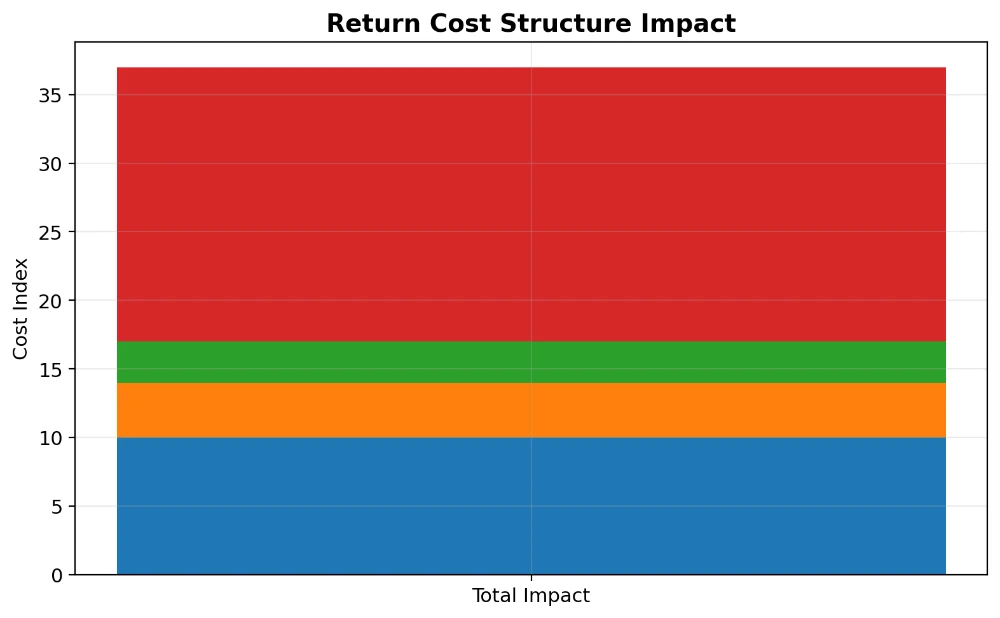
Color-related problems often look like product quality problems from the outside.
But in many cases, the root cause is poor positioning.
Below are the most common mistakes we see in outdoor solar light sourcing and private-label projects.
Mistake 1: Selling Cool White as a Cozy Garden Light
Cool white can look clean and bright, especially in product photography. But if it is sold as a cozy garden light, the customer may feel disappointed after installation.
Typical Problem
The listing says:
Warm garden atmosphere, relaxing backyard glow.
But the product uses:
6000K cool white LED.
The customer receives the product and feels the light is too cold.
Better Positioning
For cool white, use words like:
- Bright white
- Modern
- Clean
- Crisp
- Contemporary
- Clear pathway illumination
For warm white, use words like:
- Soft glow
- Cozy
- Warm ambiance
- Relaxing
- Decorative
- Patio atmosphere
The color temperature and marketing message must match.
Mistake 2: Treating RGB as an Upgrade for Every Market
RGB looks more advanced, but it is not automatically a better product for every buyer.
Typical Problem
A buyer chooses RGB because it looks more feature-rich, then stocks too much inventory year-round.
After the holiday season, sales slow down. Customer service issues increase because users do not understand the modes.
Better Strategy
Use RGB for:
- Holiday collections
- Party lights
- Event decoration
- Novelty outdoor products
- Controlled seasonal campaigns
Do not use RGB as the default core SKU unless your channel has already proven stable repeat demand.
Mistake 3: Ignoring LED Bin Control
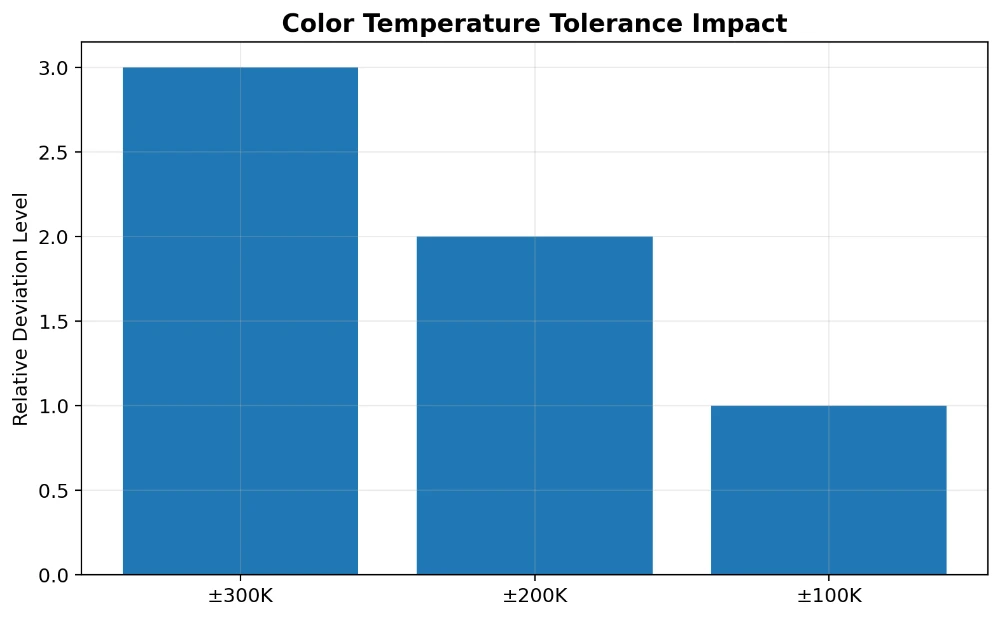
Color consistency is one of the most overlooked issues in repeat orders.
A buyer may approve one sample at 3000K, but the next batch may look slightly warmer or cooler if LED bin control is not managed properly.
Why This Matters
Customers often install multiple lights together.
If one batch is visibly different from another, the product may look inconsistent even if both batches are technically within a loose specification range.
Typical complaints include:
- “The new lights do not match the old ones.”
- “The color is different from my last order.”
- “The set looks inconsistent.”
- “Quality seems different this time.”
What Buyers Should Request
For repeat orders or project-based installations, ask the supplier about:
- LED bin control
- Color temperature tolerance
- Batch records
- Sample approval from production batch
- Whether the same LED supplier can be maintained
- Whether replacement orders can match the original batch closely
This is part of quality control, not only product design. You can also review Glowyard’s broader quality control approach for outdoor lighting production.
Practical Specification Example
Instead of only writing:
Warm white
Use a clearer specification such as:
Warm white 3000K, target tolerance controlled within agreed production range.
For large repeat programs, the buyer and supplier should agree on tolerance before mass production.
Mistake 4: Confusing Brightness with Color Temperature
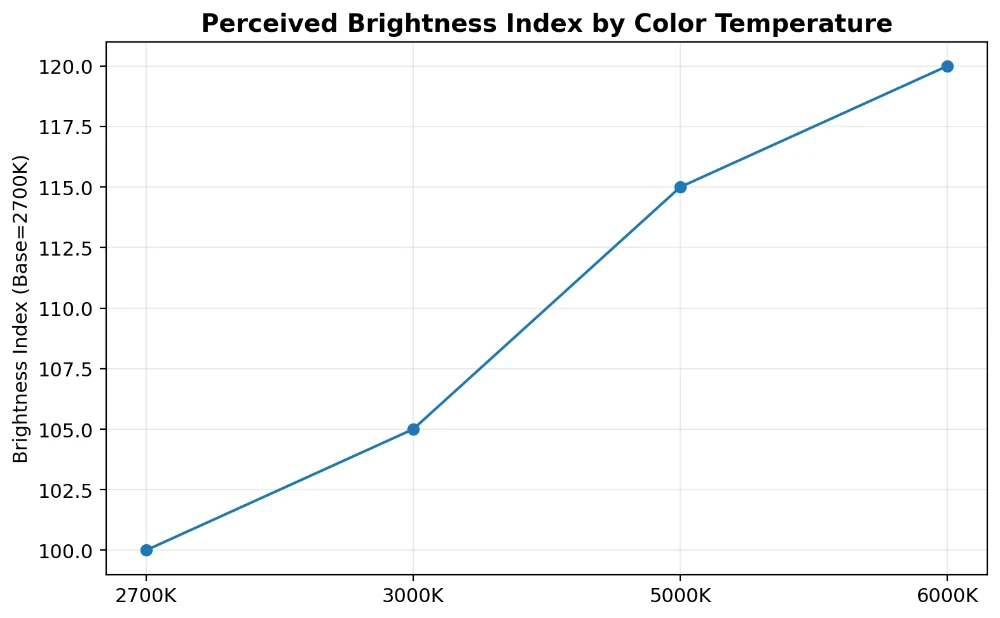
Customers often perceive cool white as brighter than warm white, even when measured lumen output is similar.
This creates a marketing trap.
Typical Problem
A product uses warm white LEDs, but the listing says:
Super bright solar garden lights.
The customer expects a strong white light. After installation, they see a soft warm glow and think the light is dim.
Better Positioning
For warm white products, focus on:
- Ambiance
- Soft glow
- Decoration
- Relaxation
- Garden atmosphere
For cool white products, focus on:
- Bright appearance
- Modern look
- Clear illumination
- Pathway visibility
- Contemporary outdoor space
The product description should set the right expectation before purchase.
Cost and Margin: Single-Color vs RGB Solar Lights
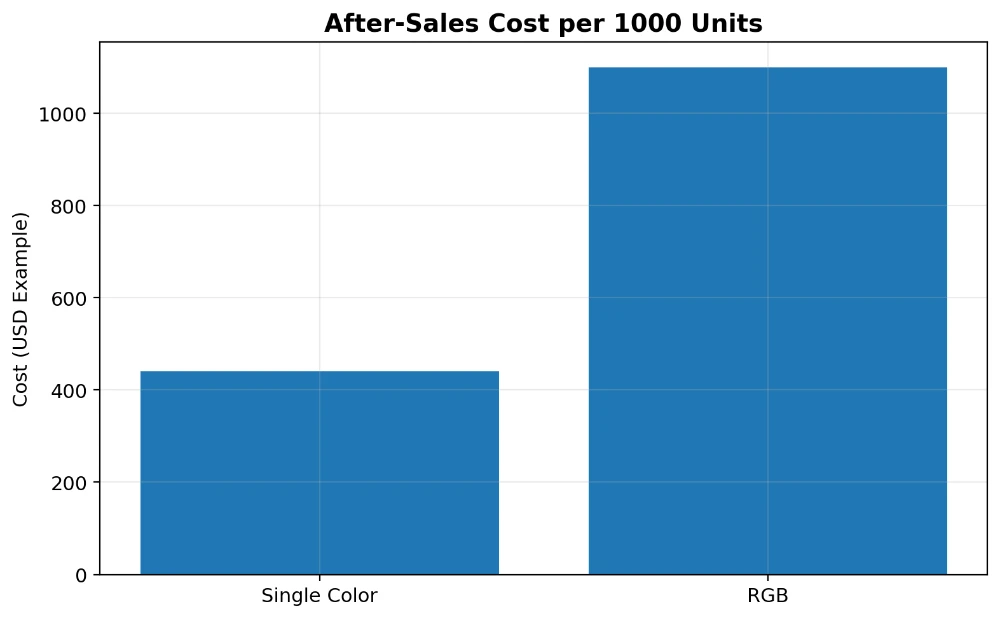
For wholesale buyers, color selection also affects cost structure.
RGB products may support higher retail pricing, but they also bring more complexity.
Single-Color Solar Lights
Single-color models usually use:
- One LED color
- Simpler PCB design
- Basic driver circuit
- Fewer control functions
- Easier quality inspection
Advantages:
- Lower production complexity
- More stable assembly
- Easier troubleshooting
- Lower after-sales pressure
- More predictable reorder performance
Best for:
- Year-round residential products
- Garden centers
- Online marketplaces
- Long-term private-label programs
- Stable wholesale replenishment
RGB Solar Lights
RGB models may require:
- Multi-color LED package
- Mode control circuit
- Remote control receiver
- More complex PCB layout
- Larger or better-managed battery capacity
- More detailed user instructions
Advantages:
- Strong visual appeal
- Higher feature value
- Good seasonal promotion potential
- Attractive product video content
Risks:
- More support questions
- Higher user confusion
- Higher component complexity
- Faster battery drain in some modes
- More quality checkpoints during production
Decision Table
| Factor | Single-Color | RGB / Multi-color |
|---|---|---|
| Production complexity | Low | Higher |
| QC difficulty | Lower | Higher |
| User operation | Simple | More complex |
| After-sales risk | Lower | Higher |
| Year-round inventory stability | Strong | Weaker |
| Seasonal sales potential | Moderate | Strong |
| Best role | Core SKU | Seasonal add-on |
The right choice depends on the buyer’s sales model.
If the goal is stable year-round turnover, single-color warm white is usually safer.
If the goal is holiday campaign differentiation, RGB can be useful in a controlled batch.
How to Choose the Right Color Mix by Sales Channel
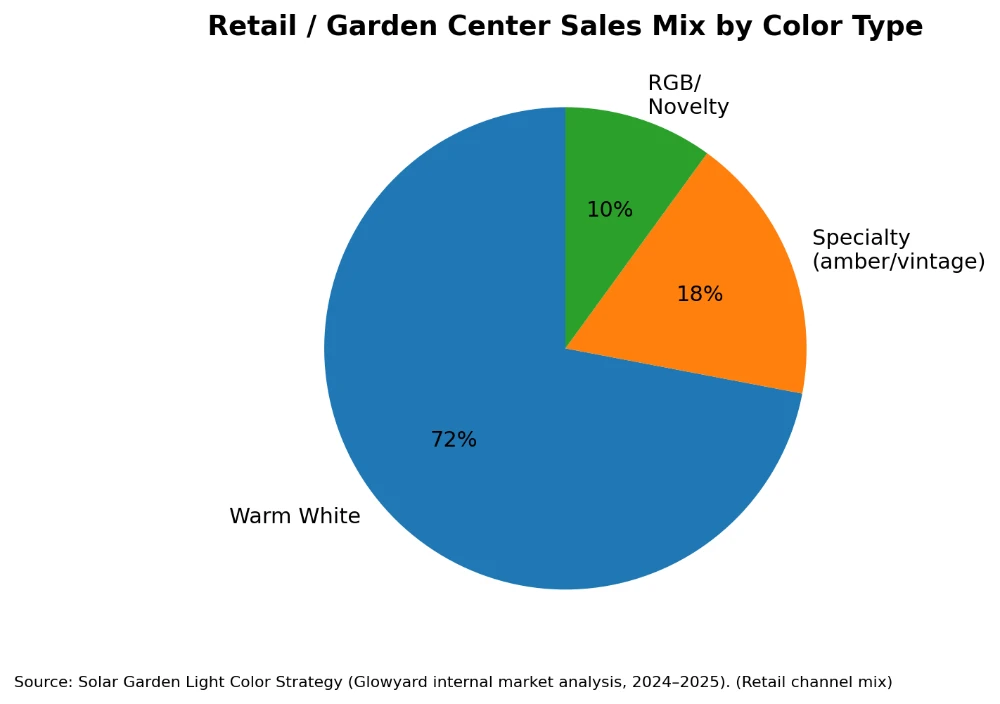
Different channels need different color strategies.
A good color mix for Amazon may not be right for a garden center. A good color mix for North America may not be right for the Middle East.
Online Marketplaces
Online marketplaces are highly sensitive to reviews, photos and customer expectations.
For this channel, color clarity is extremely important.
Recommended Strategy
| Color | Role |
|---|---|
| Warm White | Core SKU |
| RGB | Seasonal add-on |
| Cool White | Test carefully with clear positioning |
| Amber | Niche decorative option |
What Matters Most
Online buyers often cannot see the real light before purchase, so product images and wording must be accurate.
For warm white listings:
- Show real night effect
- Avoid over-promising brightness
- Use “soft warm glow” language
- Show patio, garden and pathway scenes
For cool white listings:
- Show modern installation context
- State the color temperature clearly
- Use “bright white” or “modern” wording
- Avoid cozy or romantic positioning
For RGB listings:
- Add video if possible
- Explain modes clearly
- Show actual color effect
- Include simple operation instructions
This reduces “not as expected” complaints.
Garden Centers and Retail Stores
Retail buyers prefer products that are easy to explain and easy to replenish.
Too many color options can make shelf management harder.
Recommended Strategy
| Color | Role |
|---|---|
| Warm White | Main shelf product |
| Amber / Vintage | Premium decorative option |
| RGB | Seasonal display |
| Cool White | Limited, if market demand exists |
Garden centers usually need clear product stories.
For example:
- Warm white: “classic garden glow”
- Amber: “vintage lantern effect”
- RGB: “holiday and party decoration”
- Cool white: “modern bright pathway light”
Simple positioning helps store staff and end customers understand the product faster.
Commercial and Project-Based Buyers
Commercial buyers may care less about cozy ambiance and more about consistency, clarity and project matching.
Recommended Strategy
| Application | Suitable Color |
|---|---|
| Modern pathway | Cool white or neutral white |
| Outdoor hospitality | Warm white or amber |
| Decorative installation | Warm white, amber or RGB depending on theme |
| Repeat project order | Controlled LED bin and batch record |
| Large multi-unit installation | Tight color consistency requirement |
For project-based buyers, color consistency is often more important than color preference alone.
If dozens or hundreds of units are installed together, even small differences in color temperature can become visible.
This is where supplier control matters.
Regional Color Preferences
Color preference can vary by region.
North America and Europe
For residential garden and patio products, warm white is usually the safest foundation. Customers often associate it with comfort and traditional outdoor lighting.
Recommended mix:
- 70–80% warm white
- 10–20% RGB or seasonal color
- 5–10% cool white or amber, depending on channel
Middle East and Some Modern Commercial Markets
Cool white may perform better where buyers prefer a brighter, cleaner and more modern look.
Recommended mix:
- 40–60% cool white or neutral white
- 30–40% warm white
- 10–15% specialty or RGB, depending on seasonal demand
Cemetery and Memorial Products
For cemetery and memorial products, color preference depends strongly on local culture and product type.
Warm white, amber and red LED effects may be more suitable than cold white in many memorial contexts because they feel softer and more candle-like.
If your product line includes cemetery or memorial lights, the color decision should be tested by market, not copied directly from garden lighting.
Glowyard also supports grave and cemetery solar lighting projects where color tone, housing style and local preference are part of product development.
OEM Color Control: What Buyers Should Ask Before Ordering
Color strategy does not stop at choosing warm white, cool white or RGB.
The supplier also needs to control production consistency.
For OEM and ODM solar light projects, buyers should confirm the following details before bulk production.
1. Color Temperature Target
Do not only write “warm white” or “cool white.”
Use a more specific target:
| General Term | Better Specification |
|---|---|
| Warm white | 2700K, 3000K or agreed range |
| Neutral white | 4000K or agreed range |
| Cool white | 5000K, 6000K or agreed range |
| Amber | Sample-approved visual standard |
| RGB | Mode sequence and color effect confirmed by sample |
For decorative products, the approved sample is often as important as the written number.
2. LED Bin Control
Ask whether the supplier can control LED bin selection for repeat orders.
This matters especially when:
- The order is large
- The product is sold as a set
- Customers may reorder later
- Units are installed side by side
- The same SKU will run for multiple seasons
Without bin control, repeat orders may look slightly different even if the product name is the same.
3. Sample Approval Process
Before mass production, confirm:
- Color temperature
- Night effect
- Brightness perception
- Runtime
- Packaging description
- Product photos
- RGB mode sequence, if applicable
Do not approve color based only on daylight product photos. Solar lights should be reviewed in a realistic night environment.
4. Runtime and Battery Matching
Color can also affect perceived runtime and customer satisfaction.
RGB modes may consume more power depending on the circuit and usage pattern. Cool white and warm white can also differ depending on LED efficiency, battery size and solar panel capacity.
For more detail on runtime planning, see our guide on how battery choice impacts night runtime in solar garden lights.
Before confirming an order, ask the supplier:
- What runtime is tested under standard conditions?
- Does RGB mode reduce runtime?
- Is battery capacity matched to the LED and usage scenario?
- Are winter or cloudy-day expectations clearly explained?
- Is the runtime claim realistic for the target market?
Overstated runtime claims can create after-sales pressure later.
5. Packaging and Listing Wording
For private-label and retail buyers, the product description should match the actual color experience.
Warm White Wording
Use:
- Soft warm glow
- Cozy garden atmosphere
- Relaxing patio light
- Decorative outdoor ambiance
Avoid:
- Super bright white light
- High-intensity security lighting
- Daylight brightness
Cool White Wording
Use:
- Bright white appearance
- Modern outdoor lighting
- Clear pathway illumination
- Contemporary garden design
Avoid:
- Candle-like glow
- Warm romantic ambiance
- Soft cozy light
RGB Wording
Use:
- Multi-color modes
- Holiday and party decoration
- Color-changing outdoor light
- Seasonal garden effect
Avoid:
- Simple everyday light
- Maintenance-free core product
- Brightest lighting solution
Good wording reduces returns because the customer understands what they are buying.
Recommended Wholesale Color Mixes
The following structures are not fixed rules, but they are useful starting points for buyers building a new product range.
Starter Mix for Residential Garden Products
| Color | Suggested Share | Role |
|---|---|---|
| Warm White | 70–80% | Core SKU |
| Amber / Neutral / Cool White | 10–20% | Test or secondary option |
| RGB | 5–10% | Seasonal add-on |
Best for:
- Garden centers
- Residential marketplaces
- General distributors
- First-time private-label buyers
Online Marketplace Mix
| Color | Suggested Share | Role |
|---|---|---|
| Warm White | 65–75% | Review-stable core product |
| RGB | 10–20% | Seasonal listing and video-driven traffic |
| Cool White | 5–10% | Modern buyer segment |
| Amber | 5–10% | Niche decorative listing |
Best for:
- Amazon sellers
- Online retailers
- Seasonal campaign sellers
- Brands that rely heavily on product reviews
Modern / Commercial Mix
| Color | Suggested Share | Role |
|---|---|---|
| Cool White / Neutral White | 40–60% | Modern and commercial applications |
| Warm White | 30–40% | Residential and hospitality balance |
| RGB / Amber | 5–15% | Specialty projects |
Best for:
- Commercial landscape projects
- Modern architecture channels
- Regional markets with cool white preference
- Project-based buyers
Holiday and Event Mix
| Color | Suggested Share | Role |
|---|---|---|
| RGB | 30–50% | Seasonal visual appeal |
| Warm White | 30–50% | Stable decorative foundation |
| Amber / Specialty | 10–20% | Theme-based differentiation |
Best for:
- Christmas collections
- Halloween products
- Party and event lighting
- Short seasonal promotions
For this type of product line, buyers should also review after-sales planning. Glowyard’s after-sales service can help buyers understand how replacement, issue tracking and product feedback are handled after shipment.
Practical Buyer Checklist Before Confirming Color
Before placing a wholesale solar light order, check the following:
Product Positioning
- Is the product decorative, functional or seasonal?
- Is the target customer residential or commercial?
- Does the color match the product story?
- Will customers expect cozy ambiance or bright illumination?
Market and Channel
- Is this for online marketplace, retail store or project use?
- Are product photos enough to explain the color?
- Does the channel tolerate higher return risk?
- Is the product sold year-round or seasonally?
Technical Control
- Is the color temperature specified?
- Is LED bin control required?
- Will samples be tested in night conditions?
- Are repeat orders expected?
- Are batch records needed?
RGB-Specific Questions
- How many modes are included?
- Does the light remember the last mode?
- Is remote control included?
- Is the mode sequence easy to explain?
- Does RGB mode reduce runtime?
- Are instructions clear enough for end customers?
Commercial Risk
- Could this SKU create slow inventory?
- Is the color mix too complicated?
- Is the MOQ suitable for market testing?
- Can the buyer start with a smaller test batch?
- Is the supplier able to support repeat color consistency?
A good color strategy should reduce risk before the order is placed.
How Glowyard Helps Buyers Build the Right Color Strategy
At Glowyard, color selection is part of the OEM and ODM discussion, not just a final appearance choice.
For custom solar garden light projects, we can help buyers review:
- Target market and customer environment
- Product category and usage scenario
- Warm white, cool white, amber or RGB configuration
- LED bin and color consistency requirements
- Packaging wording and positioning
- Battery and runtime matching
- Small-batch testing before scale-up
- Mixed SKU or mixed container planning
This is especially useful for buyers who want to test a new product line without overcommitting to the wrong color mix.
For example:
- A garden center buyer may start with warm white as the main SKU and test amber in smaller quantities.
- An Amazon seller may use warm white as the review-stable base and launch RGB only before holiday season.
- A commercial buyer may require cool white or neutral white with tighter color tolerance.
- A cemetery product buyer may prefer warm, amber or candle-like tones depending on the local market.
If you are planning a private-label or OEM solar light program, our OEM solutions can help you decide which color structure is realistic for your MOQ, target market and reorder plan.
FAQ: Solar Light Color Selection for Wholesale Buyers
What is the safest solar light color for wholesale distributors?
For most residential garden and patio products, warm white 2700K–3000K is the safest starting point. It fits common customer expectations for cozy outdoor ambiance and usually creates fewer “too harsh” complaints than cool white in residential channels.
Is cool white better than warm white?
Not always. Cool white looks brighter and more modern, but it can feel too cold in traditional garden settings. It works better for modern architecture, commercial pathways and regions where buyers prefer bright white light.
Warm white is usually better for residential decoration, patios, garden lanterns and softer outdoor ambiance.
Are RGB solar lights good for wholesale orders?
RGB solar lights can be good for seasonal or event-driven sales, especially holidays and parties. However, they are more complex than single-color models and can create more after-sales questions.
For wholesale buyers, RGB should usually be treated as a seasonal add-on, not the main year-round SKU.
Why do customers complain that warm white solar lights are not bright enough?
Warm white appears softer than cool white at the same lumen output. If the product is marketed as “super bright,” customers may expect a cool white effect and feel disappointed.
For warm white products, it is better to use words like “soft glow,” “warm ambiance” and “decorative garden light” instead of over-promising brightness.
Why is LED bin control important?
LED bin control helps keep color temperature consistent between production batches.
Without it, one batch of “3000K warm white” may look more yellow, while another may look more neutral. This can create visible differences when customers install repeat orders side by side.
For repeat wholesale programs, LED bin control and batch records are important quality requirements.
What color mix should a new distributor start with?
A safer starting mix for residential solar garden lights is:
- 70–80% warm white
- 10–20% secondary color such as amber, neutral or cool white
- 5–10% RGB for seasonal testing
The exact mix should depend on region, channel and product type.
Final Recommendation
For most wholesale buyers, the safest solar light color strategy is not to chase every color trend.
A more stable approach is:
- Use warm white as the core SKU for residential garden products.
- Use cool white only where the market or application clearly supports it.
- Use RGB as a seasonal, controlled add-on.
- Use amber or vintage tones for niche decorative positioning.
- Require LED bin control for repeat orders and multi-unit installations.
- Match product wording with the real color effect.
Color selection is not only about appearance. It is about inventory risk, return control, customer expectation and long-term reorder stability.
If you are developing a new solar garden light collection, Glowyard can help you compare color options, test samples, plan OEM configurations and build a practical wholesale assortment before mass production.



![do solar lights work in winter at cemeteries [2026 guide]](https://glowyard.com/wp-content/uploads/2026/03/Do-Solar-Lights-Work-in-Winter-at-Cemeteries-2026-Guide.webp)