
How to Reduce After-Sales Issues and Maintenance Costs for Garden Solar Lights in Bulk Orders
For bulk buyers, the real cost of garden solar lights does not stop at the unit price. A product that looks competitive on paper can become expensive later through returns, complaints, spare-part handling, replacements, and customer support pressure.
The good news is that many after-sales problems can be reduced before the order is placed. In most cases, they come from a few predictable areas: battery quality, waterproofing, material durability, batch consistency, packaging, and weak supplier support.
This guide explains how importers, distributors, retailers, and brand owners can reduce after-sales issues and maintenance costs when sourcing garden solar lights in bulk.

Why After-Sales Problems Become Expensive in Bulk Orders
A single failed garden light is a small problem. A failed batch is a margin problem.
When bulk orders go wrong, the cost often shows up in several places at once:
- return handling
- replacement shipments
- warehouse sorting
- customer complaint time
- lost confidence from retailers or end buyers
- extra pressure on your internal service team
That is why experienced buyers do not only ask, “What is the price?” They also ask, “How likely is this product to create after-sales work later?”
What Causes Most After-Sales Problems in Bulk Garden Solar Light Orders?
Most after-sales problems in bulk orders come from a small group of recurring issues:
- unstable battery performance
- weak waterproofing or poor material durability
- inconsistent mass-production quality
- fragile structure or poor packaging
- unclear certification or technical documentation
- poor post-shipment support from the supplier

1. Battery problems are one of the most common causes
A solar light may look attractive and still generate complaints if the battery performance is weak.
Typical problems include:
- short runtime
- poor charging in low-sun conditions
- fast capacity drop after a short period of use
- unstable winter performance
For bulk buyers, this leads to more than technical complaints. It also creates replacement cost, stock write-offs, and service workload.
If battery reliability is a recurring issue in your category, our article on 4 Most Common Battery Issues in Solar Garden Lights may also be useful.
2. Batch quality is not always as consistent as the sample
One common sourcing mistake is approving a sample and assuming the full order will behave the same way.
In bulk orders, problems often come from:
- inconsistent LED brightness
- variable charging performance
- different fit quality between units
- mixed appearance quality in the same shipment
This is where weak production control quickly turns into returns and complaint handling.
3. Water ingress and material ageing create long-term failures
Outdoor solar lights are exposed to rain, heat, UV, dust, and seasonal temperature changes. If the housing, seals, stake, or finish are weak, failures often show up after installation rather than before shipment.
Common risk points include:
- poor sealing around the battery or LED compartment
- plastic that yellows, cracks, or becomes brittle under UV
- untreated metal parts that rust
- decorative stakes or joints that break during installation or transport
4. Poor packaging creates avoidable returns
Even if the product itself is acceptable, weak packaging can increase after-sales problems by causing:
- broken stakes
- scratched finishes
- cracked decorative parts
- loose internal components after shipment
In bulk projects, packaging quality is part of product quality.
5. Missing or unclear compliance documents create extra risk
For EU, UK, and other regulated markets, after-sales problems do not only come from product failure. They can also come from unclear certification or incomplete compliance documentation.
Buyers should confirm these points before shipment, not after goods arrive at customs or retail channels. For a broader guide, see What Certifications Should You Check Before Importing Outdoor Lights?.
How to Choose Garden Solar Lights That Are Easier to Maintain
A lower-maintenance product usually starts with better design, not better complaint handling.
1. Prefer serviceable designs over fully sealed disposable units
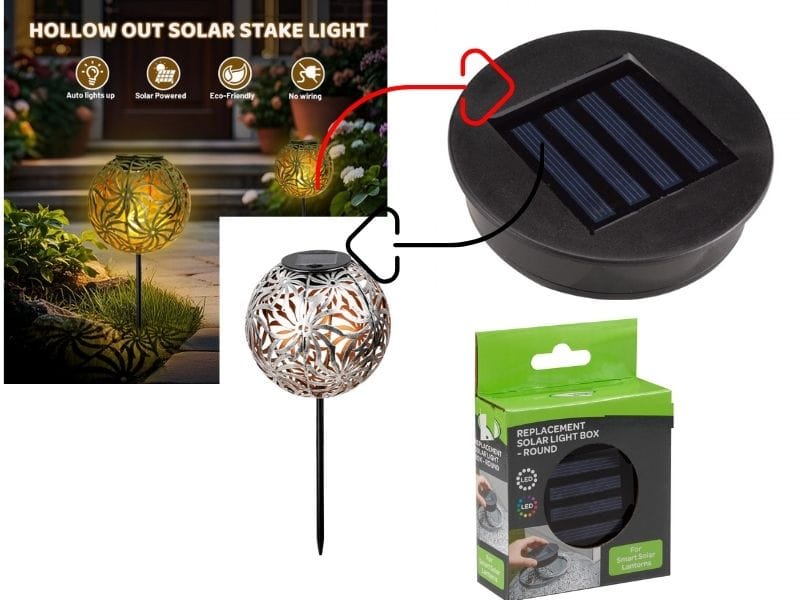
For B2B buyers, one of the most useful features is serviceability.
A maintenance-friendly light is more likely to have:
- battery access that can be opened without destroying the unit
- replaceable stakes, heads, or modules where possible
- structure that allows easier diagnosis if a failure happens
Integrated units may save cost upfront, but they often increase replacement cost later.
2. Check waterproof design, not only appearance
A decorative housing may still fail quickly if the sealing points are weak.
At minimum, buyers should confirm:
- where the main sealing areas are
- how the battery compartment is protected
- whether the joint design fits the target market conditions
- whether the IP rating is realistic for the actual use case
For a more practical comparison, see our guide to IP44 vs IP65 vs IP67.
3. Choose materials that can survive outdoor exposure
Material choice directly affects maintenance cost.
Low-maintenance products are more likely to use:
- UV-resistant plastics
- better-treated metal parts
- more durable decorative housings
- stronger stake and base structures
If plastic durability is a concern in your market, especially under strong sun exposure, see How to Improve the Durability of Plastic in Solar Garden Lights Under Outdoor Sun Exposure.
4. Keep the structure simple where possible
A product with many delicate parts may look attractive but can also create more service issues later.
Simpler structures often reduce:
- breakage points
- assembly errors
- sealing risk
- spare-part complexity
This does not mean every design should be plain. It means the product should balance appearance with maintainability.
A Practical Buyer Checklist Before Placing a Bulk Order
Before confirming a bulk order, it helps to check the product in these areas:
| Check Point | Why It Matters |
|---|---|
| Battery quality and runtime consistency | Reduces early failure and complaint rate |
| Replaceable or serviceable structure | Lowers replacement cost later |
| Waterproof design and IP suitability | Reduces field failure from water ingress |
| UV and material durability | Helps prevent cracking, rust, and ageing |
| Batch consistency testing | Reduces sample-to-mass-production gap |
| Packaging protection | Prevents shipping damage and installation returns |
| Compliance documents | Reduces customs and market-entry risk |
| Spare parts and support policy | Makes post-sales handling easier |
This kind of checklist is often more useful than focusing only on quoted price.
What Support Should a Supplier Offer to Reduce After-Sales Work?
You are not only buying a product. You are also buying the supplier’s ability to help you handle problems efficiently if they happen.

A more dependable supplier should be able to provide:
1. Clear product and installation information
This may include:
- technical specifications
- installation guidance
- images or videos for setup
- battery or charging instructions where needed
This reduces misuse and helps your team answer basic questions faster.
2. Spare-part logic
For many buyers, a spare-part plan is more valuable than replacing complete units.
Useful questions include:
- Can batteries, heads, or stakes be supplied separately?
- Which failures can be solved with spare parts?
- What parts are practical to stock locally?
3. A realistic response process
Buyers should confirm:
- how quickly technical questions are answered
- what information is needed for claims
- whether the supplier can help diagnose common failures
- whether there is a standard replacement workflow
4. Written warranty terms
A vague warranty creates more work, not less.
Buyers should ask:
- what is covered
- what is excluded
- how replacement is handled
- what evidence is needed
- what the expected timeline is
For a better view of how we manage product consistency before and after shipment, you can also review Our Quality and After Sales Service.
How Glowyard Helps Bulk Buyers Reduce After-Sales Risk
At Glowyard, we do not see after-sales as something that starts after the goods leave the factory. We see it as something that should be reduced during product selection, production control, packaging, and project planning.
That is why we focus on areas such as:
- more stable product structures
- quality checks before shipment
- clearer documentation
- practical spare-parts support
- faster technical feedback when questions appear
For buyers working on larger or recurring orders, our Purchasing Tips page also explains how to reduce sourcing risk earlier in the process.
Conclusion
Bulk after-sales problems usually do not come from bad luck. They usually come from predictable weak points that were missed before ordering:
- poor battery quality
- weak waterproofing
- unstable batch quality
- fragile materials
- weak packaging
- unclear supplier support
The most effective way to reduce maintenance cost is to control those risks early.
For importers, distributors, retailers, and brand owners, that means choosing better-designed products, confirming the right technical details before production, and working with suppliers who can support both quality control and post-shipment handling.
If you are reviewing new projects or trying to lower after-sales pressure in existing orders, Glowyard can help you evaluate product structure, durability, quality consistency, and support options before those issues turn into returns and complaints.



![do solar lights work in winter at cemeteries [2026 guide]](https://glowyard.com/wp-content/uploads/2026/03/Do-Solar-Lights-Work-in-Winter-at-Cemeteries-2026-Guide.webp)