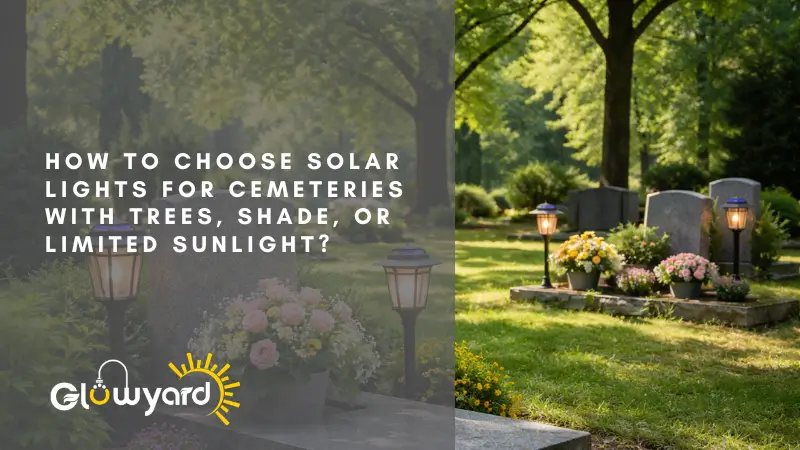
How To Choose Solar Lights for Cemeteries with Trees, Shade, or Limited Sunlight?
Choosing solar cemetery lights for a shaded cemetery is possible — but not every product is suitable for that environment.
If a grave is surrounded by trees, tall headstones, or receives only limited direct sun, the right choice is usually not the brightest light or the cheapest light. It is the light that can still charge reliably, run predictably, and look respectful in a quiet memorial setting.
In most cases, that means choosing a model with a larger solar panel, more conservative brightness, a stronger battery, a weather-ready housing, and more realistic runtime expectations. And if the plot sits in deep shade for most of the day, a remote-panel design or even a battery-powered alternative may be the better answer.
Glowyard’s observation: In shaded cemetery environments, disappointing solar performance is often linked more to placement and sunlight conditions than to appearance alone. That is why this guide starts with site conditions first, then moves into product specs.
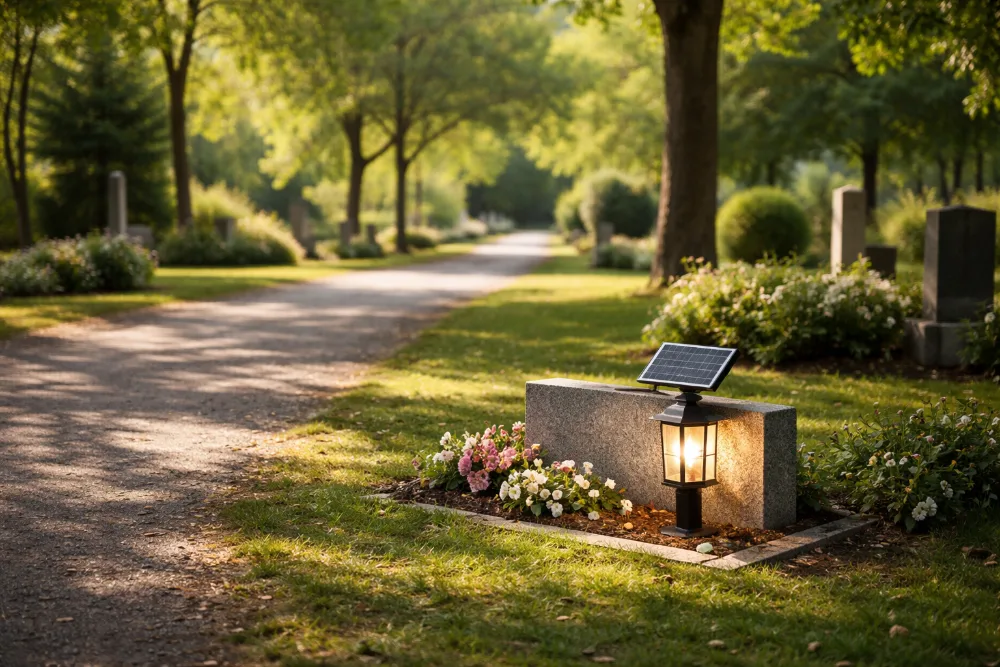
Can solar cemetery lights still work under trees or in shade?
Yes — but only if the shade level is realistic and the product is selected for low-sun use.
This is the point many buyers miss. A cemetery plot can look “bright enough” during the day and still be a poor solar location. Light filtering through branches is not the same as reliable direct sun. A grave may also receive a short patch of sunlight in the morning, then sit in shadow for the rest of the day because of trees, monuments, walls, or surrounding structures.
That matters because even partial shading can reduce solar output much more than people expect. Some solar performance references suggest that light shading may already reduce output by around 15–25%, moderate shading by roughly 25–40%, and heavy shading by 40–95%. Other research also points out that shading losses are often not proportional to the shaded area, which means a small amount of badly placed shade can still cause a large performance drop. See the Easysolar shading overview, the partial shading PV paper, and the NREL report.
For cemetery buyers, the practical takeaway is simple:
- A little shade is manageable
- Mixed sun and shade requires more careful product selection
- Deep shade all day is usually a warning sign
So the real question is not “Will any solar light work here?”
It is:
How much usable sunlight does this grave actually receive, and what kind of solar light is realistic for that condition?
How much sunlight is enough for a cemetery solar light?
A cemetery solar light becomes much more dependable when the panel gets regular direct sun. If the site only gets short or inconsistent sun, you need to choose much more carefully.
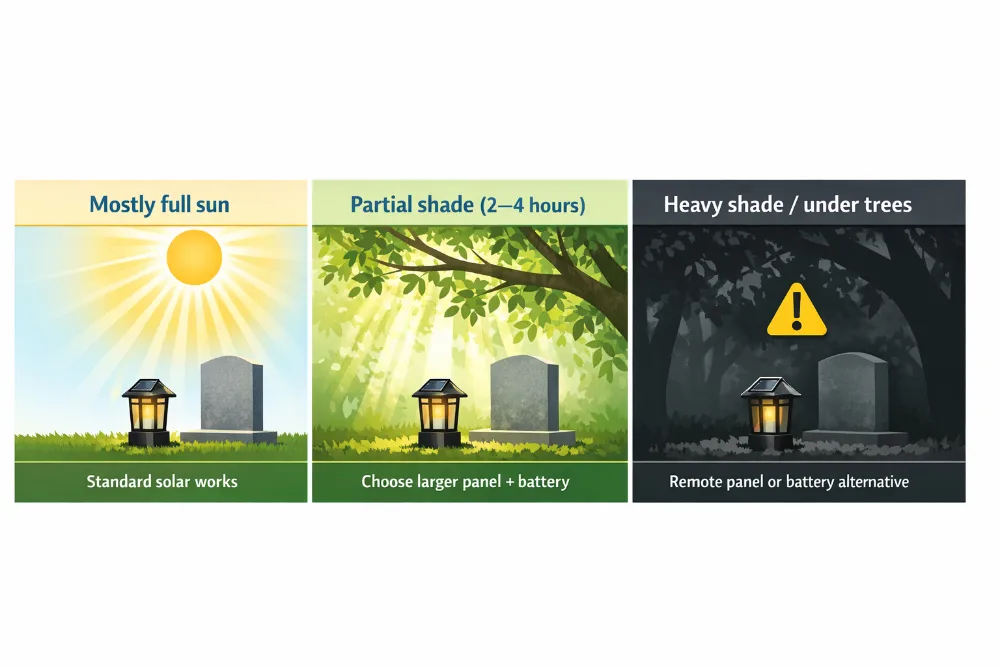
To make the decision easier, it helps to divide cemetery plots into three simple categories.
Quick Shade Decision Guide
| Site condition | What it usually means | Best approach |
|---|---|---|
| Mostly full sun | The panel gets strong direct light for much of the day | Standard solar cemetery lights are usually a practical option |
| Partial shade (around 2–4 hours of direct sun) | The light may still work, but charging and runtime become less predictable | Choose larger panels, larger batteries, and lower output modes |
| Heavy shade / under trees / very low sun | The site is at high risk of weak charging and short runtime | Prioritize remote-panel systems or consider battery/electric alternatives |
In practice, this makes a vague sunlight problem much easier to evaluate.
Mostly full sun
If the grave receives regular direct sunlight through the middle part of the day, solar lights are usually the easiest choice. In this situation, buyers have more flexibility with style, light pattern, and runtime.
That does not mean specs stop mattering. It simply means the solar system has a better chance to perform close to its advertised design.
Partial shade
This is where many cemetery plots actually fall.
The location may receive morning sun, or a few hours of open light between tree shadows, but not enough uninterrupted sun for a small, decorative solar unit to perform consistently every day. In this zone, buyers should stop thinking in terms of “pretty lantern first” and start thinking in terms of charging margin.
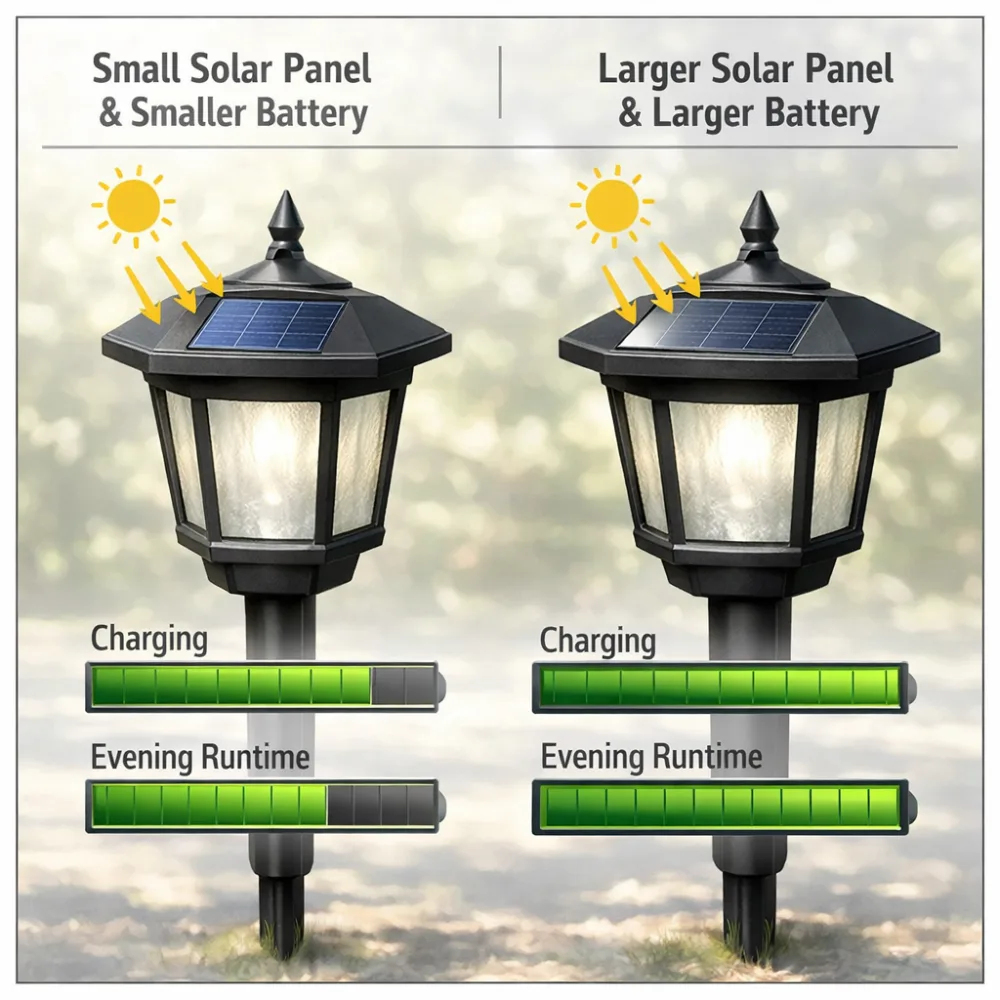
A partial-shade site usually benefits from:
- a larger solar panel
- a larger battery reserve
- a lower, softer light output
- a more modest runtime expectation
- a product with honest specs, not exaggerated “all night” claims
Heavy shade
If the grave is under dense trees, beside tall monuments, or in a row where sun access is poor for most of the day, a normal integrated solar light becomes a risky purchase.
This does not always mean solar is impossible. It means the usual one-piece decorative solar product is often the wrong format. In these cases, the smarter solution may be:
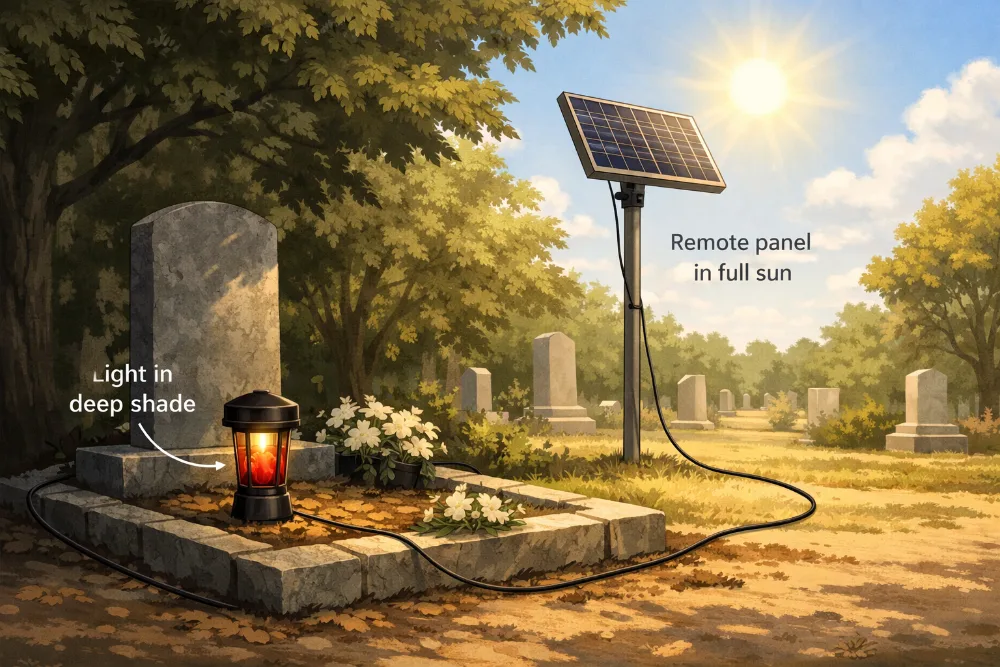
- a remote solar panel placed in full sun
- a different mounting position
- or a battery-powered memorial light instead of solar
That is a much better outcome than buying a standard solar light, hoping for the best, and ending up with a lamp that only glows weakly for an hour or two after sunset.
What should you look at first: style or charging reliability?
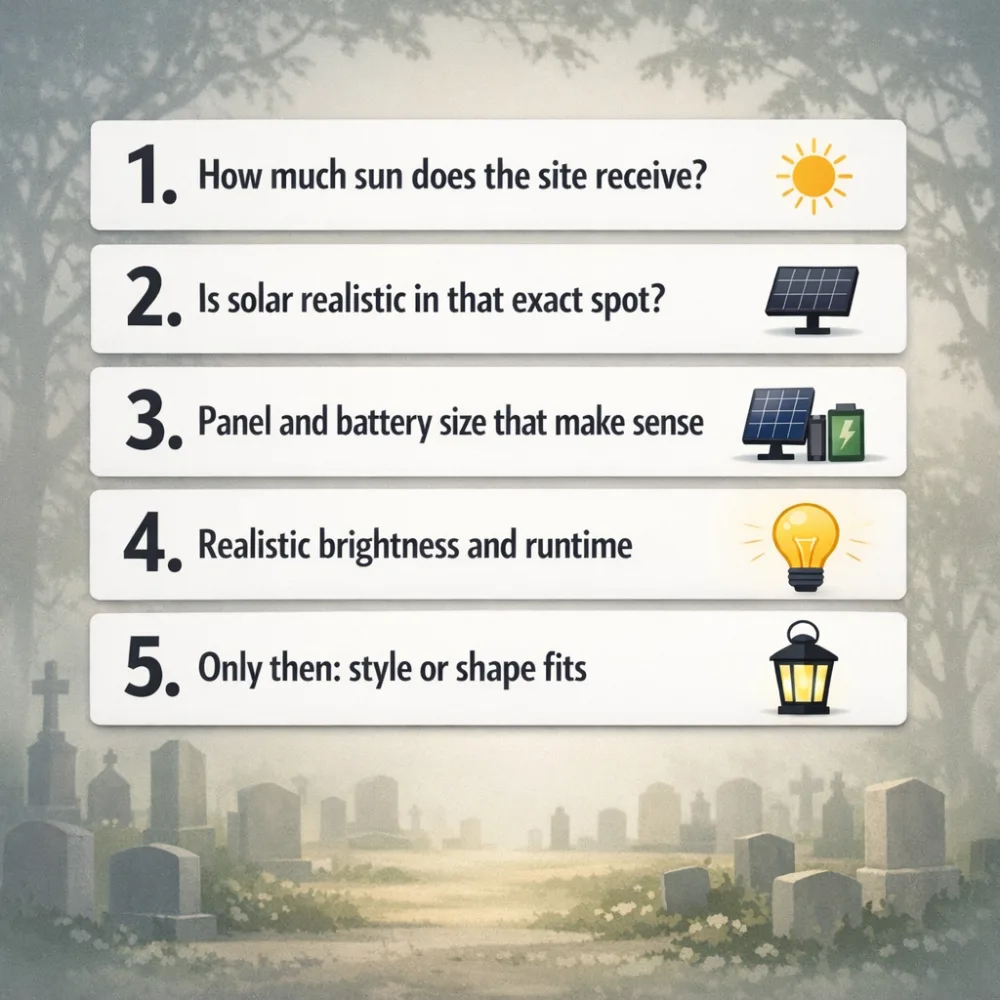
Always check charging reliability first. In shaded cemeteries, appearance matters, but sunlight conditions matter more.
This is one of the most important mindset shifts in the whole article.
Many buyers begin with questions like:
- Should I choose a lantern shape or a candle shape?
- Is warm white better than red?
- Which design looks more premium?
Those are valid questions, but in shaded cemetery locations they are secondary. A beautiful solar light that does not charge properly will not deliver a respectful memorial effect for long.
At the early selection stage, the better order is:
- How much sun does the site receive?
- Is solar realistic at all in that exact spot?
- What panel and battery size make sense for that sunlight level?
- What brightness and runtime are realistic?
- Only then: which style or shape fits the memorial best?
A short brand perspective also helps clarify the point:
Based on what Glowyard commonly sees in low-sun cemetery applications, placement and charging margin often matter more than style at the early selection stage.
Which specs matter most when sunlight is limited?
In low-sun cemetery environments, not all product specs matter equally. The most important ones are panel size, battery capacity, light output, runtime honesty, and IP rating.
Specs That Matter Most in Shade
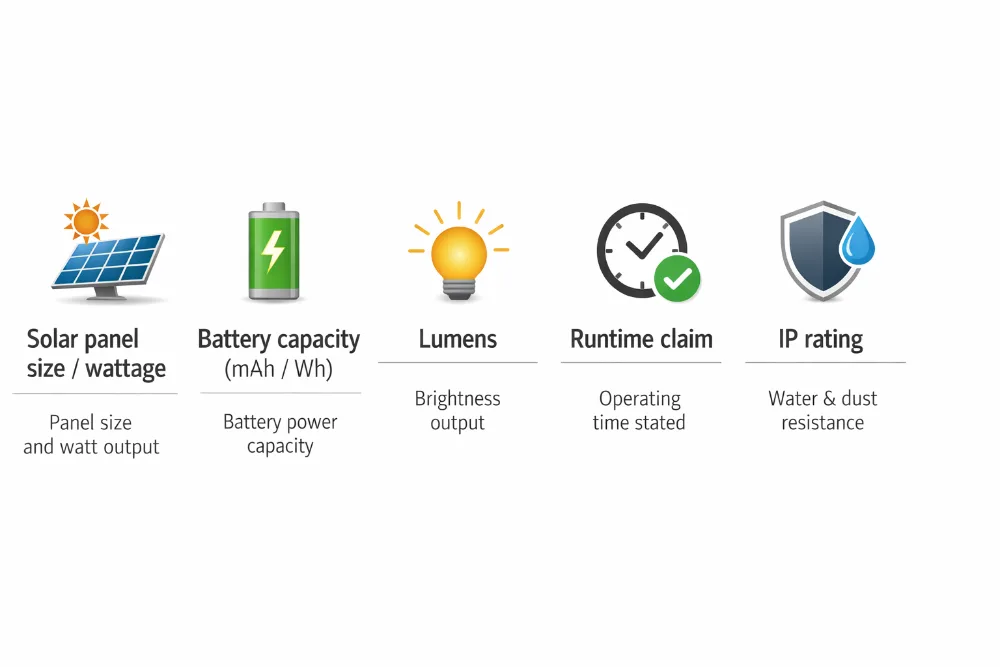
| Spec | What it means in plain English | What matters in shaded cemeteries | Red flag |
|---|---|---|---|
| Solar panel size / wattage | How much energy the light can collect | Bigger collection area usually gives more charging margin | Tiny panel on a product claiming long runtime |
| Battery capacity (mAh / Wh) | How much stored energy the light can keep | Larger capacity helps stabilize runtime when sunlight is inconsistent | No battery spec listed |
| Lumens | Actual light output, not power draw alone | Lower or moderate lumens are often more realistic in shade | Very high lumen claim with no matching panel/battery info |
| Runtime claim | How long the light is said to stay on | Needs to be judged against real sunlight conditions | “12 hours” with no explanation of test conditions |
| IP rating | Resistance to dust and water | Exposed cemetery use should usually aim higher, not lower | No IP rating or only sheltered-use protection |
Why does solar panel size matter so much in shade?
In shade, a small panel is often the first point of failure.
When sunlight is limited, the system has fewer chances to collect energy. That makes panel size and charging efficiency much more important than they would be in open sun.
This is why a shaded cemetery light should not be judged like a standard decorative garden stake. In a challenging site, a larger panel is not just a premium feature — it is often the difference between a usable product and a disappointing one.
A buyer may think, “The light only needs to be gentle, not bright.” That is true. But even gentle lighting still needs enough stored energy to last through the evening. If the panel is too small for the site condition, the light will struggle no matter how attractive the housing looks.
Why is battery capacity so important for runtime?
The battery is what turns daytime charging into evening reliability.
Many buyers overlook battery capacity, even though it is central to lighting time. In a cemetery setting, this matters even more because the expectation is emotional as well as practical: people want the memorial light to come on calmly and stay on for a meaningful part of the evening, not flicker out unexpectedly.
That is why battery capacity should be read together with panel size and brightness. A higher-capacity battery can help store more energy when charging conditions are uneven. But it is not magic. A large battery paired with a very small panel in a very shaded plot may still underperform because the system cannot fully recharge.
A second point many buyers miss is that battery behavior also changes with temperature. In winter, cold conditions can reduce usable capacity and shorten runtime, while repeated summer heat can accelerate long-term battery aging. That is one reason shaded cemetery lights should be chosen with extra charging margin rather than optimistic best-case assumptions.
So the more useful question is not:
- “Does it have a large battery?”
It is:
- “Does the battery size make sense for the panel, the light output, and the actual site condition?”
Are higher lumens always better in a cemetery?
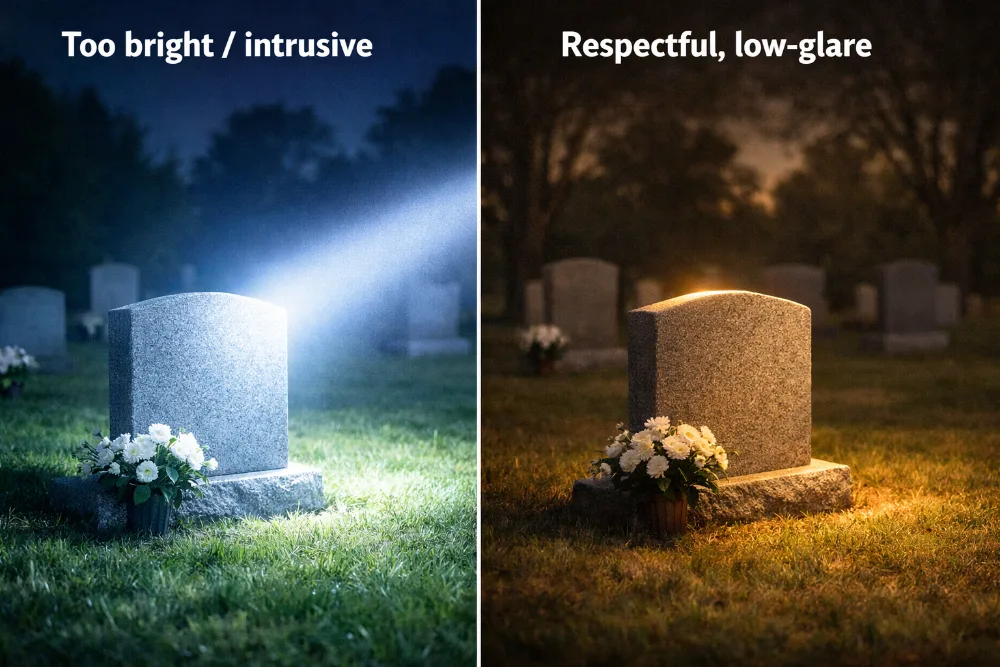
No. In shaded graves, excessive brightness often creates a worse product, not a better one.
A common confusion in solar lighting is the assumption that brighter always means better. But higher light output consumes more energy, which means the battery drains faster and the panel needs to work harder to replenish it. See the lumen guide and the solar garden light buying guide.
For cemetery use, that tradeoff matters a lot.
Most families do not need a grave light to behave like a pathway floodlight. They need something softer:
- enough to gently mark the plot
- enough to illuminate the name area or symbolic element
- enough to feel present and cared for
- not so bright that it becomes intrusive or drains too quickly
In other words, respectful light usually beats aggressive light.
That is especially true in partial shade, where a moderate output level often gives a much more stable and elegant result than chasing a brighter beam that cannot sustain itself after dusk.
What IP rating should you choose for cemetery solar lights?
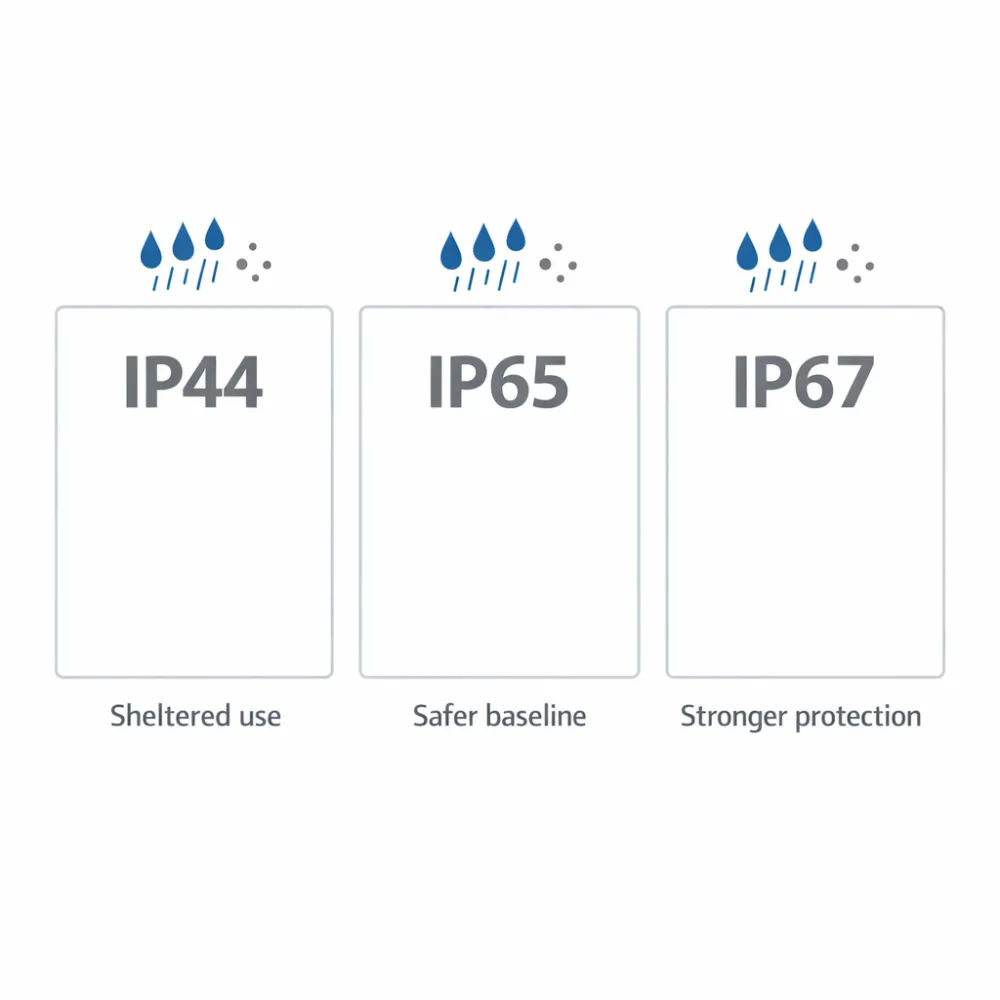
For buyers comparing IP44 vs IP65 vs IP67, IP65 or above is usually the safer starting point for exposed cemetery use.
This matters because cemetery lights do not live in ideal showroom conditions. They may face:
- rain and wind-driven moisture
- dust and pollen
- sprinklers
- fallen leaves and dirt buildup
- summer heat and winter cold
- repeated outdoor exposure over long periods
That is why a solar light for a cemetery should not only “look outdoor-friendly.” It should have an enclosure that is realistically prepared for outdoor exposure.
IP Rating Cheat Sheet
| IP rating | What it usually means in practice | Cemetery suitability |
|---|---|---|
| IP44 | Basic splash protection, more suitable for sheltered use | Only acceptable in more protected locations |
| IP65 | Better dust protection and water resistance | A much safer baseline for exposed cemetery use |
| IP66 | Stronger protection against harsh outdoor exposure | A good option for more demanding environments |
This is also consistent with practical outdoor guidance from Lighting Style’s IP rating guide and YESSS Electrical’s outdoor IP explanation, both of which distinguish between more sheltered applications and more exposed outdoor conditions.
Still, IP rating should not be treated as the only durability signal.
A decent cemetery solar light also needs durable material choices as well as a housing that seals properly over time.
- a housing that seals properly over time
- materials that resist UV aging
- parts that do not crack easily in temperature swings
- a build that keeps dirt and water away from internal electronics
In other words, IP rating tells you something important, but not everything. A well-built light with transparent specs is usually a better long-term choice than a cheap unit with vague outdoor claims and no meaningful sealing details.
What color temperature looks most respectful in a cemetery?
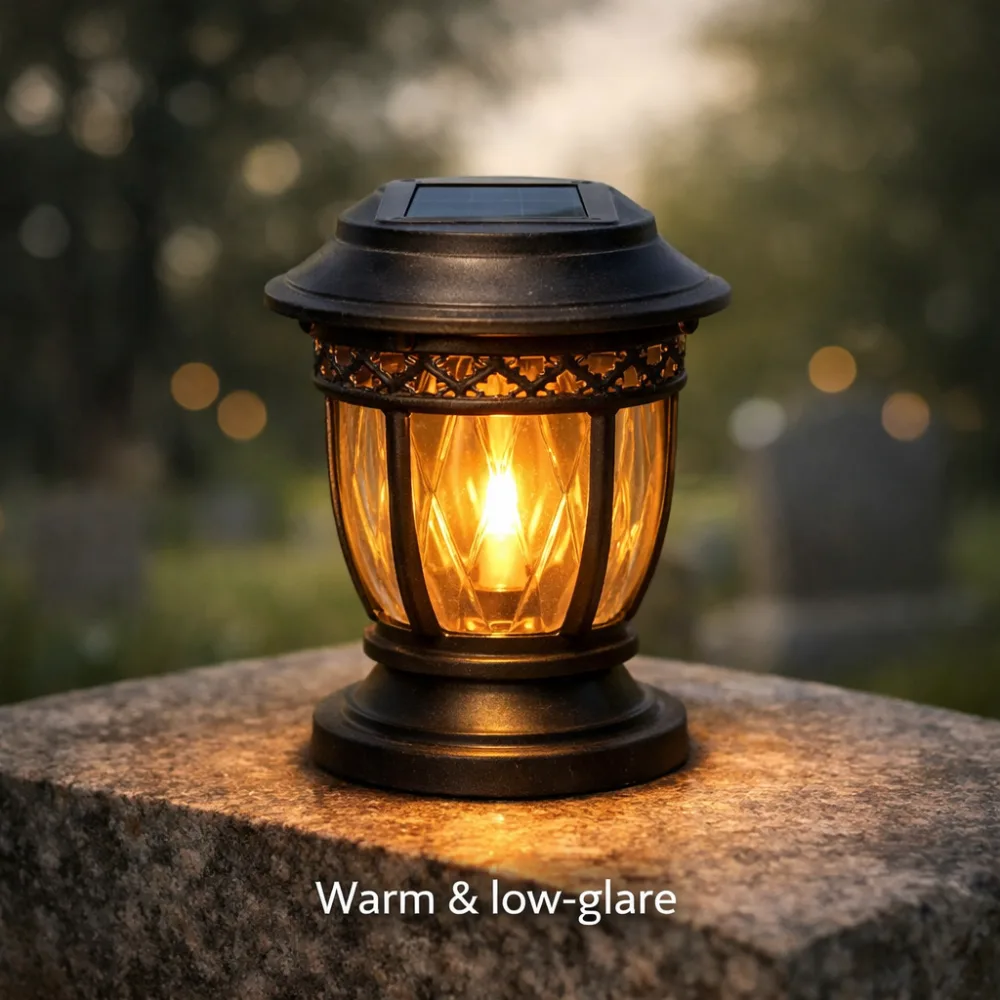
Warm, low-glare light is usually the better choice. In most cemetery settings, gentle illumination feels more appropriate than sharp, cold brightness.
This is where product selection becomes more than a technical decision. A cemetery light is not just there to provide visibility. It also shapes the mood of the memorial space.
Outdoor lighting guidance from DarkSky’s lighting principles and related low-impact lighting recommendations consistently favors lighting that is useful, targeted, low-level, controlled, and warm-colored, while very cool, high-Kelvin light can feel harsher and create more visual intrusion.
For a cemetery article, that can be translated into plain language:
- Warm white usually feels calmer and more respectful
- Cool white may appear brighter, but can also feel harsh
- Shielded light helps focus attention on the grave itself
- Unshielded light can become distracting, especially in quiet memorial rows
In a cemetery, the goal is usually not to create a bright spotlight effect. It is to create a calm, visible presence that does not disturb neighboring plots.
That is why, in shaded sites, a lower and warmer output often works better than trying to compensate with a colder, more aggressive beam.
A simple ambience guide
| Light style | Typical visual effect | Better for cemetery use? |
|---|---|---|
| Warm, shielded glow | Calm, soft, focused | Yes |
| Neutral white, moderate beam | Practical but less atmospheric | Sometimes |
| Cool, bright, exposed beam | Sharper, harsher, more intrusive | Usually no |
This section also pairs naturally with the earlier lumen discussion. You do not need to push huge brightness numbers here. In fact, a cemetery light usually works better when it gives gentle, controlled visibility rather than a harsh, attention-grabbing effect.
Is a remote solar panel a better choice for shaded graves?
Yes — in many shaded cemetery plots, a remote panel is the smartest solar solution.
This is one of the most valuable distinctions in the whole article because it gives readers a practical alternative between two bad outcomes:
- buying a normal integrated solar light that underperforms
- giving up on solar too early
A remote-panel setup allows the light head to stay near the grave while the solar panel is placed in a sunnier nearby location.
That makes remote-panel systems especially useful when:
- the grave itself is shaded by trees
- the headstone casts repeated shadow on the light
- surrounding monuments block the best charging angle
- the memorial location needs soft light, but the panel can be mounted elsewhere nearby
In practical terms, a remote-panel system helps separate two jobs that are often forced into one product:
- collecting sunlight efficiently
- placing the light where it looks respectful
That is why a remote-panel design can be much more reliable than a decorative one-piece solar lantern in difficult locations.
When does a remote panel make sense?
Choose a remote-panel approach when:
- the light body belongs near the headstone
- the shaded area still has a sunnier edge nearby
- you want solar, but site exposure is inconsistent
- you want better charging without moving the memorial light away from the intended visual position
When might it be less suitable?
A remote panel may be less suitable when:
- the cemetery does not allow visible extra hardware
- cable routing would look intrusive
- maintenance access is too difficult
- there is simply no nearby sun-exposed area at all
It is also worth checking cemetery rules before using visible extra hardware such as remote panels, taller supports, or offset mounts.
Practical guidance from sources like Homes & Gardens and Shonestore also supports using sunnier nearby positions when the grave itself is shaded.
How realistic should runtime expectations be in shaded cemeteries?
Much more conservative than the packaging often suggests. A “12-hour runtime” claim should never be read as a guarantee for tree-covered or low-sun sites.
This is one of the most important buyer-protection points in the article.
In real use, runtime depends on all of these working together:
- available sunlight
- panel size
- battery capacity
- light output
- operating mode
- season and temperature
So when a product promises long runtime, readers should mentally ask:
- Was that tested in full sun?
- At what brightness level?
- In what season?
- With what battery condition?
- Under what kind of installation angle?
That is why the better buyer mindset is not:
“Will this light stay on all night no matter what?”
It is:
“What operating mode gives the most reliable performance for my real site condition?”
Mode planning for shaded plots
| Mode | What it does | Best use case |
|---|---|---|
| Constant low mode | Gentle steady output for several hours | Best for calm memorial presence |
| Stepped dimming | Brighter early, lower later | Good when some evening visibility matters but energy is limited |
| Motion-boosted mode | Low base light, temporary higher output | Better for adjacent paths than for symbolic grave lighting |
For many cemetery applications, constant low or stepped dimming is more suitable than a high-output dusk-to-dawn promise. A lower setting often produces a more elegant and dependable result.
This is also why runtime claims should be treated as full-sun estimates unless the product clearly explains how performance changes in low-sun conditions. Helpful context can be found in this solar garden light buying guide and this government solar street light specification PDF.
What should buyers avoid in shaded cemetery environments?
Avoid any product that looks impressive on the box but does not match the realities of the site.
What to avoid
-
Tiny solar panels on heavily shaded plots
They simply do not leave enough charging margin. -
Very high lumen claims with no matching battery or panel details
Brightness without energy support usually means disappointment. -
“12-hour runtime” claims with no test conditions explained
In shade, that number may be unrealistic. -
IP ratings that are too low for exposed use
A cemetery light must handle more than occasional light moisture. -
Very cool blue-white light
It may appear brighter, but often feels harsher and less respectful. -
Unshielded beams or floodlight-style glare
These can spill into neighboring plots and break the quiet atmosphere. -
Designs that interfere with mowing or groundskeeping
Even a good-looking light becomes a bad choice if it is placed where it causes regular maintenance conflict. -
Cheap products with vague specs
If panel size, battery information, IP level, and runtime conditions are unclear, the buyer is taking on too much risk.
A good rule is this:
In shaded cemeteries, underperformance is usually not caused by one single bad spec. It is caused by a mismatch between the site, the product format, and the buyer’s expectations.
How should you place and maintain solar lights in tree-covered cemetery areas?
Good placement matters almost as much as the product itself. In shaded cemetery environments, a decent solar light can still fail if the panel is installed in the wrong spot, at the wrong angle, or left dirty for too long.
That is why buyers should think beyond the product photo and treat placement as part of the selection process.
A practical cemetery setup should aim for three things at the same time:
- the panel gets the best available sunlight
- the light remains visually respectful near the grave
- the whole setup stays simple enough to maintain over time
A simple placement checklist
Before choosing the final position, check the site in this order:
-
Observe sunlight over a full day
A grave can look bright in the morning and still become a poor charging location by midday or afternoon. Tree shade moves, and tall monuments can block light at the exact time the panel needs it most. -
Look for the brightest realistic position, not just the most convenient one
If the decorative light looks best beside the headstone but the best sun is one or two meters away, that is often a strong reason to consider a remote panel setup. -
Avoid overhanging branches and repeated shadow lines
A little shifting shade can make charging inconsistent, even when the site does not seem heavily shaded at first glance. -
Use a sensible panel angle
A fixed panel usually performs better when it is tilted rather than left flat, especially where dirt, leaves, or water can collect. A simple rule of thumb is to use a tilt roughly suited to the local latitude rather than a completely flat position. -
Keep the panel clear and easy to reach
A solar light that requires awkward cleaning or sits where leaves constantly pile up will usually become less reliable over time.
A practical cemetery-specific reminder
In cemetery spaces, “best solar position” and “best visual position” are not always the same thing.
That is why the best installation is often the one that balances:
- reliable charging
- respectful appearance
- low maintenance
- minimal interference with nearby graves or groundskeeping
How much maintenance should buyers realistically expect?
Even a good solar light is not fully maintenance-free. In shaded environments, small maintenance issues can turn into noticeable performance losses much faster.
This is especially important for cemetery use because many families do not visit every week. Some may only come occasionally, which means the product should be chosen with realistic maintenance habits in mind.
The main maintenance points are simple:
- clean the panel surface
- remove leaves and debris
- check whether branches have grown into the sunlight path
- inspect seals and housing condition
- watch for battery aging after long seasonal exposure
A helpful rule for readers is this:
The more shade, dust, leaves, and seasonal weather a light faces, the less forgiving the system becomes.
That means even a thin layer of dirt or a few weeks of fallen debris can matter more in a shaded grave than it would in a fully sunny garden.
A low-maintenance routine relatives can actually follow
A simple “wipe and inspect” routine is often enough:
- wipe the panel clean during visits
- clear off leaves, pollen, or dirt buildup
- confirm the light still turns on at dusk
- check whether the output has become noticeably shorter or dimmer
- make sure no part of the housing looks cracked, loose, or water-damaged
This kind of routine is much more realistic for cemetery use than pretending the light will never need attention.
What should you check if a solar cemetery light starts underperforming?
Most failures in shaded cemetery locations are not mysterious. They usually come from shade, dirt, battery aging, water ingress, or unrealistic runtime expectations.
A short troubleshooting section makes the article feel more useful and grounded.
Quick troubleshooting checklist
| Problem | Likely cause | What to check first |
|---|---|---|
| The light looks too dim | Not enough charging, dirty panel, too much shade | Clean the panel and reassess sunlight exposure |
| The light turns off after 1–2 hours | Battery not fully charged, battery aging, brightness too high for site conditions | Check charging conditions and consider a lower-output mode |
| The light never comes on | Deep shade, battery failure, water damage, switch/settings issue | Test in a sunnier spot, inspect seals, and check the battery/setup |
| Performance dropped after a season | Heat, cold, aging battery, dirt buildup | Inspect the battery condition and panel cleanliness |
| It works in summer but not in winter | Shorter days, lower sun angle, colder battery performance | Lower runtime expectations or switch to a more conservative solution |
A sentence like this explains the pattern well:
In many shaded cemetery plots, underperformance is gradual rather than sudden — the light still works, but for less time, at lower brightness, and with less consistency.
That matches real user frustration better than framing every issue as a product defect.
When should you choose battery or electric memorial lights instead?
Choose battery or electric alternatives when the site is too shaded for solar to work reliably, or when stable lighting matters more than energy independence.
This section is important because it makes the article more trustworthy. A good guide should not force solar into places where it is simply the wrong tool.
When are battery memorial lights the better choice?
Battery memorial lights are often the better option when:
- the grave sits in deep shade most of the day
- there is no good nearby location for a remote panel
- the family wants simple, predictable use
- the expected lighting time is moderate and periodic battery changes are acceptable
- the site is visually sensitive and extra hardware would be unwelcome
Battery lights are often a practical answer for graves under dense trees, beside tall monuments, or in narrow cemetery rows where solar charging opportunities are weak.
When are electric memorial lights worth considering?
Electric memorial lights are worth considering when:
- the site requires more consistent long-duration lighting
- a stable power source is already available
- cemetery rules allow that setup
- the buyer prioritizes reliability over solar convenience
- the installation is part of a more permanent memorial arrangement
Electric solutions are not always available or appropriate, but when they are, they can remove much of the uncertainty caused by shade, season, and battery charging limitations.
A simple decision summary
| Situation | Best fit |
|---|---|
| Mostly sunny grave | Standard solar |
| Partially shaded grave | Solar with larger panel/battery or remote panel |
| Heavily shaded grave | Battery light or remote-panel solar |
| Need very stable long-duration lighting | Electric if practical and permitted |
This kind of section helps the article end as a decision guide rather than a one-sided solar sales page.
Are there any cemetery rules or etiquette issues to consider?
Yes — and they should be checked before the final product choice, not after.
Even a well-chosen light can become the wrong purchase if the cemetery does not allow:
- taller fixtures
- visible wiring
- remote panels
- extra stakes or offset mounts
- brighter or more numerous lights
That does not need to become a long legal section. A short, respectful reminder is enough:
Before installing a remote panel, taller support, or any less typical fixture layout, check the cemetery’s rules on height, wiring, brightness, and placement.
This keeps the article practical and avoids leading the reader into a setup that may later be removed.
Glowyard can help buyers choose more realistic low-sun cemetery lighting
Choosing solar lighting for a shaded cemetery plot is rarely just about style. It depends on how much usable sunlight the site receives, how long the light needs to stay on, how exposed the area is to weather, and how much maintenance the family can realistically manage.
Glowyard helps buyers compare cemetery lighting options based on actual outdoor conditions — including solar models for better-exposed plots, more conservative low-sun configurations, and alternative memorial lighting choices where standard solar products are likely to disappoint. Buyers can compare options more realistically by looking at panel size, battery setup, housing durability, and expected exposure conditions instead of relying on brightness claims alone.
If you are trying to narrow down the most realistic fit for a shaded site, Glowyard can help you compare solar, battery, and low-sun-friendly cemetery lighting options more clearly before you commit to one format.
FAQ
Will solar cemetery lights work under my tree?
They can, but it depends on how much usable sunlight still reaches the panel. Light or partial shade may still be workable with the right product, while deep shade for most of the day usually makes standard integrated solar lights much less reliable.
How many hours of sun do I really need?
There is no single answer for every product, but in practical buying terms, more direct sun means more reliable charging. Partial-shade sites need more conservative product choices, while heavy-shade sites often need remote panels or alternative lighting.
What IP rating do I need if sprinklers or weather hit the grave?
For exposed cemetery use, IP65 or above is usually a safer starting point. IP44 is better treated as a sheltered-use level, not a default choice for open outdoor gravesites.
What color temperature looks most respectful?
Warm, low-glare light is usually the better fit. It tends to feel calmer and less intrusive than very cool, harsh white light.
Do I need to replace the battery after a few years?
Often, yes. Outdoor battery performance gradually changes with age, heat, cold, and charging conditions. In shaded graves, battery decline may become noticeable sooner because the system already operates with less charging margin.
Final takeaway
The best solar cemetery light for a shaded plot is not the one with the most dramatic brightness claim. It is the one that matches the real site.
If the grave gets decent sunlight, a standard solar light may work well. If the site is only partly sunny, buyers should lean toward larger panels, better batteries, lower output, and more realistic runtime expectations. And if the grave sits in heavy shade for most of the day, a remote-panel solution — or even a battery or electric alternative — is often the smarter and more respectful choice.
In the end, choosing well means judging the environment first, the specs second, and the appearance third. That order usually leads to a product that not only looks appropriate on day one, but continues to perform in a way that feels calm, reliable, and fitting over time.


![do solar lights work in winter at cemeteries [2026 guide]](https://glowyard.com/wp-content/uploads/2026/03/Do-Solar-Lights-Work-in-Winter-at-Cemeteries-2026-Guide.webp)