Grave Solar Lights in Germany vs USA: Market Differences, Standards & Buyer Insights
Introduction: Who This Analysis Is For
This report is written specifically for:
Learn more from our grave & cemetery lights manufacturer program.
- Importers
- Distributors
- Cemetery equipment suppliers
- Memorial product wholesalers
If you are sourcing grave solar lights for either the United States or Germany, it is critical to understand that these two markets operate under fundamentally different demand logics.
The differences are not limited to:
- Product design
- LED color
- Price positioning
- Certification standards
They are deeply rooted in:
- Cemetery culture
- Consumer psychology
- Climate conditions
- Retail channel structure
Many importers assume that a single SKU strategy can serve both markets. In practice, this often leads to:
- Higher return rates
- Mismatched LED preferences
- Structural durability issues
- Compliance cost surprises
The goal of this analysis is to help buyers understand how the German and US grave solar light markets diverge structurally — and how sourcing decisions should adapt accordingly.
As a solar garden lights manufacturer with over 15 years of export experience to both regions, we’ve observed these differences firsthand through client feedback, return data, and market-specific testing protocols.
I. Cemetery Culture & Consumer Behavior Differences
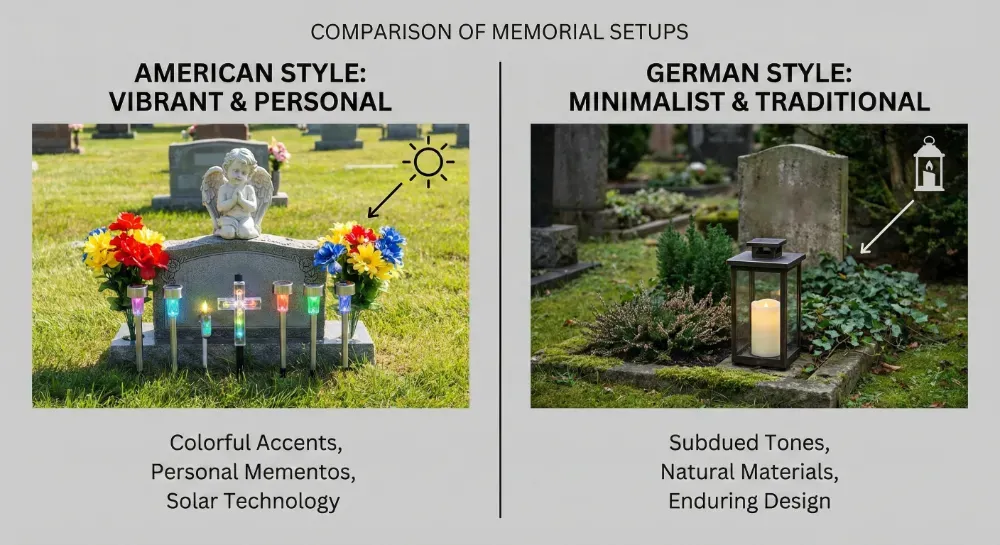
Understanding cultural context is the foundation of product positioning. Grave solar lights are not impulse garden décor products — they are emotionally sensitive memorial items.
🇺🇸 USA Market Characteristics
The US cemetery lighting market is more commercially diversified and visually expressive.
1. Strong Decorative Preference
American consumers often treat grave decorations as a visible expression of remembrance. As a result:
- Decorative housings are common
- Cross designs sell consistently
- Angel and faith-related motifs perform well
- Molded resin and ABS structures dominate mid-range SKUs
The product often serves both a functional and symbolic role.
2. High Proportion of Plastic Structures
ABS and plastic dominate because:
- They reduce retail price pressure
- They are easier to standardize at scale
- They align with Amazon-driven cost competition
- They are lighter for parcel shipping
While glass options exist, they typically occupy higher price tiers.
3. Amazon-Driven Standardization
A significant portion of US grave solar lights are sold via:
- Amazon
- Walmart online
- DTC Shopify brands
This drives:
- Standardized packaging sizes
- Cost-sensitive BOM decisions
- Emphasis on IP65 waterproof labeling
- Bright warm white LED as default
Product differentiation is often secondary to rating performance and review volume.
4. Multi-Tier Pricing Structure
The US market contains:
- Entry-level low-cost plastic models
- Mid-range decorative molded versions
- Premium resin or metal/glass hybrids
This creates competitive pressure across multiple pricing bands rather than one dominant positioning.
🇩🇪 Germany Market Characteristics
The German grave lighting market operates under a more traditional and restrained memorial culture.
1. Emphasis on Dignity and Simplicity
German cemetery aesthetics favor:
- Minimalist forms
- Symmetrical lantern structures
- Subdued finishes
- Neutral or matte metal elements
Overly decorative or symbolic motifs (such as large crosses or bright shapes) are less dominant in mainstream demand.
2. Higher Proportion of Glass Structures
Glass-bodied solar grave lanterns are significantly more common because:
- They align with traditional candle lantern formats
- They communicate permanence and seriousness
- They are perceived as higher quality
Metal + glass combinations are common in mid-to-high-end SKUs.
Plastic exists, but is often positioned lower or for temporary use.
3. Red LED Preference
Unlike the US warm white preference, Germany shows strong acceptance of:
- Red LED
- Candle-like flicker simulation
This connects directly to long-standing European memorial candle traditions.
Warm white is used, but red remains culturally embedded in many regions.
4. Long-Term Stability Over Brightness
German buyers prioritize:
- Consistent winter operation
- Structural durability
- Longevity over brightness output
The expectation is not “high lumen impact” — it is “reliable presence through seasons.”
Key Behavioral Contrast
| Behavioral Dimension | USA | Germany |
|---|---|---|
| Emotional Expression | Decorative & visible | Reserved & dignified |
| Structure Preference | Plastic dominant | Glass dominant |
| LED Color | Warm white | Red preference |
| Purchase Driver | Online reviews & price | Tradition & durability |
| Replacement Cycle | Faster turnover | Longer-term usage |
Based on our export experience to both US and EU markets, attempting to use a single design logic across both regions often results in mismatched demand signals.
For importers, the cemetery culture layer is not superficial — it directly determines:
- LED configuration
- Housing material
- Price positioning
- Warranty expectations
In the next section, we will move from cultural behavior to structural product differences — breaking down how material, battery, IP rating, and price band strategy diverge between the US and German markets.
II. Product Structure Differences
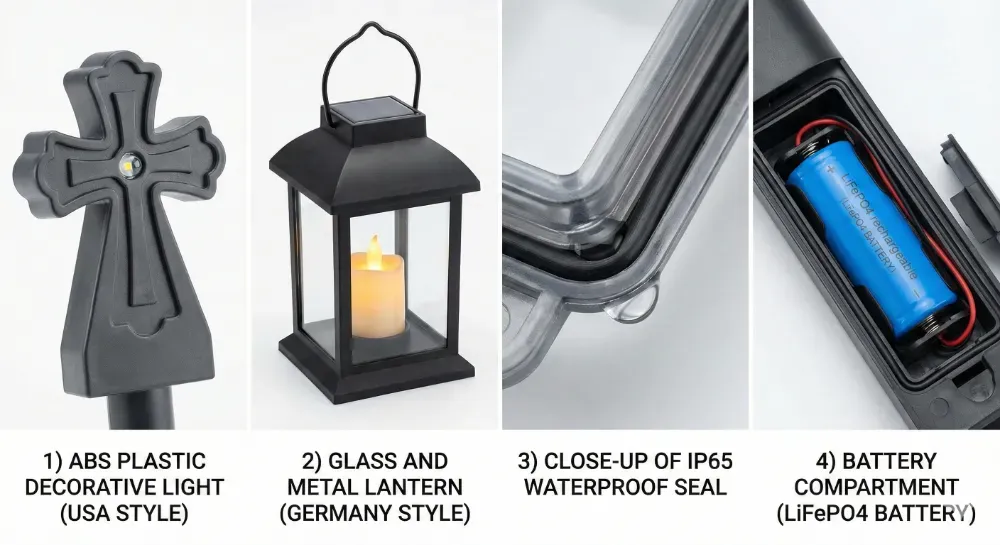
When comparing the US and German grave solar light markets, structural differences go beyond aesthetic preference.
They reflect deeper differences in:
- Retail channel pressure
- Climate expectations
- Consumer durability standards
- Price positioning logic
Below is a professional structural comparison overview.
Structural Comparison Table
| Item | USA Market | Germany Market |
|---|---|---|
| Housing Material | ABS dominant | Glass + metal dominant |
| LED Color | Warm white (steady) | Red dominant (often flicker) |
| IP Rating | IP65 mainstream expectation | IP44 still exists, high-end moving to IP65 |
| Battery Capacity | Emphasis on longer runtime (mAh marketing) | Emphasis on stable low-temperature discharge |
| Price Structure | Multi-tier (low to premium) | Mid-to-high positioning more common |
1. Housing Material Logic
🇺🇸 USA – ABS Dominant
ABS is widely used because:
- Lower mold and material cost
- Lighter for e-commerce shipping
- More impact-resistant during parcel transport
- Compatible with Amazon price competition
Many US distributors prioritize:
- Consistent IP65 labeling
- Lightweight packaging
- Lower breakage claims
Plastic structures allow easier SKU scaling across price tiers. For a detailed comparison of housing materials, see our guide on resin vs iron vs plastic vs glass for solar lights.
🇩🇪 Germany – Glass + Metal Dominant
In Germany:
- Glass lantern structures resemble traditional candle holders
- Metal frames communicate durability and dignity
- Weight is less of a disadvantage because many products are sold through physical retail or specialty suppliers
Glass communicates permanence, which aligns with German memorial culture.
However, it introduces:
- Higher breakage risk
- Stricter packaging requirements
- Higher freight cost
2. LED Color Strategy
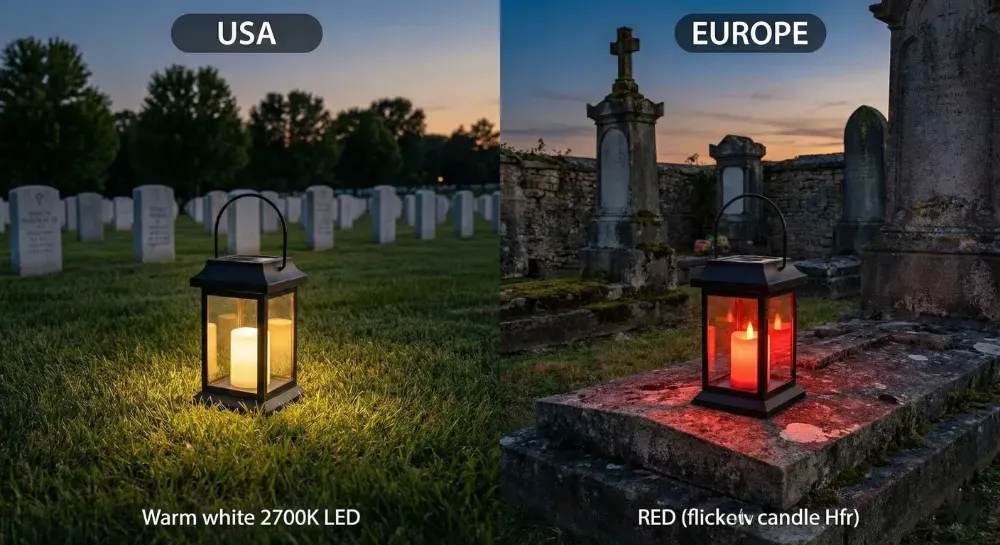
🇺🇸 Warm White Dominance
Warm white LEDs are preferred because they:
- Match garden lighting trends
- Photograph well for e-commerce
- Appear modern and clean
Brightness is often marketed as a selling point.
🇩🇪 Red LED Tradition
Red LEDs remain culturally accepted in Germany due to:
- Long-standing memorial candle tradition
- Religious symbolism
- Visual continuity in cemetery environments
Flicker simulation is common.
Importers targeting Germany often require dual-SKU strategy:
- Red version
- Warm white version
3. IP Rating Expectations
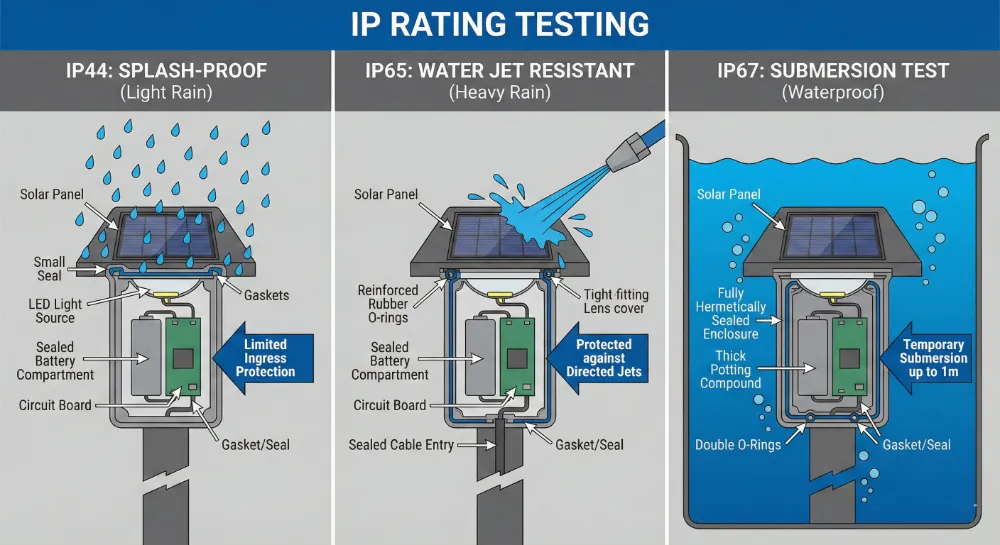
🇺🇸 IP65 as Baseline
Because of Amazon listing competition, IP65 is often treated as minimum expectation.
Even if actual exposure is moderate, IP65 labeling:
- Reduces negative reviews
- Improves perceived quality
- Lowers return risk during heavy rain events
For a comprehensive understanding of waterproof ratings, refer to our IP44 vs IP65 vs IP67 comparison guide.
🇩🇪 Mixed Reality
Germany historically tolerated IP44 for sheltered cemetery lantern use.
However:
- Consumer awareness is increasing
- Retailers increasingly request IP65
- Winter durability complaints push higher waterproof standards
We are observing gradual migration toward IP65 for mid-range SKUs.
4. Battery Capacity vs Stability Logic
🇺🇸 Marketing-Oriented Runtime
US listings often highlight:
- “12–15 hours runtime”
- Higher mAh battery numbers
This creates pressure to increase nominal capacity.
However, higher mAh does not always equal better winter performance.
🇩🇪 Stability-Oriented Performance
German buyers care more about:
- Consistent winter operation
- Controlled discharge curve
- Battery behavior in low temperatures
Based on our export projects to Central Europe, winter complaints are often related to:
- Reduced discharge efficiency below 0°C
- Shortened illumination duration during cloudy weeks
This shifts focus from “maximum capacity” to “low-temperature stability.”
III. Climate & Environmental Impact
Climate differences significantly influence product structure decisions.
🇺🇸 United States Climate Diversity
The US market spans:
- High-temperature southern states
- Humid eastern regions
- Dry western coastal areas
Key Impacts
1. High Temperature Stress
- Plastic UV degradation
- Battery swelling risk
- Solar panel encapsulation stress
2. Humidity & Rain
- Seal integrity testing critical
- IP65 expectation reinforced
3. UV Exposure
- Long sun hours accelerate ABS aging
Because of these variables, US-focused products must balance:
- UV-resistant materials
- IP protection
- Cost control
🇩🇪 Germany Climate Characteristics
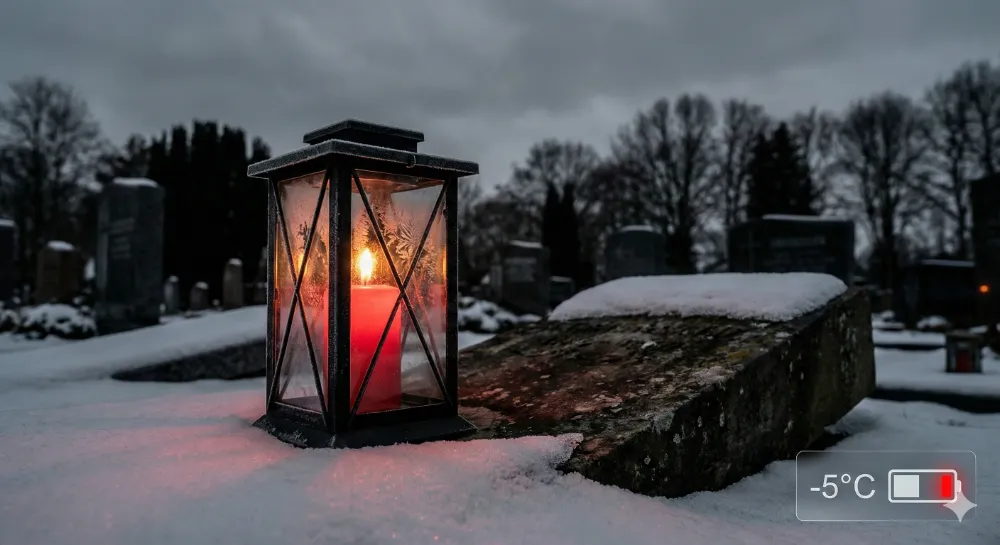
Germany faces:
- Long winters
- Extended cloudy periods
- Frequent humidity
- Sub-zero night temperatures
Key Impacts
1. Low Temperature Battery Efficiency Loss
Below 0°C:
- Lithium-ion discharge efficiency drops
- Runtime decreases significantly
2. Weak Solar Charging in Winter
Reduced sunlight hours lead to:
- Incomplete daytime charging
- Higher sensitivity to panel efficiency
3. Moisture Retention & Corrosion Risk
Persistent damp conditions require:
- Reliable sealing
- Anti-corrosion coating on metal parts
Why LiFePO4 Performs Better in German Winters
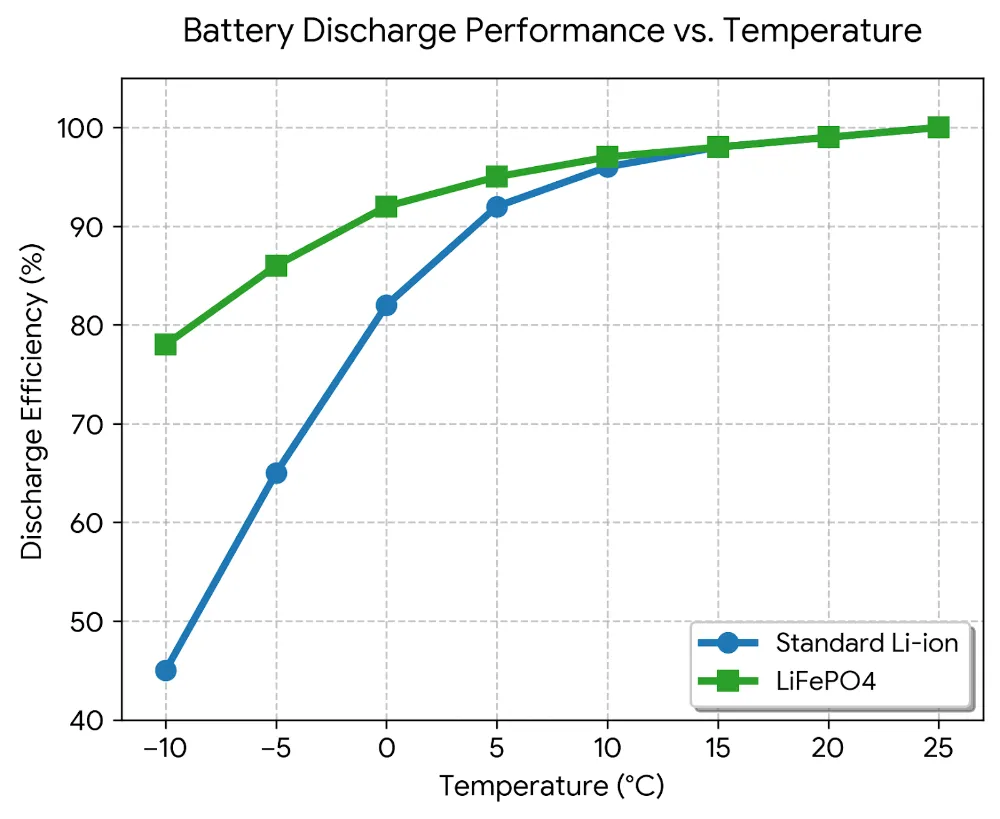
In low-temperature testing for German clients, we observed:
- LiFePO4 batteries maintain more stable discharge curves
- Better cycle life in fluctuating temperature conditions
- Lower swelling risk compared to standard Li-ion
While LiFePO4 increases BOM cost, it reduces:
- Winter return rates
- Capacity degradation complaints
- Early battery failure
For Germany-targeted SKUs, LiFePO4 is increasingly recommended for mid-to-high-end models.
Climate as a Structural Decision Factor
In summary:
- The US market prioritizes UV resistance + IP rating + price flexibility
- The German market prioritizes winter stability + glass structure + low-temp battery performance
Product structure should not be duplicated across both regions without adjustment.
In the next section, we will examine how certification, compliance standards, and regulatory frameworks further widen the gap between the US and German markets.
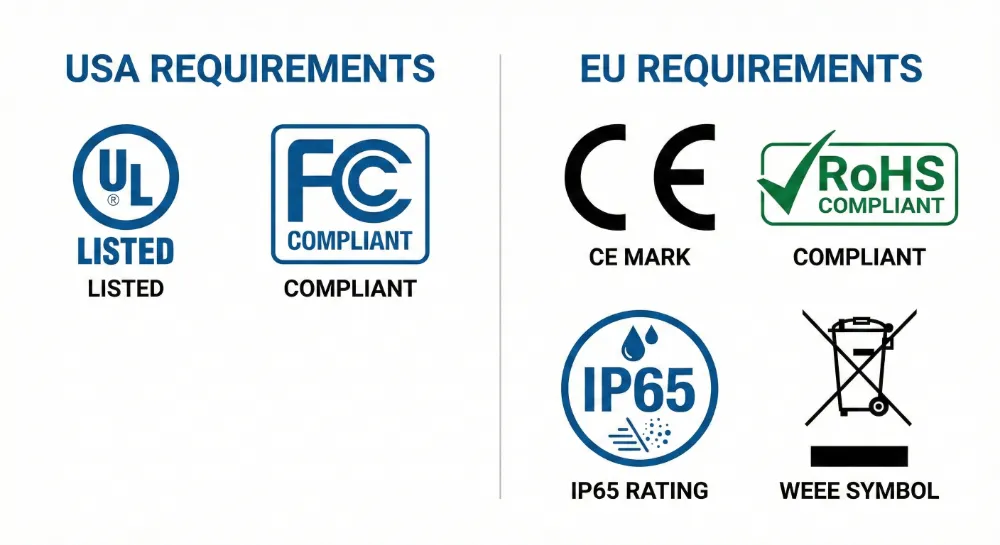
IV. Certification & Compliance Differences
Regulatory requirements are not just paperwork — they directly affect:
- Import cost
- Testing timeline
- Battery configuration
- Labeling design
- Packaging documentation
Many importers underestimate how certification structure differs between the US and Germany (EU market).
🇺🇸 United States Compliance Landscape
1. UL (Trend-Based, Not Always Mandatory)
While not all grave solar lights legally require UL listing, large retailers increasingly prefer:
- UL-certified adapters (if applicable)
- UL-recognized battery components
- Safety-tested electrical systems
For Amazon-focused sellers, UL can improve:
- Platform trust
- Reduced compliance flag risk
- Brand positioning
However, it significantly increases upfront testing cost. Learn more about our certification capabilities.
2. FCC Compliance
Because grave solar lights contain electronic control boards:
- FCC Part 15 may apply (EMI emissions)
For many low-power solar lanterns, this is relatively manageable — but still a cost layer.
3. Battery Transportation (UN38.3)
For US imports, lithium battery products must comply with:
- UN38.3 testing
- MSDS documentation
- Proper shipping labels
Battery type (Li-ion vs LiFePO4) influences testing documentation and logistics classification.
🇩🇪 Germany / EU Compliance Framework
Germany follows broader EU regulatory structure.
1. CE Marking (Mandatory)
CE is not optional — it covers:
- Electrical safety
- EMC compatibility
- Product risk assessment
Self-declaration is common, but documentation must be complete and technically defensible.
2. RoHS
Restriction of hazardous substances applies to:
- PCB components
- LED elements
- Soldering materials
This requires upstream supplier documentation. For detailed information on environmental compliance, see our RoHS certification guide for solar garden lights.
3. EMC Testing
Electromagnetic compatibility is more strictly interpreted within EU markets.
Products must avoid:
- Signal interference
- Electrical disturbance risks
4. WEEE Registration
Waste Electrical and Electronic Equipment regulations require:
- Producer registration
- Recycling compliance
- Marked labeling
This adds ongoing administrative cost.
Compliance Cost Implications
| Aspect | USA | Germany / EU |
|---|---|---|
| Certification Structure | Retail-driven (UL optional trend) | Legally structured (CE mandatory) |
| Battery Logistics | UN38.3 focus | UN38.3 + EU transport alignment |
| Recycling Responsibility | Less centralized | WEEE structured |
| Documentation Depth | Platform risk-based | Formal technical file required |
For importers, compliance differences impact:
- Testing budget
- Lead time
- Product labeling design
- Legal exposure
Based on our export experience to both US and EU markets, the EU documentation layer is typically more paperwork-intensive, while the US platform-driven compliance risk is more review-sensitive.
V. Channel Structure Comparison
Distribution channel structure strongly influences product strategy.
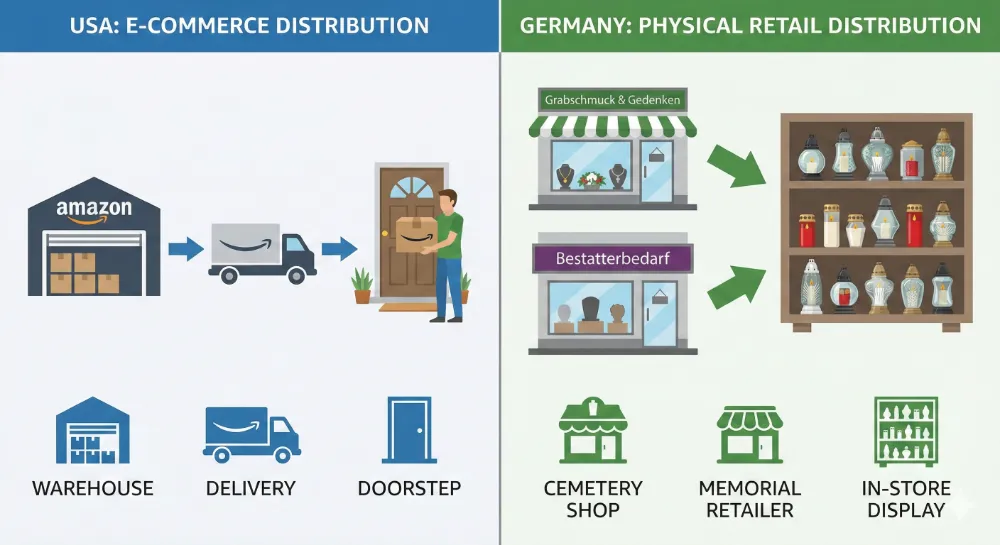
🇺🇸 United States Channel Logic
1. Amazon-Dominated Online Sales
A significant portion of grave solar light sales occur via:
- Amazon
- Walmart online
- DTC brand websites
Implications:
- SKU standardization
- Packaging optimized for parcel shipping
- Heavy emphasis on product ratings
- Price competition across tiers
Return processes are platform-controlled and customer-friendly.
2. Large Retail Chains
Some distributors supply:
- Home improvement chains
- Garden centers
- Seasonal retail programs
These buyers require:
- Volume stability
- Barcode compliance
- Consistent pallet configuration
MOQ is often higher but predictable.
🇩🇪 Germany Channel Logic
1. Physical Cemetery Shops
Many grave lanterns are sold through:
- Cemetery-adjacent stores
- Memorial specialty retailers
These buyers focus on:
- Appearance quality
- Material feel
- Brand trust
Packaging often includes:
- German-language instructions
- Local compliance markings
2. Memorial Product Wholesalers
Germany has specialized memorial distributors supplying:
- Regional funeral service providers
- Cemetery maintenance companies
This leads to:
- Smaller batch but higher-margin orders
- Longer product lifecycle
- Lower SKU turnover frequency
Channel Impact on Strategy
| Factor | USA | Germany |
|---|---|---|
| MOQ Sensitivity | Medium to high (retail scale) | Often smaller but premium |
| Packaging Focus | E-commerce optimized | Retail presentation quality |
| Price Pressure | High | Moderate |
| Product Lifecycle | Faster refresh | Longer usage cycle |
Channel structure directly shapes:
- Packaging design
- Language requirements
- SKU planning
- Inventory turnover expectations
VI. Return Rate & Risk Differences
Risk exposure differs significantly between the two markets.
🇺🇸 USA Risk Factors
1. High Platform Return Rate Risk
Amazon return policies allow:
- Easy refunds
- Customer-friendly disputes
Common return reasons:
- “Not bright enough”
- Water leakage after heavy rain
- Short runtime complaints
Even minor perception issues can generate:
- Negative reviews
- Listing ranking drops
2. IP Rating Sensitivity
If product claims IP65 but fails under heavy rain:
- Reputation damage escalates quickly
This pushes US-focused SKUs toward stronger sealing validation.
🇩🇪 Germany Risk Factors
1. Glass Breakage During Shipping
Glass-dominant structures introduce:
- Higher transit damage probability
- Packaging cost increase
Proper foam protection and drop testing are critical.
2. Winter Failure Complaints
Extended cloudy winters can cause:
- Reduced runtime
- Non-functioning units after prolonged freezing
Battery selection and charge controller stability are essential.
3. LED Color Deviation Complaints
German buyers are more sensitive to:
- Inconsistent red tone
- Flicker irregularities
Batch-level LED bin control becomes important.
Risk Control Recommendations
For USA:
- Reinforce IP sealing validation
- Provide realistic runtime claims
- Avoid exaggerated lumen marketing
For Germany:
- Upgrade packaging protection
- Consider LiFePO4 for winter SKUs
- Maintain strict LED color consistency
From a manufacturing perspective, risk reduction strategy must align with target region — not generic global design.
In the next section, we will move into strategic recommendations for importers and explore how 2026 market trends may reshape both regions.
VII. Strategic Recommendations for Importers
After analyzing culture, structure, climate, compliance, channel logic, and return risks, the key question becomes:
How should importers structure their product strategy differently for the US and German markets?
Below are practical, region-specific recommendations based on export experience to both markets.
If You Target the 🇺🇸 USA Market
1. Treat IP65 as the Practical Baseline
Even when real cemetery exposure is moderate, IP65:
- Reduces negative rain-related reviews
- Improves listing conversion rate
- Protects long-term rating performance
Sealing validation and gasket quality control should not be minimized.
2. Lead With Warm White SKUs
Warm white remains the safest mainstream choice because:
- It aligns with garden lighting trends
- It performs better visually in product photography
- It reduces LED color-related complaints
Red versions can exist, but they are niche compared to Germany.
3. Maintain Multi-Tier Product Lines
The US market supports:
- Entry-level ABS models
- Mid-range decorative versions
- Premium hybrid structures
Instead of pushing only high-end glass models, consider a tiered SKU strategy to cover price-sensitive and quality-sensitive segments simultaneously.
4. Optimize for E-Commerce Logistics
Focus on:
- Lightweight structure
- Standardized carton size
- Drop-tested packaging
- Clear runtime communication
Avoid exaggerated lumen or runtime claims that may lead to review backlash.
If You Target 🇩🇪 Germany Market
1. Reinforce Glass Structure Integrity
Because glass is common:
- Use thicker wall glass when possible
- Strengthen metal frame joints
- Upgrade internal fixing structure
Packaging protection must be stronger than US plastic SKUs.
2. Offer Red LED Options
Red LED remains culturally relevant.
If you only offer warm white, you may miss a key segment.
Dual-version strategy is recommended:
- Red (traditional)
- Warm white (modern)
3. Consider LiFePO4 for Mid-to-High-End SKUs
For German winters:
- LiFePO4 improves low-temperature stability
- Reduces winter failure complaints
- Extends lifecycle expectations
While BOM increases, it aligns with Germany’s durability-focused buying logic.
4. Invest in Better Winter Performance Testing
Testing should include:
- Sub-zero discharge simulation
- Low-light charging efficiency validation
- Moisture ingress stress tests
In our low-temperature testing for German clients, runtime stability in January conditions became a decisive purchasing factor.
One Market, Two Strategies
Attempting to unify US and German product structures into one identical SKU often results in:
- Over-engineering for one market
- Under-performance in the other
- Misaligned pricing
Strategic differentiation improves:
- Margin control
- Risk management
- Channel alignment
VIII. 2026 Outlook: Where Are These Markets Heading?
Market behavior is not static. Based on recent buyer inquiries and product evolution trends, several directional shifts may occur.
🇩🇪 Will Germany Fully Transition to IP65?
Historically, IP44 was common for sheltered cemetery lanterns.
However:
- Increased consumer awareness
- Online review influence
- Climate unpredictability
May push more mid-range products toward IP65 by 2026.
This does not eliminate glass preference — but sealing standards will likely strengthen.
🇺🇸 Will the US Market Increase Battery Capacity Expectations?
We are observing:
- More Amazon listings highlighting 15+ hour runtime
- Increased competition around battery mAh numbers
This may lead to:
- Larger nominal capacity claims
- Higher emphasis on perceived endurance
However, without structural improvement, capacity inflation may increase return risk.
Will Glass Be Replaced by High-End Polymer?
In Germany, glass currently dominates mid-to-high-end positioning.
Potential future shift:
- UV-resistant premium polymers mimicking glass appearance
- Lighter structures with lower breakage rate
Whether consumers accept this substitution depends on:
- Visual authenticity
- Perceived dignity
- Retail education efforts
Will Red LED Remain Dominant in Europe?
Red LED is culturally rooted, but gradual modernization may increase:
- Warm white adoption
- Candle-simulation amber tones
However, full replacement is unlikely in the near term.
Traditional symbolism remains strong in many regions.
IX. Glowyard’s Cross-Market Manufacturing Experience: What 15 Years of Exporting Has Taught Us

At Glowyard Lighting, we’ve been manufacturing and exporting solar garden lights since 2011. Over the past 15 years, we’ve shipped grave solar lights to both US and European markets — and we’ve learned that successful cross-regional sourcing isn’t about finding one "universal" product. It’s about understanding how design decisions cascade into real-world performance.
What We’ve Observed Across US and EU Projects
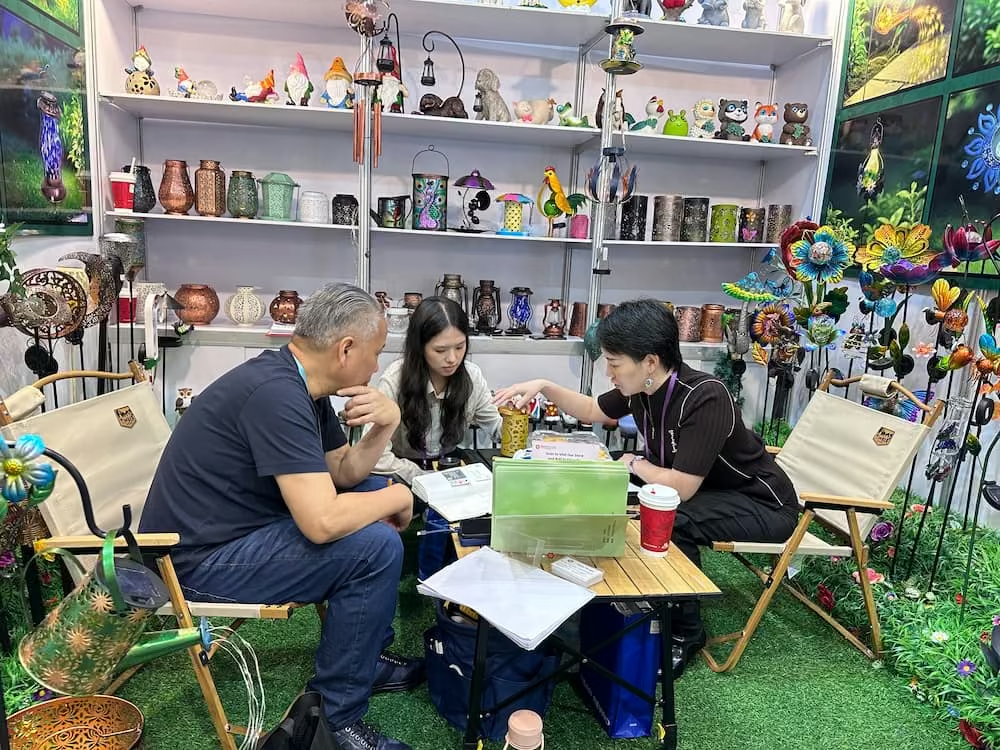
When working with US distributors, the conversation typically centers on:
- Sealing validation: Even minor IP rating failures generate disproportionate review damage on Amazon
- Packaging optimization: Dimensional weight pricing makes every centimeter count for e-commerce shipping
- Runtime claims: Buyers are increasingly skeptical of exaggerated specifications
- Color consistency: Warm white must photograph well across different lighting conditions
For European clients — particularly those serving German, Austrian, and Swiss markets — the priorities shift:
- Winter reliability: Products must function predictably through extended cloudy periods
- Material authenticity: Glass and metal aren’t just aesthetic choices; they signal permanence
- LED tone accuracy: Red LED batch variation becomes a quality control issue
- Long-term durability: The expectation is multi-year outdoor use, not seasonal replacement
A Testing Experience That Changed Our Approach
A few years ago, we ran comparative low-temperature discharge tests at our Fujian facility for a Central European distributor. The client had received winter complaints about shortened runtime — not complete failure, but inconsistent performance below 0°C.
What our R&D team discovered:
- Standard Li-ion batteries showed 30-40% capacity drop in sub-zero conditions
- LiFePO4 maintained more stable discharge curves, even at -10°C
- The issue wasn’t nominal capacity (both were 1200mAh) — it was discharge efficiency under stress
This led us to recommend LiFePO4 for Germany-targeted mid-range SKUs, despite the BOM increase. The result: winter return rates dropped significantly, and the distributor expanded their order volume the following season.
This experience reinforced something we now apply across all our European grave light projects: winter stability matters more than peak capacity numbers.
To understand how different materials are manufactured, explore our detailed guides on plastic lights manufacturing, glass lights manufacturing, and metal lights manufacturing.
What This Means for Importers Working with Us
From our 15 years of manufacturing experience, the most successful partnerships are with importers who:
- Accept regional differentiation — trying to force one SKU across both markets usually creates compromise products that underperform in both
- Invest in appropriate testing — IP validation for US, low-temperature testing for EU
- Understand channel dynamics — Amazon return policies vs. European specialty retail have fundamentally different risk profiles
- Communicate realistic specifications — exaggerated claims create short-term sales but long-term reputation damage
The grave solar light category is unique because it sits at the intersection of:
- Emotional memorial culture
- Outdoor durability requirements
- Price-sensitive retail competition
- Regulatory compliance complexity
Getting it right requires more than just sourcing the cheapest unit. It requires understanding how cultural expectations, climate realities, and channel structures shape what "quality" actually means in each market.
Our manufacturing philosophy: Market-specific engineering decisions reduce long-term risk more effectively than universal design simplification. This isn’t just theory — it’s what we’ve learned from years of post-shipment feedback, return data analysis, and client conversations across both continents.
With production facilities in both Fujian and Guangdong, an R&D team of 15-20 engineers, and annual capacity exceeding 600,000 units, Glowyard has the infrastructure to support region-specific customization without sacrificing efficiency. But more importantly, we have the experience to know when that customization actually matters.
For more insights into the memorial solar lights industry, including market trends and buyer behavior analysis, refer to our comprehensive 2025 Memorial Solar Lights Industry White Paper.
X. Final Takeaway
The US and German grave solar light markets may appear similar at surface level, but they differ fundamentally in:
- Cultural expectation
- Material preference
- Climate exposure
- Compliance structure
- Channel dynamics
- Risk sensitivity
For importers, understanding these structural differences enables:
- Better SKU planning
- More accurate cost forecasting
- Lower return exposure
- Stronger long-term positioning
In cross-regional sourcing, adaptation is not optional — it is strategic necessity.
To explore our full range of solar powered memorial lights and discuss region-specific customization options, contact our team for a consultation.

![do solar lights work in winter at cemeteries [2026 guide]](https://glowyard.com/wp-content/uploads/2026/03/Do-Solar-Lights-Work-in-Winter-at-Cemeteries-2026-Guide.webp)