How Battery Choice Affects Solar Light Runtime (B2B Guide)
For B2B buyers, runtime is not a marketing number — it is a project risk indicator.
When outdoor solar lights fail to stay on through the night, the consequences are rarely minor:
- maintenance visits increase
- customer complaints appear faster
- dark spots affect perceived quality and safety
- replacement cost rises
- brand trust drops over time
Yet many product sheets still promote “10–12 hours runtime” without explaining:
- under what charging condition?
- at what brightness level?
- in which temperature?
- after how many cycles?
- with how much rainy-day reserve?
This guide explains how battery choice directly affects real night runtime, long-term stability, and the risk profile of outdoor solar lighting projects.
Quick answer
If runtime stability matters more than the lowest initial cost, battery chemistry matters as much as battery size.
In most year-round outdoor applications:
- LiFePO4 usually offers the strongest long-term runtime stability
- Lithium-ion can work well in mid-range projects with enough energy margin
- NiMH is better suited to lower-power or shorter-lifecycle products
- Lead-acid is now rare in compact outdoor solar lights
Runtime Is Not the Same as Battery Capacity
Many sourcing conversations begin with one question:
“What is the battery capacity?”
But capacity alone does not determine real night runtime.
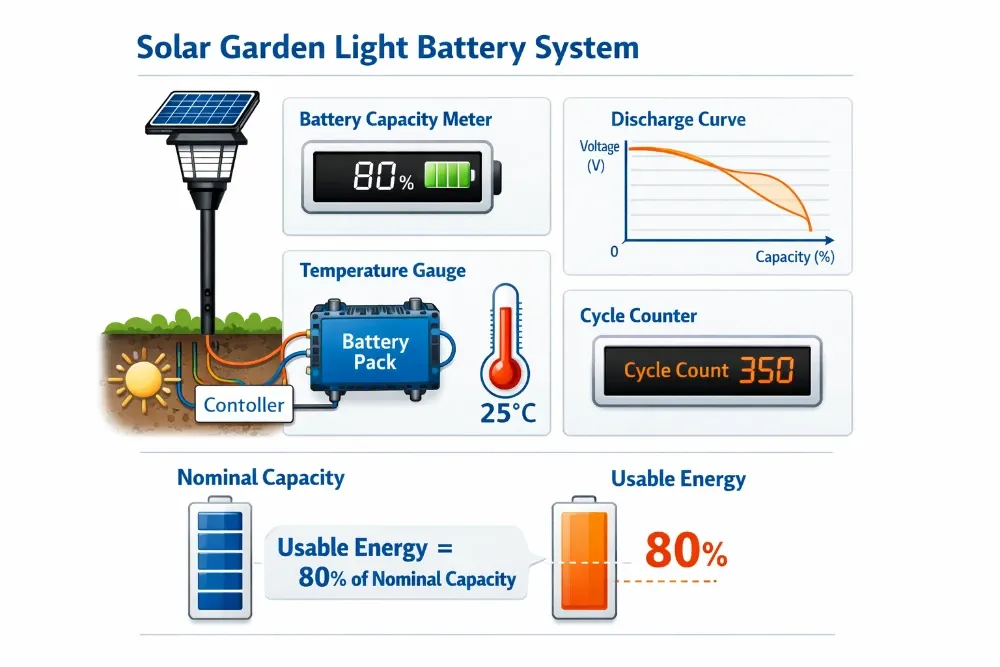
In practice, runtime is shaped by five interacting variables:
- Battery chemistry
- Usable depth of discharge
- Temperature performance
- Cycle degradation rate
- Energy management strategy
That is why two products with the same advertised mAh can perform very differently outdoors.
Nominal Capacity vs Usable Energy
A common procurement mistake is comparing batteries only by labeled capacity.
For example:
- Battery A: 6000mAh (Li-ion)
- Battery B: 6000mAh (LiFePO4)
They may look identical on paper, but they differ in:
- voltage platform
- usable discharge range
- discharge curve shape
- degradation behavior
- thermal stability
So the real equation is closer to this:
Usable Energy × System Efficiency ÷ Load Power = Real Runtime
Light color and mode design can also influence perceived runtime, especially for RGB or multi-color solar lights. For sourcing decisions beyond battery capacity, see our warm white vs cool white vs RGB solar light selection guide.
For B2B buyers, the question is not “how large is the battery?” but:
How much stable energy is still usable after months of outdoor cycling?
Why Day-One Runtime Is a Weak Metric
Most suppliers test runtime:
- at full charge
- at room temperature
- under ideal sunlight
- with fresh batteries
That tells you very little about real outdoor performance after six months, one winter, or one rainy season.
Better questions are:
- What is runtime after 300 cycles?
- What is runtime at 0°C?
- What happens after two cloudy days?
- What is the pass rate across 20 tested units?
In outdoor projects — especially for decorative garden lights, cemetery and grave lights, seasonal products, and wider outdoor installations — the key metric is not peak runtime on a fresh unit.
It is:
Consistent full-night performance across seasons
Which Battery Chemistry Delivers More Stable Night Runtime?
Not all batteries are optimized for the same goal.
Some are chosen for low initial cost.
Some for compact size.
Some for longer cycle life and better runtime retention.
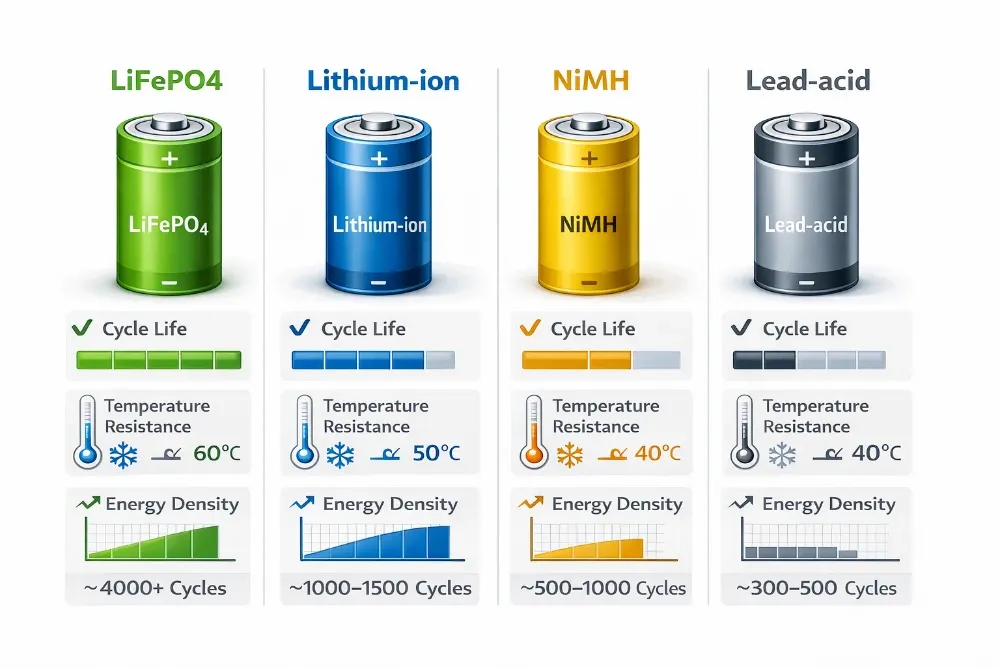
Battery chemistry comparison for runtime-focused buying
| Battery Type | Typical Cycle Life | Runtime Stability Over Time | Heat Tolerance | Rainy-Day Resilience | Best Fit |
|---|---|---|---|---|---|
| LiFePO4 | 2000–4000+ | High | Strong | Strong | long-life outdoor projects |
| Lithium-ion | 800–1500 | Moderate | Medium | Moderate | mid-range outdoor programs |
| NiMH | 500–800 | Lower | Moderate | Lower | decorative / entry-level lines |
| Lead-acid | 300–500 | Low | Weak | Weak | larger legacy systems only |
For a broader chemistry comparison, see our guide to Lithium vs NiMH vs NiCd batteries.
The gap between lithium-based systems and NiMH is not just theoretical. It also broadly matches the pattern discussed in Moreno et al.’s photovoltaic battery behavior study, which compared Li-ion and NiMH behavior under isolated solar charging conditions.
LiFePO4: Best for Long-Term Runtime Stability
LiFePO4 usually performs best when the priority is stable runtime over years, not just good first-month performance.
Why buyers prefer it:
- flatter discharge curve
- better cycle stability
- stronger thermal safety
- higher usable energy in daily cycling
- lower long-term maintenance pressure
This makes it especially suitable for:
- decorative garden lights expected to stay outdoors season after season
- cemetery and grave lights that must remain dependable in winter
- year-round outdoor products sold on quality and reliability
- larger project installations where replacement is expensive
Lithium-ion: Strong Day-One Runtime, More Sensitive Over Time
Lithium-ion can deliver very good runtime in compact products and often helps with:
- smaller battery pack size
- higher energy density
- better design flexibility
- balanced cost-performance in mid-range products
But compared with LiFePO4, it is usually more sensitive to:
- heat
- deeper discharge stress
- faster visible aging in under-designed systems
In other words, lithium-ion can still be an excellent choice — but only when the product has enough runtime margin from the start.
NiMH: Acceptable for Lower-Power or Shorter-Lifecycle Use
NiMH still works in some lower-power outdoor solar products, especially where:
- cost matters more than long-term stability
- the lighting load is light
- the product is seasonal
- replacement cycles are accepted
But for daily outdoor use, NiMH typically shows:
- faster runtime decline
- higher self-discharge
- weaker resilience after cloudy periods
- less stable winter performance
That is why it is usually a weaker fit for engineered B2B projects.
Lead-Acid: Rare in Compact Outdoor Solar Lights
Lead-acid still exists in some larger systems, but for compact outdoor solar lights it is increasingly outdated.
Its drawbacks are familiar:
- bulky size
- deeper discharge sensitivity
- heavier weight
- faster decline under daily cycling
For most decorative and compact outdoor lighting products, it is no longer the preferred direction.
What Buyers Should Ask Suppliers to Prove Runtime Claims
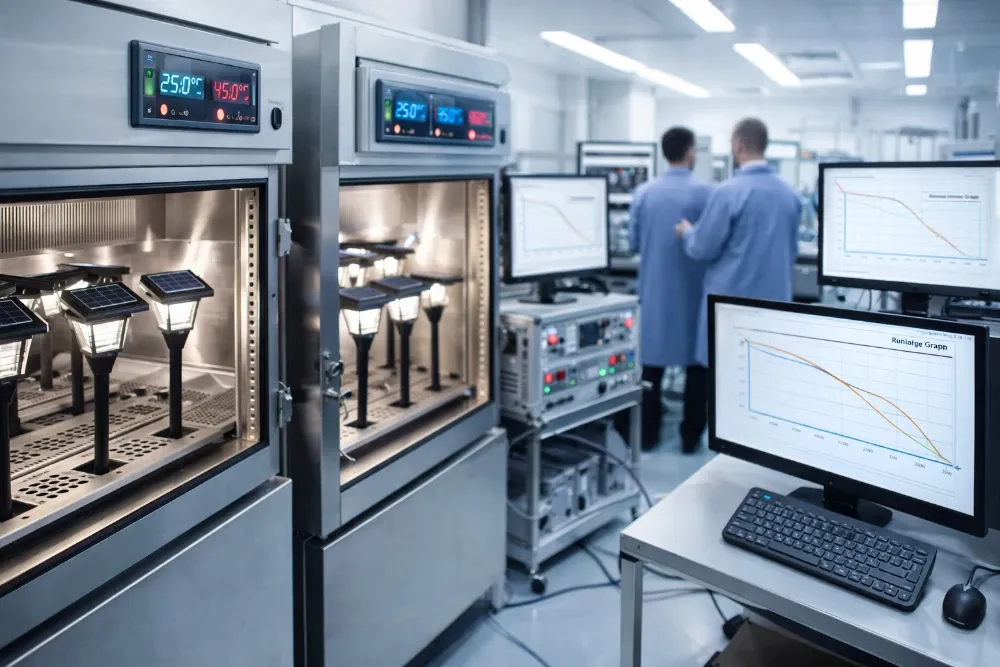
A runtime claim should never stand alone.
“12 hours runtime” is not enough unless the supplier also defines:
- charging input condition
- brightness level
- test temperature
- battery chemistry
- sample size
- runtime after aging
For lithium-based outdoor solar lights, buyers should also confirm whether the battery system is documented against relevant safety and transport paperwork tied to IEC 62133-2 and UN 38.3-related lithium battery test summaries. For nickel-based rechargeable systems, IEC 62133-1 is also a useful checkpoint when reviewing supplier files.
Minimum runtime data a professional supplier should provide
1. Full-night lighting pass rate
Not just the best unit.
Ask how many units actually meet the target runtime.
Example:
- target runtime: 10 hours
- tested units: 20
- units passing: 18
- pass rate: 90%
That tells you much more than one ideal result.
2. Consecutive cloudy-day autonomy
Outdoor solar lights are rarely used under perfect sunshine every day.
Ask for:
- reduced-charge simulation
- rainy-day autonomy
- minimum runtime after partial recharge conditions
3. Low-temperature runtime retention
A system that runs 10 hours at 25°C may fall well below that in cold weather.
For year-round products, ask for runtime at:
- 0°C
- -5°C
- -10°C when relevant
4. Aging simulation
This is one of the most useful B2B filters.
Ask for:
- runtime after 300 cycles
- runtime after 500 cycles
- capacity retention curve
- estimated runtime after 24 months
Example of a useful runtime validation summary
| Metric | Example Result |
|---|---|
| Initial runtime at 25°C | 11.5 hours |
| Runtime after 300 cycles | 10.4 hours |
| Runtime after 500 cycles | 9.6 hours |
| Runtime at 0°C | 9.2 hours |
| Full-night pass rate (n=20) | 95% |
| Rainy-day autonomy | 2.5 nights |
This table shows the level of detail buyers should request — not a universal benchmark for every product.
Why batch consistency matters more than peak runtime
Outdoor lights are rarely installed one by one.
They are installed in:
- gardens and patios
- cemeteries and memorial spaces
- residential communities
- seasonal display programs
- wider outdoor projects
If some units turn off earlier than others, customers do not care what the best unit achieved in a lab.
They notice:
- dark gaps
- visible inconsistency
- early shutdown complaints
- maintenance cost
That is why buyers should ask for:
- minimum observed runtime
- average runtime
- standard deviation
- pass-rate threshold
If you are troubleshooting field failures rather than selecting a new platform, our article on 4 Most Common Battery Issues in Solar Garden Lights is the most natural follow-up read.
What Runtime Targets Make Sense for Different Outdoor Applications?
A useful mistake to avoid is applying the same runtime expectation to every product type.
Different outdoor-light applications require different margins.
Suggested runtime targets by application
| Outdoor Application | Typical Runtime Target | Suggested Reserve / Autonomy | Battery Preference |
|---|---|---|---|
| Decorative garden and patio lights | 8–10 h | 1–2 nights | Lithium-ion / LiFePO4 |
| Cemetery and grave lights | 10–12 h | 2–3 nights | LiFePO4 preferred |
| Seasonal holiday outdoor lights | 6–8 h | 1–2 nights | NiMH or Lithium-ion |
| Outdoor wall lights and lanterns | 8–10 h | 1–2 nights | Lithium-ion / LiFePO4 |
| Pathway or landscape projects | 10–12 h | 2 nights | LiFePO4 preferred |
This is one reason why a runtime article should not stay trapped inside “garden lights” only. The logic of runtime stability applies across multiple outdoor categories, but the buying priority changes by application.
For decorative assortment planning, Decorative Garden Lights is the most natural product-direction page behind this topic.
For year-round remembrance products, runtime becomes even more sensitive because winter, shade, and long-term exposure quickly expose a weak battery system. That is why Grave & Cemetery Solar Lights is a natural secondary destination for this article.
This topic can also matter for holiday programs, especially when battery-related complaints appear during a short peak sales window. In that context, a lighter supporting direction is Holiday Solar Lights Manufacturer.
What Real Projects Usually Teach
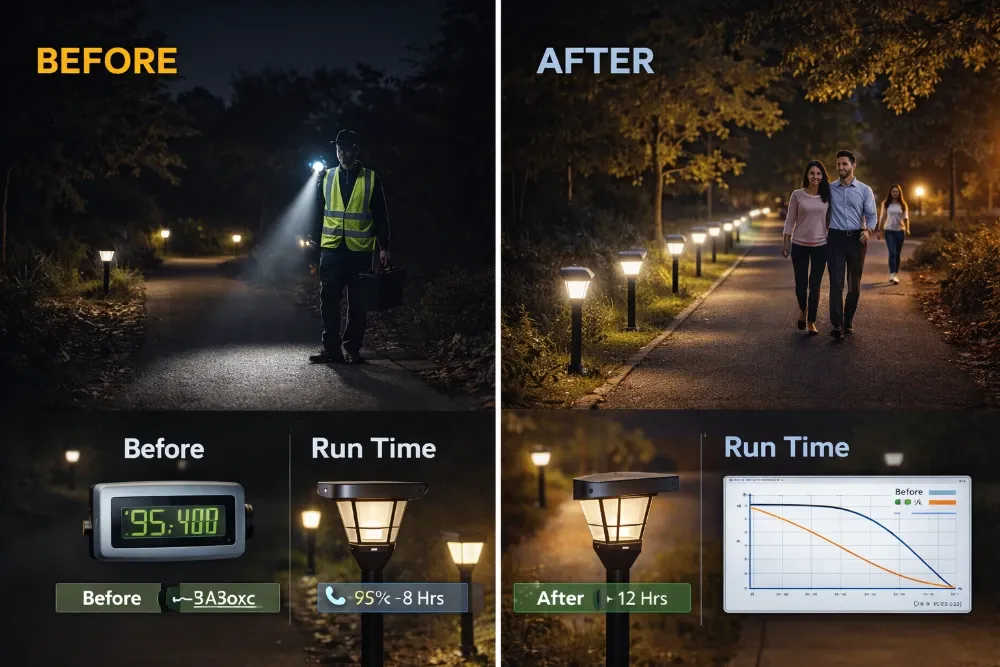
Across outdoor solar lighting projects, the same patterns appear again and again.
In decorative garden and cemetery products, runtime problems are often noticed very quickly because early shutoff and visible inconsistency are easy for end users to see in daily use.
Typical project patterns
| Situation | What Usually Goes Wrong | Better Strategy |
|---|---|---|
| Decorative garden products with low energy margin | noticeable dimming and shorter runtime after 1–2 seasons | use more stable chemistry and allow margin for aging |
| Cemetery products in winter or shade | overnight performance drops below expectation in cold or low-charge periods | prioritize LiFePO4 and test low-temperature retention |
| Seasonal outdoor lines | returns spike when batteries underperform during peak season | balance price with realistic seasonal runtime needs |
| Pathway or larger outdoor projects | inconsistency across units creates visible dark gaps | validate pass rate and batch consistency, not just peak runtime |
The most common lesson
The products that age well are rarely the ones designed to the bare minimum.
They are the ones designed with margin for:
- degradation
- low temperature
- cloudy days
- batch variation
- real usage conditions
That principle matters more than any single headline capacity figure.
The Most Common Procurement Mistakes That Shorten Runtime
1. Choosing by mAh alone
Capacity is useful, but without chemistry context and usable energy, it can be misleading.
2. Ignoring cycle aging
A battery that performs well on day one may not meet the same runtime after a year of daily charging.
For the broader lifespan view, see How Long Do Solar Batteries Last.
3. Underestimating charging conditions
Shading, winter, dust, and long cloudy stretches all affect usable runtime.
A good supporting article here is How to Charge Solar Lights Without Sunlight.
4. Forgetting waterproof system design
Runtime can also collapse when water ingress damages the battery compartment, controller, or connectors.
That is why battery selection should be evaluated together with sealing and protection level. See IP44 vs IP65 vs IP67.
5. Designing to the minimum requirement
This is probably the most expensive mistake of all.
Products fail not because the battery was totally wrong on day one, but because there was no margin for aging and weather variation.
FAQ: Battery Runtime for Outdoor Solar Lights
How many hours of runtime should B2B buyers target?
For most products:
- decorative garden and patio use: 8–10 hours
- cemetery and memorial use: 10–12 hours
- seasonal holiday use: 6–8 hours
- broader project or pathway use: 10–12+ hours with reserve
Is LiFePO4 always better than lithium-ion?
Not always.
LiFePO4 is usually better for:
- longer product life
- stronger cycle stability
- lower long-term risk
Lithium-ion can still be a strong option when:
- space is limited
- the product is mid-range
- the system has enough runtime margin
How many cloudy days should a solar light survive?
That depends on the application, but as a rough buying rule:
- decorative garden products: 1–2 nights
- cemetery and memorial products: 2–3 nights
- seasonal holiday lines: 1–2 nights
- larger outdoor projects: 2 nights or more
What supplier data matters most?
Ask for:
- sample size
- full-night pass rate
- low-temperature runtime
- cycle-aging runtime
- cloudy-day autonomy
- battery chemistry details
If the supplier gives only one “maximum runtime” number, the data is incomplete.
A Manufacturer’s View
At factory level, battery choice affects far more than runtime on paper.
It also affects:
- battery compartment size
- PCB matching
- charging strategy
- rainy-day reserve
- long-term replacement rate
- how the product is perceived after one winter outdoors
At Glowyard, we look at runtime as a system outcome, not a single battery number. The right chemistry still needs the right panel, controller, waterproofing, and energy margin to perform well in real installations.
As an outdoor lighting manufacturer, we usually see the biggest runtime differences show up first in decorative garden assortments and cemetery products, because those are the categories where visual consistency and overnight reliability are easiest for customers to notice.
Conclusion
Night runtime is not just a battery specification.
It is the result of:
- battery chemistry
- usable energy design
- temperature behavior
- cycle degradation
- charging conditions
- system efficiency
For B2B buyers, the real question is not:
“How long does this light run on day one?”
It is:
“Will this product still meet real night-performance requirements after months of outdoor use?”
When runtime is treated as a long-term performance decision — not a marketing claim — outdoor solar lighting projects become easier to scale, easier to maintain, and far less risky.
For your current site structure, that decision matters most where product expectations are highest: decorative garden lines first, cemetery and grave products second, seasonal holiday programs third, and broader project scenarios after that.
Related Reading
- Lithium vs NiMH vs NiCd batteries
- 4 Most Common Battery Issues in Solar Garden Lights
- How Long Do Solar Batteries Last
- How to Charge Solar Lights Without Sunlight
- Do Solar Lights Work in Winter at Cemeteries?
- How To Choose Solar Lights for Cemeteries with Trees, Shade, or Limited Sunlight?
- IP44 vs IP65 vs IP67


![do solar lights work in winter at cemeteries [2026 guide]](https://glowyard.com/wp-content/uploads/2026/03/Do-Solar-Lights-Work-in-Winter-at-Cemeteries-2026-Guide.webp)