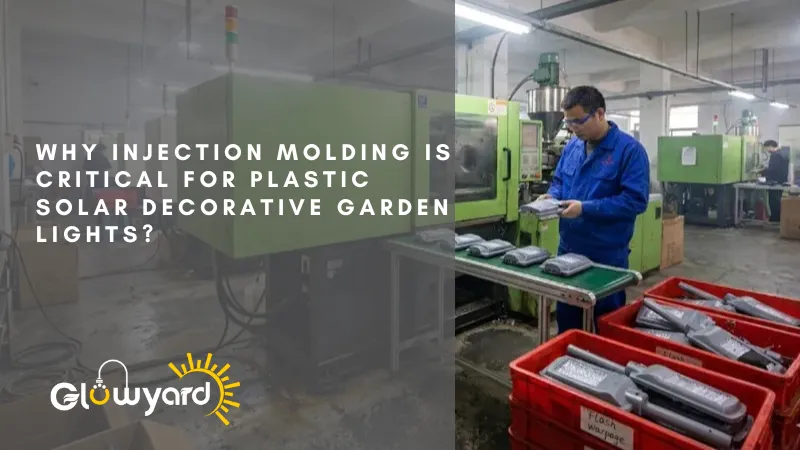
Why Injection Molding Is Critical for Plastic Solar Decorative Garden Lights
When people talk about solar decorative garden lights, they often focus on design, lumen output, or battery capacity. In actual production, however, injection molding quality is just as important as the electronics—especially for plastic housings.
Over the past 10+ years producing plastic solar garden lights for overseas brands, we have seen the same pattern again and again: when injection molding is well designed and well controlled, everything else in the project becomes easier—IP performance, appearance consistency, assembly efficiency, and even after-sales stability.
At the same time, the outdoor solar LED market continues to expand. In a fast-growing and increasingly competitive market, weak molding control can quietly erode profit, raise defect rates, and damage brand reputation long before the issue is obvious in the field.
A Brief History and Global Market of Injection Molding
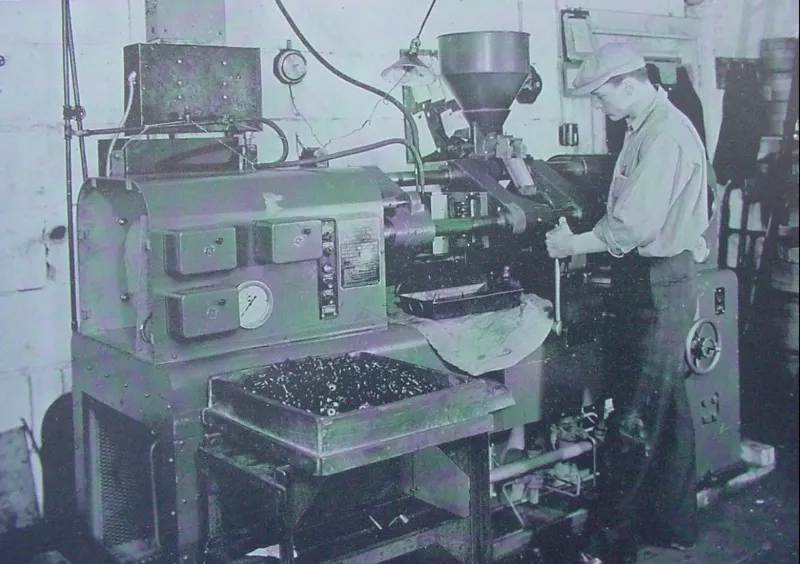
A short history of plastic injection molding
From an industry history perspective, plastic injection molding is not a new technology. According to historical overviews from technical sources such as Xometry and New Berlin Plastics, the first recognizable injection molding machine was patented in 1872 by brothers John Wesley Hyatt and Isaiah Hyatt in the United States. Their early machines used a simple heated cylinder and plunger to process celluloid.
In the 1930s–1940s, engineers like James Watson Hendry introduced the first screw-type injection molding machines, which allowed much more precise control over melting, mixing and injection. After the Second World War, the rapid development of new thermoplastics and automation made injection molding one of the dominant methods for producing plastic parts in consumer goods, automotive, appliances and electronics.
In our own projects, we feel the benefit of this long evolution every day: modern machines and controls make it possible to repeat the same housing design hundreds of thousands of times with very tight tolerances, as long as the tooling and process are engineered correctly.
Key milestones in plastic injection molding history (overview):
- 1872 – First injection molding machine patented by John and Isaiah Hyatt (celluloid processing).
- 1930s–1940s – Screw-type injection molding machines introduced (James Watson Hendry).
- Post-1945 – Rapid expansion with new thermoplastics and automation.
- 2000s–2020s – Widespread use across consumer goods, automotive, electronics and lighting.
Global market size and growth
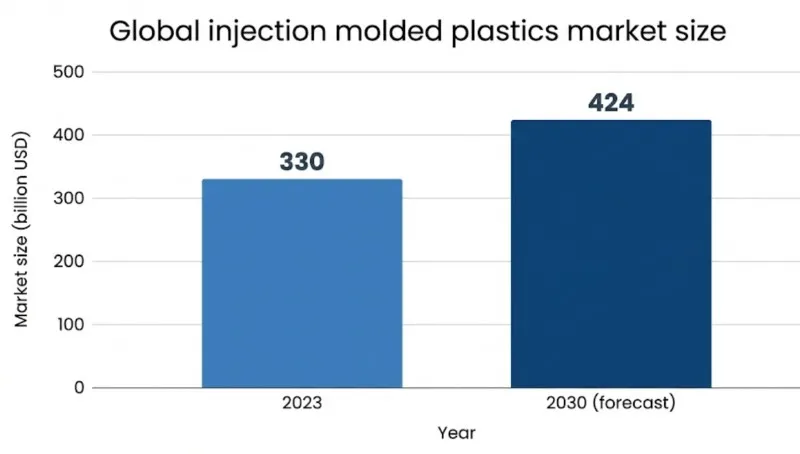
Beyond solar lighting, injection molded plastics are a massive global industry in their own right. Grand View Research estimates that the global injection molded plastics market was worth around USD 330 billion in 2023, and is projected to reach approximately USD 424 billion by 2030, growing at a CAGR of about 3–4% from 2024 to 2030.
This scale matters for buyers of solar garden lights for two reasons:
- Injection molding benefits from huge economies of scale in materials, machines and know-how.
- Continuous investment from automotive, packaging and consumer goods industries keeps pushing the technology forward, and lighting manufacturers can leverage these advances.
When we design a new plastic housing for a solar decorative light, we are standing on more than a century of accumulated process development and a global industry worth hundreds of billions of dollars.
Why Chinese injection molding is widely chosen
According to industry statistics compiled by Statista, China has been the world’s largest producer of plastic materials for years, accounting for roughly one-third of global plastic materials production in the late 2010s and early 2020s. Separate analyses of China’s plastics and injection molding sector also highlight that the country hosts tens of thousands of plastics and plastic products manufacturers, supported by a dense network of material suppliers and machine builders.
Based on both public data and our direct experience working with Chinese injection partners, buyers tend to choose China for plastic housings for three main reasons:
- Scale and ecosystem – A very large base of plastics processors and mold makers, plus local producers of injection molding machines and auxiliary equipment, creates strong cost and lead-time advantages.
- Experience with consumer goods and lighting – Many factories have decades of experience making small to medium-sized decorative parts, including housings, stakes, and diffusers similar to those used in solar garden lights.
- Flexibility on volume and customization – Because of the depth of the ecosystem, it is often easier to find partners in China who can balance custom designs with realistic MOQs and competitive pricing.
From Glowyard’s perspective, this is why we adopt an asset-light, R&D-heavy model: we keep design, SMT, assembly, and QC in our own hands, while leveraging specialized Chinese injection molding partners for high-quality housings. This combination lets us focus on value-adding engineering while still benefiting from the country’s mature injection molding supply chain.
What Injection Molding Really Does for a Solar Garden Light

From the outside, a plastic solar decorative light looks simple: a body, a lens or diffuser, a stake, and maybe a decorative top. Inside the factory, the plastic housing is doing much more than just “holding the parts together”.
From our injection molding projects for plastic solar lights, we see that a good housing must:
- Provide mechanical strength so the product survives shipping, installation, and outdoor use.
- Protect internal electronics against water and dust ingress.
- Maintain appearance quality (gloss, colour, texture) over years of UV exposure.
- Ensure dimensional accuracy so snap-fits, screws, and seals align at assembly.
Injection molding is the process that decides whether the housing can deliver all of these at the same time, at scale.
Factory experience: Whenever we trace high defect rates or unstable IP performance back to the root cause, more than half of the time the real issue is related to tooling design or injection process control, not just “bad workers on the line”.
How Plastic Solar Light Housings Are Made
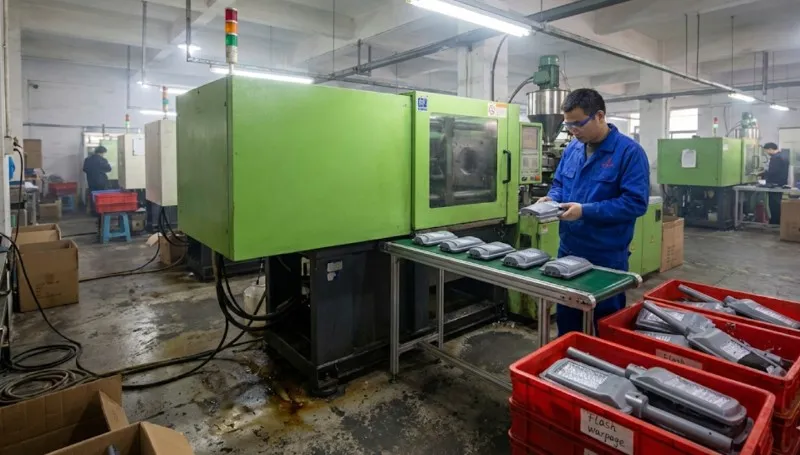
Plastic housings for solar garden lights are typically produced by injection molding. A simplified process looks like this:
- Part and mold design – engineers design the housing with draft angles, ribs, wall thickness, and sealing features that are suitable for molding and assembly.
- Tooling fabrication – a steel mold is built with cavities, runners, sprues, and cooling channels.
- Injection molding – plastic granules are melted and injected into the mold under controlled temperature, pressure, and time.
- Cooling and ejection – the part cools inside the mold and is ejected by pins or other mechanisms.
- Trimming and inspection – gates, flash, and minor defects are removed, and the part is checked.
Glowyard focuses on high-value steps such as R&D, SMT, assembly, and QC, while injection molding is handled via strategic partners that specialise in this process. However, we treat their machines and molds as an extension of our own factory: design reviews, parameter windows, and quality standards are defined together.
If you want to see how molded housings connect with incoming materials, assembly, testing, and final packing, you can also review our Plastic Lights Production Process.
What Can Go Wrong When Injection Molding Is Weak
When injection molding is not handled professionally, solar decorative garden lights may look fine in the catalogue but fail in the field.
Typical defects we see in plastic solar housings
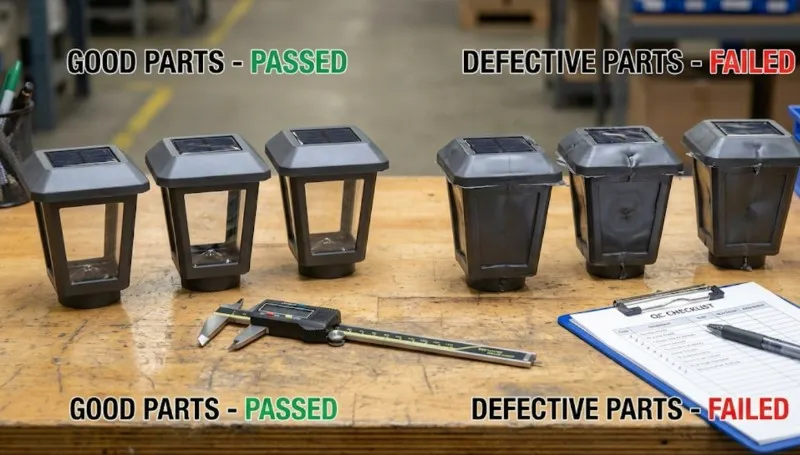
- Flash and burrs – thin layers of excess plastic along parting lines, making assembly difficult and sometimes creating potential water paths.
- Short shots – incomplete filling, especially on thin ribs or corners.
- Sink marks & warpage – uneven cooling or poor design causing dents and distortion.
- Stress whitening and cracks – from aggressive demoulding, poor material, or incorrect processing.
- Dimensional drift – housing and mating parts do not fit properly after a few thousand shots.
These issues are not only cosmetic. They directly impact waterproof performance, structural stability, and assembly cost.
Example: How process optimisation changes defect rate
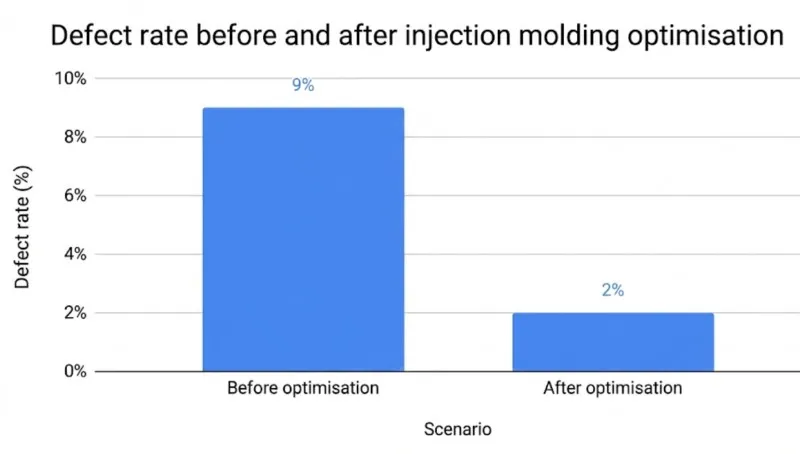
In one series of decorative solar garden lights, we helped an OEM client optimise injection molding for the plastic stake and housing. Before optimisation, the main issues were warpage and loose fit at the joint.
We re-analysed the part and mold, adjusted gate position, and refined injection and cooling parameters. Internally, our before/after defect rates looked like this:
Example: defect rate before vs after optimisation (internal data)
| Scenario | Defect rate (%) |
|---|---|
| Before optimisation | 9 |
| After optimisation | 2 |
This is only one internal example, but it reflects a common pattern: once injection molding is stabilised, quality issues across the line drop sharply.
Injection Molding and Outdoor Durability
For outdoor solar decorative lights, plastic is constantly exposed to UV, temperature changes, and humidity. Even if the electronics are well designed, poor injection molding can make the product fail early.
Wall thickness, ribs, and UV ageing
From our projects, we have learned:
- Over-thick sections tend to sink and crack under temperature cycles.
- Too thin sections become fragile and vulnerable to impact or stress.
- Properly designed ribs and bosses support structure without creating stress concentration.
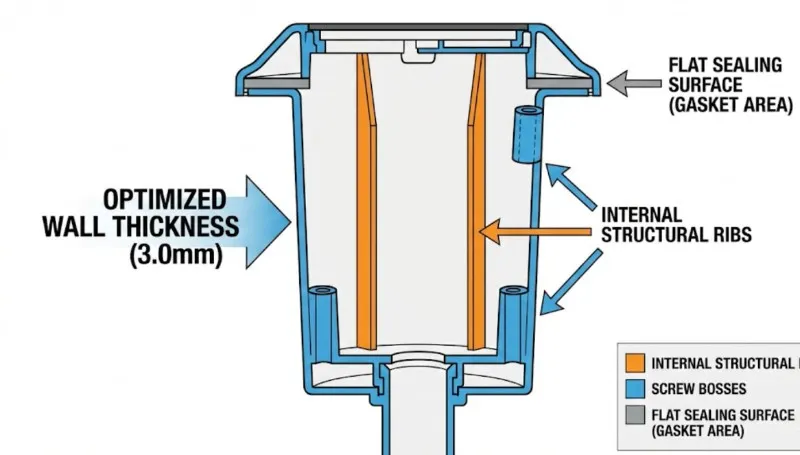
Injection molding is the stage where these structural details are firmly locked into repeatable mass production.
For readers who want to go deeper into outdoor ageing performance, we also recommend:
- UV-Stabilized vs Regular Plastic
- How to Improve the Durability of Plastic in Solar Garden Lights Under Outdoor Sun Exposure
How housings support waterproof design
Waterproofing in solar garden lights (IP44, IP65, etc.) depends heavily on:
- flat, dimensionally stable sealing surfaces
- consistent groove and gasket geometry
- correct snap-fit or screw compression around sealing lines
Poor injection molding can warp sealing surfaces, misalign screw bosses, and reduce gasket compression. In practice, we see this directly in IP-related checks: products with unstable molding performance usually need more rework during assembly and still tend to show less consistent sealing results in random sampling. If you want a broader view of how enclosure quality affects protection level, see our guide to IP44 vs IP65 vs IP67.
Why Injection Molding Matters for Cost, MOQ, and Lead Time
From a buyer’s perspective, injection molding may feel like a one-time upfront cost. In reality, it influences almost every unit cost component.
Cost structure: where injection molding sits
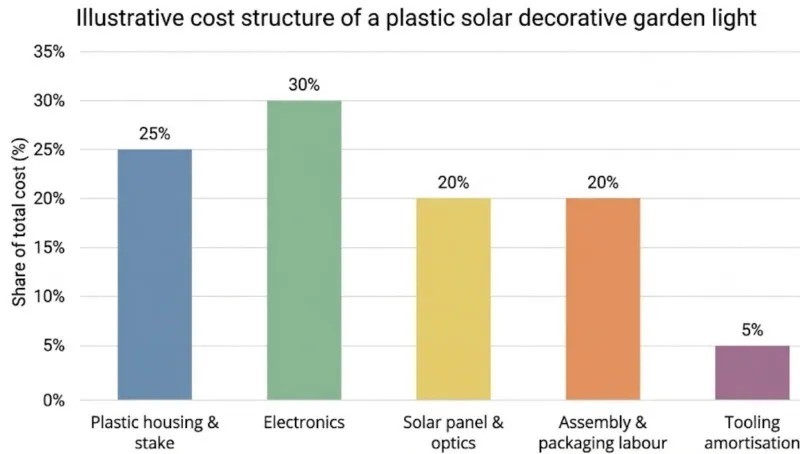
A simplified cost view for a plastic solar decorative light might look like this:
| Cost Element | Typical Share (Illustrative) | How Injection Molding Influences It |
|---|---|---|
| Plastic housing & stake | 20–30% | Scrap rate, cycle time, material yield |
| Electronics (PCB, LED, battery) | 25–35% | Housing tolerances affect assembly efficiency and rework |
| Solar panel & optics | 15–25% | Housing geometry affects integration and protection |
| Assembly & packaging labour | 15–25% | Fit & finish affect assembly time and rework |
| Tooling amortisation | 5–10% | Mold life and stability decide actual amortised cost per pc |
Better injection molding reduces scrap, rework, and downtime, and extends mold life. This keeps the effective cost per unit stable even at lower MOQs.
Impact on MOQs and flexibility
Because Glowyard works with shared molds and modular designs for many plastic solar lights, we can often support lower MOQs than the industry average. But this only works when molds and processes are stable enough that each restart or variant does not require days of re-debugging.
This is also why we put so much emphasis on mold planning before mass production. For a closer look at how tooling decisions affect delivery speed and MOQ flexibility, see How We Align Mold Design and Mass Production to Enable Fast Delivery and Low MOQs.
When injection molding is disciplined, we can:
- Ramp up new colours or minor cosmetic changes with minimal extra cost.
- Restart production for seasonal orders quickly, even after a gap.
- Offer trial orders at lower quantities without hidden process risk.
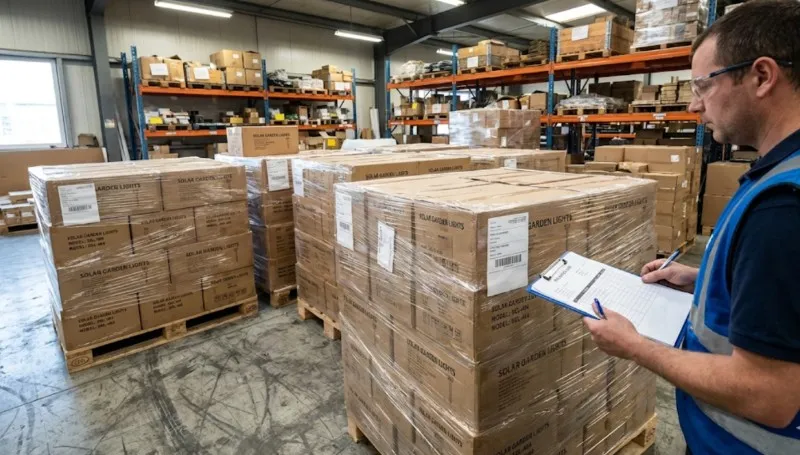
Evaluating a Supplier’s Injection Molding Capability
If you are selecting a partner for plastic solar decorative lights, you may not be able to stand next to their injection machines every day. But you can still ask targeted questions that reveal their level of control.
Questions to ask
- How do you handle DFM (Design for Manufacturing) before mold fabrication?
- Do you provide documented process windows and parameter sheets for important molds?
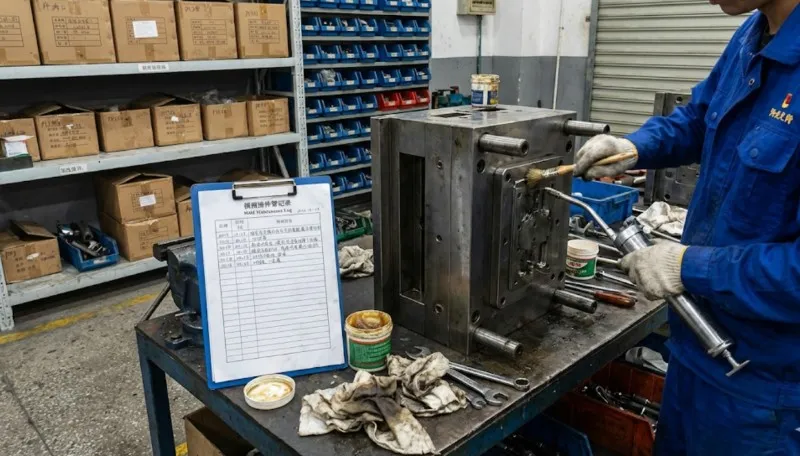
- How do you track mold health and preventive maintenance?
- Can you share real examples of defect rate improvement after process optimisation?
- How do your injection partners connect with your main assembly and QC processes?
The answers will show whether the supplier treats injection molding as a strategic capability or just a black box.
What we have found works in practice
In our projects, the most effective approach has been:
- Involving production and QC staff early in mold design.
- Treating mold trials as a structured experiment, not just a one-time approval.
- Creating simple but consistent mold health records.
- Integrating injection partners tightly with our overall outdoor lighting manufacturing process, from IQC to final assembly and testing.
How Injection Molding Links to OEM/ODM Success
For OEM/ODM projects, customers often care about two things at the same time:
unique design and reliable, repeatable production.
Injection molding is the bridge between these goals:
- It converts 3D concepts into mass-producible parts.
- It determines whether a design can survive multiple seasons outdoors.
- It decides how stable quality will be when you reorder or scale up.
When we discuss new OEM projects with clients, we always include a tooling and molding section in the plan:
- Whether to use existing shared molds or build new tools.
- Expected amortisation period and MOQ scenarios.
- Risks related to housing geometry, wall thickness, and sealing.
- Time allowed for mold trials and optimisation before final approval.
If you are evaluating a custom plastic solar decorative light project and need support on both design and manufacturability, our OEM solutions for solar garden lights page explains how we approach tooling, development, and production planning together.
Conclusion: Injection Molding as a Strategic Lever, Not a Background Detail
For plastic solar decorative garden lights, injection molding is not just a technical detail hidden behind the catalog photo. It is a strategic lever that influences:
- Outdoor durability and waterproof performance
- Visual quality and brand perception
- Realistic MOQs and flexibility for seasonal products
- Total cost and profit over the life of a project
By combining real factory experience with disciplined tooling and process control, Glowyard uses injection molding as a foundation for fast sampling, fast shipping, and competitive MOQs—rather than a hidden risk.
For buyers and brand owners, paying attention to your supplier’s injection molding capability is one of the most effective ways to protect your project before the first container even leaves the factory.
Where Glowyard Fits in This Process
For plastic solar decorative outdoor lights, we do not treat injection molding as an isolated outsourced step. In our projects, mold review, sampling, assembly fit, and final quality control are connected as one system.
That matters because buyers are not only evaluating whether a supplier can make a sample look good. They are also evaluating whether the same structure can be repeated consistently across mass production and reorders.
If you are still comparing suppliers, the most useful early discussion is usually not only about price. It is about mold strategy, process stability, expected volume, and how much production risk is being controlled before mass production starts.
Related reading: improving plastic durability in outdoor solar lights



![do solar lights work in winter at cemeteries [2026 guide]](https://glowyard.com/wp-content/uploads/2026/03/Do-Solar-Lights-Work-in-Winter-at-Cemeteries-2026-Guide.webp)