
Solar vs Battery vs Electric Memorial Lights: Which Is Best for Graves in 2026?
Part 1 — Introduction + Quick Answer
When buyers compare solar vs battery vs electric memorial lights, the best choice is usually not about brightness alone. It is about where the light will be used, how often it needs maintenance, whether wiring is realistic, and what kind of tribute experience the user expects.
In today’s market, solar memorial lights have become more visible because the wider outdoor solar lighting segment is growing quickly, supported by demand for energy-efficient, low-maintenance outdoor lighting. Market researchers currently estimate the outdoor solar LED category at roughly USD 9.8–10.1 billion in 2024–2026, with continued growth projected over the next several years, according to Grand View Research’s outdoor solar LED market analysis.
For most individual graves, family memorial spaces, and low-maintenance outdoor tribute areas, solar memorial lights are usually the best all-around option because they do not need wiring, automatically turn on at night, and are widely sold in cemetery-specific formats such as crosses, candles, lanterns, angels, and stake lights.
Battery-powered memorial lights still make sense when sunlight is unreliable, when buyers want a very simple temporary tribute, or when the product format is closer to a reusable flameless grave candle.
Electric memorial lights are the least flexible for typical graveside use, but they can still make sense in fixed indoor remembrance settings, certain religious memorial traditions, or larger site-planned memorial spaces where permanent wired lighting is acceptable.
So the short answer is this:
- Choose solar for the best balance of convenience, outdoor suitability, and long-term user friendliness.
- Choose battery for shaded areas, temporary memorial use, or simple low-cost candle-style tributes.
- Choose electric only when you have a clear reason to accept wiring, fixed placement, or indoor/structured memorial installation.
Part 2 — What Are the 3 Main Types of Memorial Lights?

Memorial lights are sold in several forms, but most buyer decisions still fall into three practical categories:
- Solar memorial lights
- Battery-powered memorial lights
- Electric / wired memorial lights
Each type solves a different problem. Solar focuses on autonomy. Battery focuses on simplicity and flexibility. Electric focuses on stable powered installation.
The difference is not only technical — it also affects maintenance frequency, product design, wholesale potential, and buyer fit.
1. Solar memorial lights
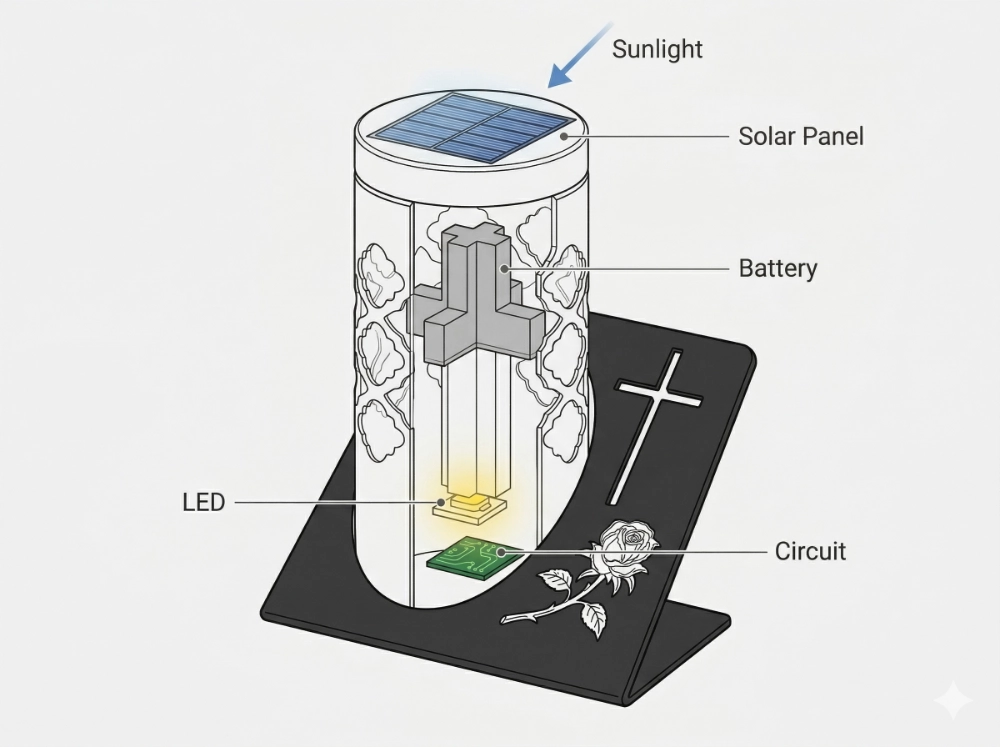
Solar memorial lights typically use a small solar panel + rechargeable battery + LED light source. During the day, the panel charges the battery, and at night the LED turns on automatically. That basic structure is now common across outdoor remembrance products, including grave candles, cross lights, angel figures, lantern-style tributes, and personalized memorial stakes.
In the market, solar memorial lights appear in several familiar forms:
- grave candles with solar tops
- cross-shaped cemetery lights
- angel or religious figurine lights
- lantern-style memorial lights
- personalized acrylic or plaque-based solar memorial markers
Their biggest advantage is that they are wire-free and largely self-running. That is why solar has become especially attractive for outdoor memorial use, where buyers want soft night lighting without trenching cable or replacing disposable cells too often.
From a B2B perspective, solar memorial lights are also highly adaptable because they can be offered in many decorative molds and symbolic styles. That makes them especially suitable for:
- distributors
- garden and memorial product retailers
- OEM/ODM suppliers
- gift-oriented remembrance product programs
Best fit: Solar is usually best for permanent graveside placement, family remembrance areas, and buyers who want the lowest day-to-day effort.
2. Battery-powered memorial lights
Battery-powered memorial lights are usually the simplest form of modern memorial lighting. Instead of charging through a solar panel, they use replaceable batteries, most commonly AA cells in small LED grave candles or compact remembrance lamps.
This type is common when buyers want a product that is:
- easy to place immediately
- not dependent on sunlight
- familiar in candle-like form
- suitable for short-term or seasonal tribute use
Battery memorial lights often feel intuitive because they resemble the logic of traditional cemetery candles: install, illuminate, then replace when needed.
One monument supplier notes in its vigil lights product information page that battery-operated memorial lights are a newer alternative to traditional vigil lights, and states that one battery version can last around three months before replacement, although that figure is supplier-specific rather than a universal industry standard.
The tradeoff is maintenance. A battery light may be simple on day one, but it usually becomes less convenient over time if it is left outdoors continuously. Once batteries drain, someone has to revisit the site, open the unit, and replace them. That is acceptable for occasional remembrance use, but less ideal for buyers who want a long-term "set and forget" solution.
Best fit: Battery is usually best for temporary tributes, shaded areas with poor sunlight, or buyers who prefer candle-style memorial products and do not mind periodic battery replacement.
3. Electric memorial lights
Electric memorial lights are the most fixed and least portable category. In the consumer market, they often appear as plug-in memorial lamps used in homes or for specific religious remembrance practices, rather than as mainstream outdoor cemetery lights.
For outdoor memorial environments, wired electric lighting usually makes more sense at the site level than at the individual product level. In other words, instead of putting a plug-in lamp on a grave, a cemetery, memorial park, or formal remembrance garden may use wired low-voltage landscape lighting to illuminate paths, monuments, plantings, or shared memorial features.
That type of system offers more consistent powered light, but it also requires installation, wiring, and long-term infrastructure planning.
That is why electric memorial lighting is usually a niche choice in comparison with solar and battery products for individual graves. It can work well when the project has:
- fixed infrastructure
- maintenance personnel
- a permanent lighting plan
- an indoor or semi-structured memorial setting
But for everyday graveside purchasing, electric is often the least practical option because it sacrifices the two things memorial buyers usually value most:
- easy placement
- independence from external power access
Best fit: Electric is usually best for indoor remembrance lamps, religious memorial traditions using plug-in lights, or professionally planned memorial landscapes with permanent power access.
Quick category summary
| Type | How it works | Most common product form | Main strength | Main limitation |
|---|---|---|---|---|
| Solar memorial lights | Solar panel charges a rechargeable battery that powers an LED at night | Crosses, lanterns, candles, angel lights, memorial stakes | No wiring, automatic night lighting, very suitable for outdoor use | Performance depends on sunlight and battery quality |
| Battery memorial lights | Replaceable batteries power an LED candle or lamp | Flameless grave candles, compact remembrance lamps | Works without sunlight, simple and familiar | Requires manual battery replacement |
| Electric memorial lights | Plug-in or wired power source runs the light continuously | Plug-in remembrance lamps or site-installed wired lighting | Stable powered output where infrastructure exists | Least flexible for ordinary graveside placement |
Part 3 — Solar vs Battery vs Electric: Side-by-Side Comparison
The broader market trend already hints at where this comparison is going. In outdoor lighting, solar is the clear growth engine: Allied Market Research estimates the global outdoor solar LED market at USD 6.4 billion in 2022, with a projection of USD 44.4 billion by 2032, while Mordor Intelligence also shows steady expansion through 2031. In memorial-specific products, the 2025 Memorial Solar Lights Industry White Paper estimates the solar memorial light segment at about USD 500 million in 2025, growing toward USD 775 million by 2030. Taken together, these figures suggest that solar is no longer just a niche alternative in remembrance lighting. It is increasingly becoming the default growth direction for outdoor memorial products.
That said, growth does not mean one format wins everywhere. The same body of research points to a more practical split: battery grave candles remain deeply established in Europe, especially for seasonal and ritual-style use, while wired low-voltage LED systems are mainly used where cemetery operators control infrastructure, such as entrances, paths, and section lighting. That leaves solar in the middle — not as the cheapest option, and not as the most infrastructure-heavy option, but as the strongest all-around choice for buyers who want outdoor use without wiring and without frequent replacement. In other words, the market itself is already separating these technologies by use case.
Quick comparison table
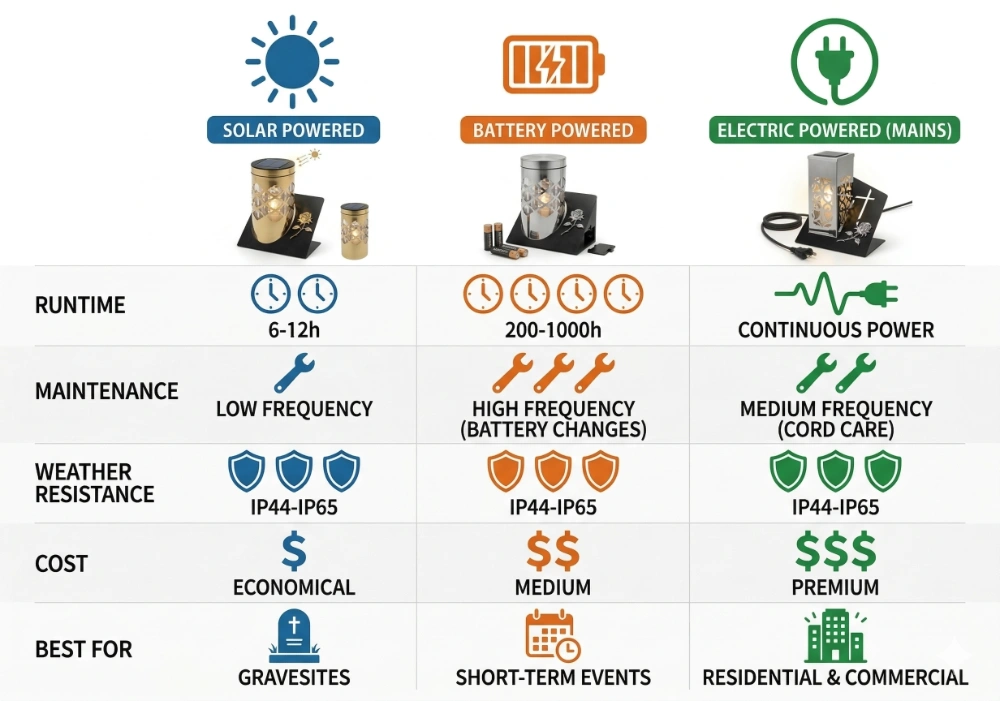
| Factor | Solar Memorial Lights | Battery Memorial Lights | Electric / Wired Memorial Lights |
|---|---|---|---|
| Power source | Solar panel charges a rechargeable battery during the day | Replaceable batteries, usually AA or C cells in candle-style products | Plug-in or low-voltage wired power system |
| Typical runtime | Usually 6–8 hours (basic) to 10–12+ hours (premium) | 200–1,000 hours per battery set | Continuous with power available |
| LED lifespan | Commonly 25,000–50,000 hours | Often 5,000–10,000 hours | Often 50,000 hours |
| Battery / service life | Rechargeable battery packs typically need replacement after 1–3 years | Battery life depends on usage hours and replacement frequency | No local battery in most systems |
| Maintenance frequency | Usually low | Medium to high | Usually low after installation |
| Weather / IP range | Commonly IP44–IP65 | Often IP44 for candle-style models | Commonly IP65 or higher |
| Winter performance | Usually weaker in winter because charging conditions drop | More predictable in shade or winter | Most stable in winter |
| Best fit | Permanent graveside use with reasonable sunlight | Temporary tributes, shaded cemeteries, seasonal use | Institutional paths, entrances, and planned memorial spaces |
| Main drawback | Depends on sun exposure | Ongoing battery replacement | Highest installation complexity |
Runtime and performance data sources: Memorial Solar Lights White Paper, Alibaba Grave Candle Guide, and representative product specifications.
Product examples by category
Solar memorial lights:
- Basic models: 6-8 hours runtime
- Premium models: 10-12+ hours runtime
- Source: Memorial Solar Lights Industry White Paper
Battery memorial lights:
- Wentronic LED grave candle: ~720 hours
- SmartaSaker memorial lantern: up to 1,000 hours
- Star Trading memorial candles: 200-300 hours
Electric wired lights:
- ABBA Lighting bollard: 50,000 hours
- Edishine pathway lights: 50,000 hours
- SUNVIE landscape lighting: Professional grade
How to read this comparison
For most family buyers, the real decision is not "Which technology is strongest on paper?" but "Which technology creates the least hassle over time?" That is the reason solar performs so well in this category. It gives buyers a light that can stay outdoors, turn on automatically, and avoid both wiring and frequent battery changes.
Battery memorial lights remain important because they solve a different problem. They are not the most efficient long-term option, but they are easy to understand, easy to stock, and useful where the visual ritual of a candle matters more than automation. That is why battery lights remain strong in temporary remembrance, anniversary visits, and lower-cost seasonal memorial programs.
Wired electric lighting is the most stable in pure technical terms, but it is rarely the most practical option for ordinary single-grave use. It belongs more naturally in cemetery paths, entrances, memorial walls, and institution-managed spaces, where reliability and code-compliant infrastructure matter more than product portability.
Part 4 — Performance and Durability in Real Cemetery Conditions
Product specifications only tell part of the story. A memorial light that looks impressive in a catalog can behave very differently once it is placed in a real cemetery with shade, rain, winter weather, maintenance limits, and decoration rules. In practice, long-term performance usually depends on five factors:
- sunlight exposure
- winter charging conditions
- enclosure quality and IP rating
- battery replacement cycle
- cemetery rules and placement restrictions
These are the factors that separate a product that sells once from a product that performs well over time.
1. Sun exposure is the deciding factor for solar performance
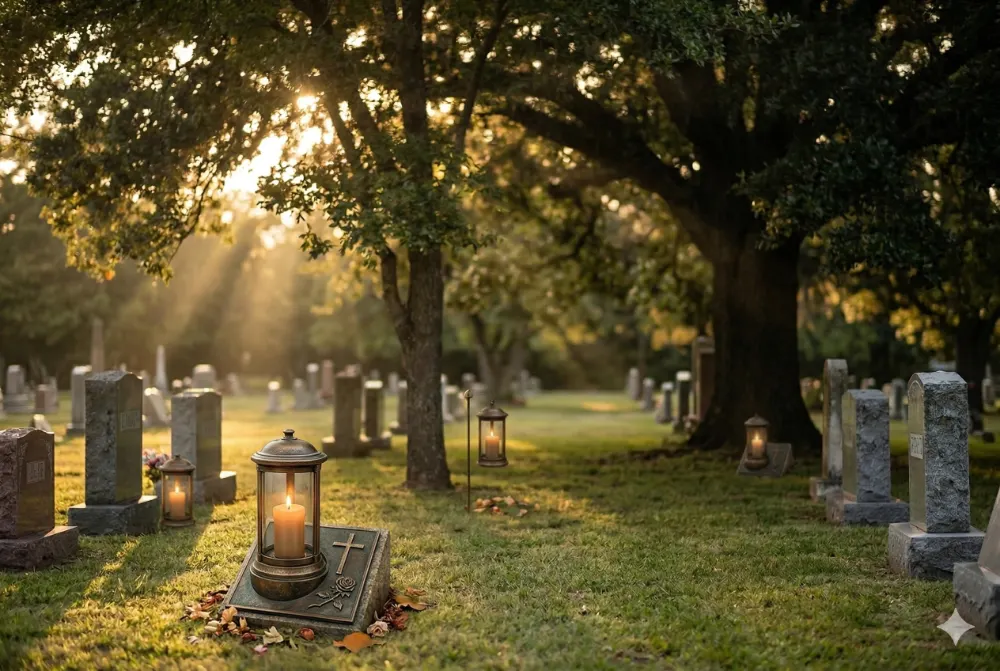
For solar memorial lights, the most important real-world variable is not just the product spec sheet — it is the actual amount of daylight the panel receives once installed. The research consistently places standard solar runtime in the 6–8 hour range for basic models and 10–12+ hours for stronger products, but those numbers assume reasonable charging conditions rather than heavily shaded cemetery placement. That is why the same lantern can feel reliable on an open lawn grave and disappointing under trees or between taller monuments.
That distinction matters because memorial lighting is not used in controlled test conditions. In real cemeteries and grave sites, panel exposure can be reduced by flowers, shrubs, nearby stonework, narrow grave rows, or seasonal tree cover. So the better buying question is not simply "How many hours is this rated for?" but "Will this panel actually receive enough daylight where it will be used?"
2. Winter is where weak solar products get exposed
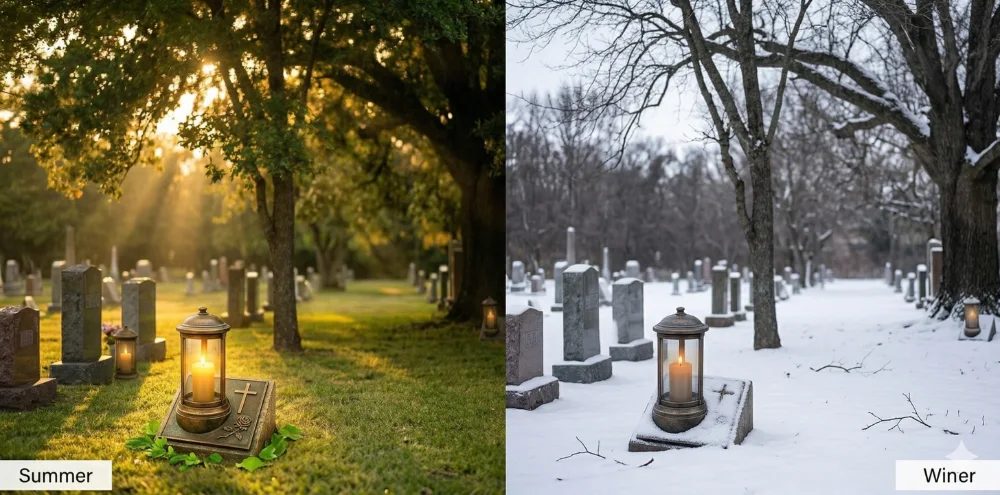
Several winter-use guides referenced in the research note that winter performance is limited mainly by shorter daylight hours, weaker sun angles, and cold-related battery derating. Standard lithium batteries can lose around 20–30% of capacity below freezing.
That matters because winter is where specification gaps become visible. A better solar memorial light may still provide useful nightly illumination, but a low-capacity model with a small panel or weak battery often fails first when daylight margins shrink. This is also one reason battery candles still hold their place in the category: in low-sun conditions, they may feel more predictable even if they are less efficient over the long run.
3. IP rating matters because cemetery products stay outdoors for long periods
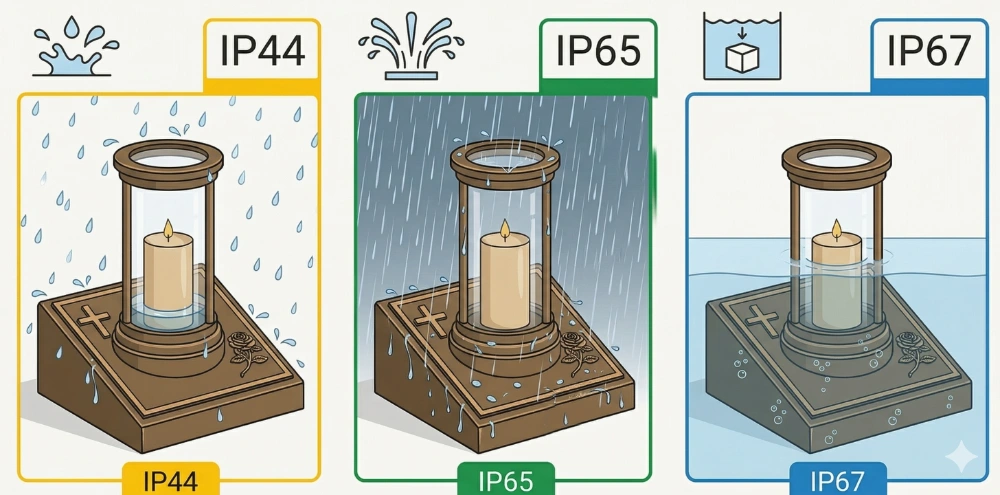
Weather resistance is not a minor feature in memorial lighting. These products are often left outdoors for long periods with minimal supervision, so sealing quality matters almost as much as brightness. Across the sources used in the comparison, IP44 to IP65 is the most common range, but IP65 is clearly the safer target for open cemetery conditions, while battery candle formats often stay closer to IP44. That difference matters because the most common real-world failures are often not LED failures at all — they are water ingress, weak seals, corroded switches, and damaged battery compartments.
This is why a modest-looking but well-sealed memorial light can outperform a more decorative product over time. In cemetery use, enclosure quality is often a better predictor of user satisfaction than visual styling alone.
IP rating guidance: Uking’s IP65 outdoor lighting guide
4. Battery maintenance is the hidden tradeoff in "easy" memorial lights
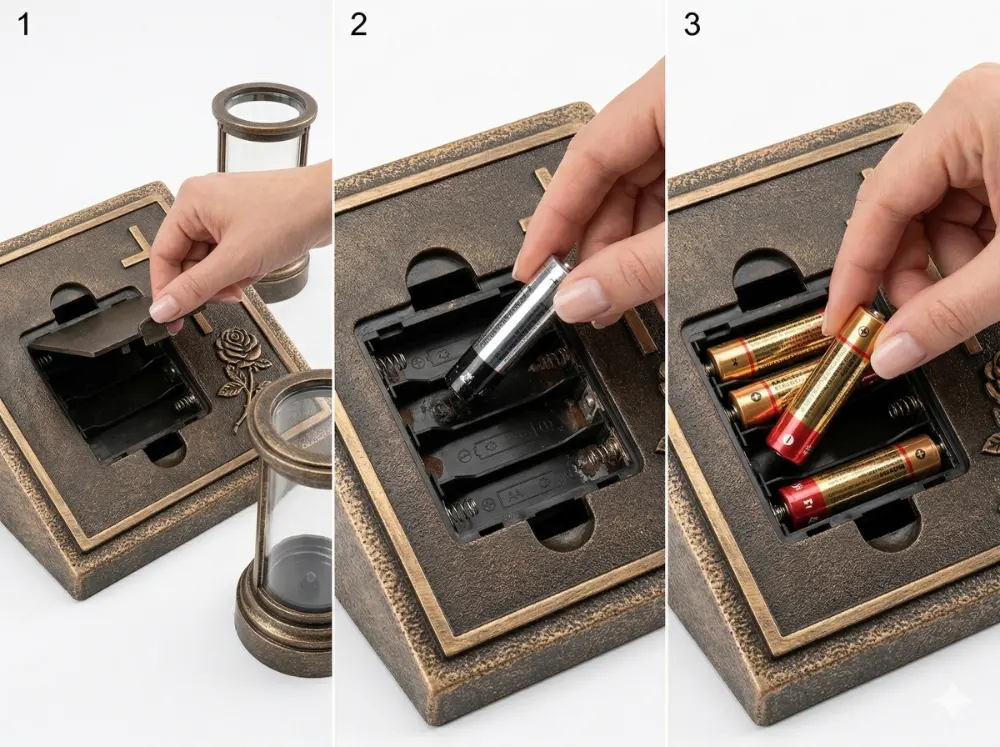
Battery memorial lights are simple at the start, which is why they remain commercially attractive. But the research also shows why that simplicity is mostly front-loaded. Representative products range from about 200–300 hours for smaller decorative memorial candles to around 720 hours or even 1,000 hours for longer-burn grave lights. Those figures sound reassuring, but they still translate into a maintenance cycle that someone has to manage.
That is the hidden tradeoff. A battery candle may be ideal for temporary remembrance, seasonal use, or a visit-based lighting routine. But once the goal becomes long-term, low-effort illumination, battery products usually require more labor than buyers first expect. That is why battery lights remain strongest in seasonal, shaded, and lower-cost use cases, rather than as a true "set and forget" memorial solution.
5. Cemetery rules can matter as much as product specs
One of the most overlooked buying factors is cemetery policy. Even when a product performs well technically, it still has to fit local decoration rules. Several cemetery-facing and memorial-product sources referenced in the research point to recurring restrictions on count, placement, height, and interference with grounds maintenance, which helps explain why compact and low-profile formats often outperform larger decorative lanterns in real-world sales.
This changes the buying logic in a practical way. The best product is not always the one with the biggest battery or the most decorative housing. In many cemeteries, the better commercial choice is the one that is easier to approve, easier to maintain, and less likely to create complaints.
Cemetery guidance sources: Gravestones.ie, Funeral.com, Accio solar lights overview
Practical takeaway for buyers
In real cemetery conditions, the strongest buying decision is not based on theory but on site fit.
A simple rule of thumb is:
- choose solar when the site has enough sunlight and the buyer wants low-maintenance outdoor use
- choose battery when the site is shaded, the usage is temporary, or the candle format matters more than automation
- choose wired electric when the project is institutional, permanent, and supported by infrastructure
Part 5 — Cost Comparison and Total Cost of Ownership
Price is where many buyers make the wrong decision. A battery memorial candle often looks cheapest at the point of purchase, while a solar memorial light looks more expensive up front, and a wired low-voltage system looks expensive enough that many family buyers dismiss it immediately. But once the comparison shifts from purchase price to total cost of ownership, the ranking changes.
The clearest pattern in the cost data is this: for individual grave use, solar usually delivers the best long-term value, because it avoids both repeated battery purchases and any need for trenching or wiring. Battery products stay cheapest only when the usage is occasional or seasonal. Wired LED systems can be extremely cost-efficient over a long service life, but only when the installation is spread across a larger institutional site rather than a single family-maintained grave.
Upfront cost is only part of the picture
Battery memorial lights remain the lowest-capex option, especially in simple plastic candle formats sold at the lower end of the memorial-lighting price range. That low entry price helps explain why battery candles still dominate in seasonal and ritual-driven cemetery buying. They are easy to stock, easy to understand, and easy to sell as an impulse or commemorative purchase.
Solar sits in the middle. It usually costs more than a basic battery candle because it includes a panel, rechargeable battery, light sensor, and sealed outdoor housing. But that extra hardware changes the economics over time. Once installed, a solar memorial light has no electricity bill and no routine battery purchases in the short term. For many family buyers, that makes it feel more expensive on day one but cheaper by year two or three.
Wired low-voltage LED is the opposite. The fixture itself may not look dramatically more expensive than premium solar, but the system cost comes from everything around it: cabling, transformers, trenching, grid connection, and in many cases permitting or contractor labor. That is why wired lighting can make sense for a cemetery operator but rarely for a single grave buyer.
Battery products often become expensive through maintenance, not hardware
This is where battery lights lose their apparent price advantage. In the product examples used in the research, smaller memorial candles may run for around 200–300 hours, while longer-burn products reach 720 hours or even 1,000 hours per battery cycle. Those numbers sound respectable at first, but the economics change quickly once the light is expected to operate frequently. A candle used every night can require several battery changes per year, and once that happens at scale, labor begins to matter more than the product price itself.
That is why battery memorial lights remain cost-effective mainly in three situations:
- the light is used only on visits, holidays, or anniversaries
- the buyer accepts regular maintenance as part of the ritual
- the priority is the lowest purchase price, not the lowest lifetime cost
For institutions, the picture is even clearer. Once hundreds of graves are involved, replacing batteries manually can cost more in labor over three to five years than the lights themselves.
Solar usually wins when buyers want low effort over time
Solar memorial lights are not the cheapest products to buy, but they often become the most economical for ordinary outdoor grave use because they remove the two recurring costs that frustrate family buyers most: manual battery replacement and electrical installation.
The long-term service cost of solar is usually limited to light maintenance and rechargeable battery replacement after roughly one to three years, depending on climate, battery chemistry, and product quality. That is a much lighter maintenance cycle than replacing disposable batteries several times a year, which is one reason solar is increasingly positioned as the stronger long-term option in the memorial lighting market.
Wired systems win only when the site already justifies infrastructure
Wired low-voltage LED is technically the most durable and stable option in the comparison. The research points to typical LED lifespans of around 50,000 hours, very low annual electricity cost for small systems, and robust IP65+ construction in mainstream outdoor fixtures. That makes wired lighting very attractive for cemetery paths, entrances, memorial walls, and section borders that will stay in place for many years.
But that same logic breaks down for individual graves. When trenching, transformers, and installation labor are added, the economics become hard to justify for a single memorial point. So while wired can outperform both solar and battery in long-horizon institutional projects, it is usually the least economical choice for family-managed graves.
What buyers should take from the cost comparison
The price hierarchy changes depending on how the light will actually be used:
- for temporary or seasonal use, battery is often the cheapest option
- for long-term individual grave use, solar is usually the best value
- for planned cemetery-wide lighting, wired LED may offer the strongest lifetime economics
That is the most useful way to read cost in this category. The cheapest light is not always the lowest-cost solution.
Part 6 — Which Type Is Best for Different Buyers and Use Cases?
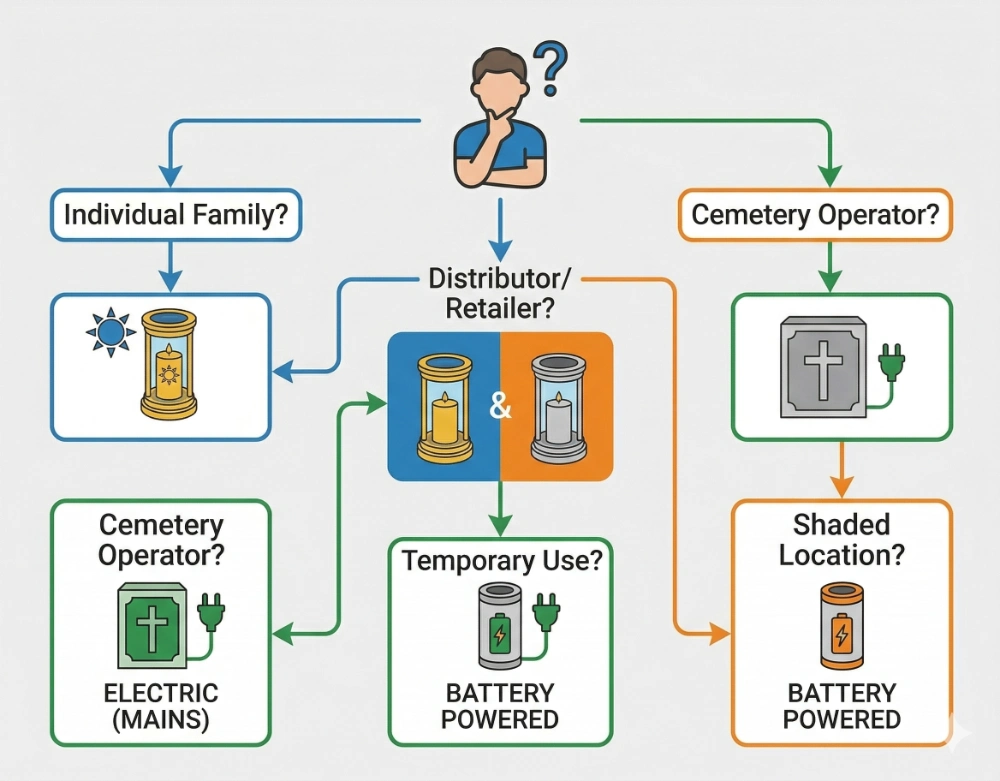
The most practical way to compare memorial lights is not by technology alone, but by buyer type. The same product that works perfectly for a family grave may be a poor choice for a wholesaler, and the system that makes sense for a cemetery operator may be completely unrealistic for a retail customer. The market research and product examples consistently show that these three technologies serve different decision environments.
1. Individual families and grave visitors
For most family buyers, solar is usually the best overall choice. The reason is simple: families usually want a light that can be placed outdoors, operate automatically, and avoid both wiring and frequent maintenance. That is exactly the gap solar fills.
Battery still makes sense for families in shaded cemetery sections, for occasional holiday use, or when the visual symbolism of a candle matters more than convenience. But for a family that wants a memorial light to stay active over time with minimal effort, solar is the stronger all-around solution.
Wired lighting is usually the weakest fit here. Even if it performs well technically, most individual families do not control site infrastructure and cannot justify trenching or electrical installation for a single grave.
2. Distributors and wholesalers
For distributors, the decision is less about personal convenience and more about sell-through, margin, complaint risk, and category positioning. This is where solar becomes especially interesting. The research positions solar memorial lights as a differentiated, growing category with stronger long-term value messaging than low-cost battery candles. That makes solar attractive for wholesalers who want to move beyond price-only competition and build a more premium memorial assortment.
Battery lights still matter in distribution, but for different reasons. They are easy to understand, easy to merchandise, and ideal for seasonal programs such as All Souls’ Day, Memorial Day, and Christmas remembrance sales.
In other words:
- battery works well for volume, price-sensitive, seasonal selling
- solar works better for higher perceived value and lower-maintenance positioning
That split is commercially important. Battery often wins on accessibility and affordability, while solar wins on differentiation and repeat buyer satisfaction.
3. Retail buyers and memorial gift channels
Retail buyers often sit between family logic and distributor logic. They need products that are emotionally understandable, visually appealing, and easy to explain without technical friction.
Battery memorial lights perform well here because the candle format is instantly familiar. They are especially effective in gift shops, flower-and-grave-decoration channels, and seasonal retail programs where buyers want a low-ticket remembrance item.
Solar, however, has a stronger story when the retailer wants a more modern or premium outdoor memorial range. It gives staff a simple value proposition: no wiring, automatic night lighting, and lower long-term upkeep. That makes it easier to justify a higher price point than a basic flameless candle.
4. Cemetery management and institutions
This is the buyer group where wired electric lighting becomes much more competitive. Institutions care less about portability and more about reliability, maintenance planning, site consistency, and long service life. That is exactly why low-voltage LED systems fit cemetery paths, entrances, section borders, and public memorial zones so well.
With 50,000-hour lifespans, robust housings, and centralized maintenance potential, wired systems align far better with site-management logic than either battery or single-point solar products.
Solar can still play a role for institutions, especially in sections without easy wiring access or in lower-cost decentralized deployments. But once a cemetery is thinking in terms of whole-site planning, wired often becomes the more rational long-term solution.
Battery is usually the weakest institutional option unless the use case is highly temporary, commemorative, or staff-managed on a limited schedule.
5. Best fit by use case
The comparison becomes easiest to apply when translated into real use cases:
Permanent individual graves
Best choice: Solar
This is the strongest use case for solar because the buyer usually wants low ongoing effort, outdoor suitability, and no electrical installation. Solar grave lights are specifically designed for this purpose.
Temporary memorials or seasonal remembrance
Best choice: Battery
Battery wins here because the light is not expected to run continuously for years, and the lowest purchase price often matters more than long-term efficiency.
Shaded cemetery sections
Best choice: Battery, unless the solar product is specifically built for low-light conditions
This is one of the few cases where battery can outperform solar in user satisfaction simply because it is more predictable.
Cemetery paths, entrances, and managed public zones
Best choice: Wired electric
This is where infrastructure, long service life, and centralized maintenance matter more than unit-level portability. For memorial parks and community spaces, wired systems often make the most sense.
Premium distributor assortments
Best choice: Solar
Solar gives distributors a stronger value story, better product differentiation, and a category that aligns with broader outdoor lighting growth.
Final buyer logic
When viewed by buyer type, the decision becomes much more intuitive:
- families usually benefit most from solar
- seasonal and low-cost retail channels still benefit from battery
- cemetery operators and institutions often benefit most from wired systems
- distributors often need both battery and solar, but for very different commercial reasons
That is why there is no single "best" memorial light for every buyer. The better question is: best for whom, and for what kind of use?
Part 7 — When Solar Wins, When Battery Still Makes Sense, When Electric Is Worth It
After comparing cost, maintenance, runtime, and buyer fit, the final decision becomes much simpler. The three technologies are not really fighting for the exact same role. They solve different problems, and the best choice depends on whether the buyer is optimizing for low maintenance, lowest entry price, or long-term site infrastructure. The research itself summarizes the long-term cost logic very clearly: solar usually delivers the best cost efficiency for individual grave use, while wired can outperform both solar and battery when it is planned and maintained as part of a whole-site installation. Battery remains the most economical only when the usage is occasional, seasonal, or ritual-driven.
When solar clearly wins
Solar memorial lights are the strongest choice when buyers want a product that can stay outdoors, turn on automatically, and avoid both wiring and repeated battery replacement. In real cemetery use, that usually means:
- permanent individual graves
- family-maintained memorials
- cemeteries without built-in electrical infrastructure
- distributors selling "better long-term value" rather than the lowest-price candle
This is exactly why solar has become the growth format in the broader outdoor lighting market and a rising category inside memorial products. It combines zero grid electricity use, automatic dusk-to-dawn operation, and relatively low ongoing maintenance, which is why it fits the "set and forget" expectation far better than battery candles.
Solar wins most clearly when three conditions are true:
- the gravesite gets reasonable daylight
- the cemetery allows solar fixtures
- the buyer values convenience over the lowest initial price
When those conditions are met, solar is usually the best all-around option.
When battery is still the better choice
Battery memorial lights still make a lot of sense, but for a narrower and more specific set of reasons. The research highlights three recurring strengths: lowest unit cost, predictable output without depending on sunlight, and a candle-like format that fits seasonal and ritual buying very well. It also notes that battery products remain especially strong in cemeteries or communities where the symbolic look of a candle matters more than year-round autonomous operation.
Battery is still preferred when:
- the buyer is highly price-sensitive
- the light is mainly used on memorial days, anniversaries, or holidays
- the gravesite is heavily shaded
- the cemetery allows small battery candles more easily than solar lanterns or spikes
That is why battery should not be treated as a failed alternative to solar. It is better understood as a consumable memorial product: accessible, familiar, and easy to sell, but not usually the best long-term low-maintenance solution.
When wired electric is worth it
Wired electric lighting only becomes the best choice when the project is no longer about one grave at a time. It starts to make sense when the buyer controls the site and is planning for decades of service, uniform lighting, and institutional maintenance standards.
This is where the research draws the clearest line. Wired low-voltage LED is positioned as the best fit for:
- cemetery entrances
- internal roads and paths
- columbaria and memorial walls
- section borders and managed public memorial zones
The reason is not just brightness. It is the combination of 50,000-hour LED life, robust IP65+ construction, centralized maintenance, and very low electricity use once the system is installed. In other words, wired wins when infrastructure already exists or when the owner is prepared to build it for the long term.
For most individual family graves, however, wired lighting still remains the least practical option because installation labor, trenching, and site permissions quickly outweigh the benefits. For specialized memorial applications like veteran memorials or pet memorial gardens, solar remains the more flexible and cost-effective choice.
The shortest version of the decision
If the question is "Which is best?" the most honest answer is:
- Solar is best for most individual graves
- Battery is best for low-cost, temporary, or shaded use
- Wired electric is best for institutional and site-planned lighting
That is not just a neat summary. It is the pattern that keeps repeating across the comparison data, the product examples, and the buyer-use scenarios in the research.
Looking for Reliable Solar Memorial Lights? Glowyard Can Help
At Glowyard, we specialize in manufacturing high-quality solar memorial lights and cemetery solar lights designed for long-term outdoor use. With over 15 years of experience since 2011, we understand what makes memorial lighting work in real cemetery conditions: reliable solar charging, weather-resistant construction, and designs that respect the solemnity of remembrance spaces.
Whether you need solar grave lights for individual family memorials, battery-compatible designs for shaded locations, or custom OEM solutions for wholesale distribution, we offer flexible MOQs starting from 50 pieces and comprehensive customization services to match your specific requirements.
Our memorial lighting collection includes crosses, lanterns, candles, angels, and stake lights—all built with IP65 waterproofing, quality solar panels, and rechargeable batteries designed for 1-3 year service life. We also provide complete after-sales support and technical guidance to ensure your memorial lights perform reliably season after season.
Ready to source better memorial lighting? Contact us to discuss your project, request samples, or learn more about our OEM/ODM capabilities for solar memorial products.
Part 8 — Conclusion
So which memorial light is best? For most real-world cemetery applications, solar is the strongest all-around choice. It offers the best balance of low maintenance, outdoor suitability, and long-term value for individual graves. That is why it is gaining momentum in both the wider outdoor lighting market and in memorial-specific product development.
But that does not make battery or wired electric obsolete. Battery memorial lights still serve an important role where price, ritual familiarity, or shade make them more practical. Wired electric lighting remains the better answer for institutions planning permanent path, entrance, or area lighting with professional maintenance standards. The real lesson is that these three formats should not be treated as direct substitutes in every case. They work best when matched to the right buyer, the right site, and the right maintenance expectation.
For buyers, the most useful question is not simply "Which light is best?" It is:
- best for this gravesite
- best for this budget
- best for this maintenance reality
- best for this cemetery policy
Once the decision is framed that way, the answer becomes much clearer.
For most families and most standard grave applications, start with solar. For temporary or low-cost remembrance, choose battery. For permanent, institution-managed lighting, invest in wired electric.
Related Articles
Looking for more guidance on memorial lighting? Check out these helpful resources:


![do solar lights work in winter at cemeteries [2026 guide]](https://glowyard.com/wp-content/uploads/2026/03/Do-Solar-Lights-Work-in-Winter-at-Cemeteries-2026-Guide.webp)