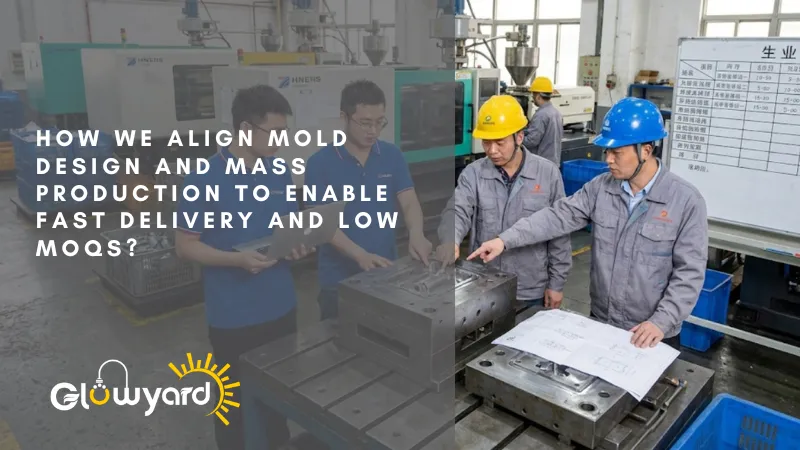
How Mold Design Reduces MOQ for Custom Solar Light Production
In low-MOQ custom solar light projects, mold design is often the part that decides whether a new idea can move into production smoothly. A lantern housing, resin statue or plastic solar light part may look simple in a drawing, but if tooling and mass production are not planned together, factories can lose weeks in debugging, scrap and repeated trial runs.
At Glowyard, many OEM and ODM solar light projects involve new tooling, shared molds, or modified housings for seasonal and decorative outdoor lighting products. Over the years, we have learned that the handover between mold design, mold trials and production records is one of the key reasons we can support faster sampling, more stable production and flexible MOQs.
This article explains how our mold design and production alignment process works in practice. For the broader factory system behind this process, you can also see our integrated outdoor lighting manufacturing system.
Why Mold Design Affects MOQ, Lead Time and Production Risk
For many importers and brand owners, MOQ looks like a commercial number. In reality, it is also a production issue.
If a mold needs repeated debugging, if parameters are not stable, or if every restart creates new defects, the factory has to protect itself with higher minimum quantities. The cost of trial runs, scrap, technician time and machine downtime has to be absorbed somewhere.
That is why mold design cannot be separated from mass production.
A well-planned mold should help the production line reach stable output faster. A poorly planned mold may look acceptable during sampling, but create hidden cost later during bulk production.
When Tooling and Production Are Out of Sync, Everyone Loses
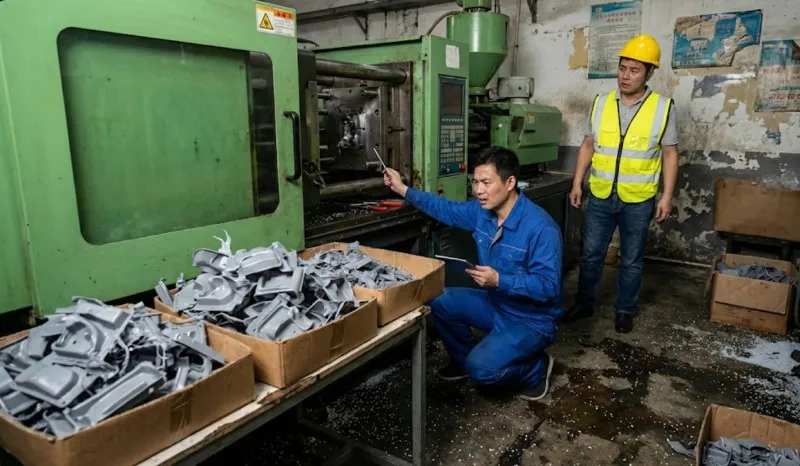
In many factories, the mold workshop and the production line behave like two separate worlds. The mold shop finishes the tooling, delivers it, and “the job is done”. Only when the injection machines start running do the real problems appear:
-
Debugging feels like gambling
New molds go onto the machine and technicians “try a bit of everything”: change temperature, pressure, cycle time and cooling again and again. Valuable production time is burned on parameter trial-and-error. -
Defects and rework quietly eat profit
Short shots, flash, sink marks, warpage and unstable dimensions lead to piles of scrap and rework. Material, labor and machine time are all wasted. -
Molds wear out early
Without a clear maintenance plan, even well-made molds are over-used, scratched or repaired in a rough way, shortening their life and increasing long-term cost.
From the outside, it may look like “production is busy”. Inside the factory, however, a lot of margin can be silently destroyed by poor coordination between tooling and production.
Glowyard’s Principle: Delivering a Stable Production System, Not Just a Mold
Our core idea is simple:
The mold workshop should not just deliver a physical mold. It should deliver a stable, documented and maintainable production capability to the line.
This means engineering, tooling, production and quality teams work as one system.
For OEM and ODM clients, the benefit is straightforward:
- Faster ramp-up from sample to mass production
- Fewer surprises during repeat orders
- Lower debugging cost
- More predictable delivery
- More realistic low or stepped MOQs
This is especially important for decorative outdoor solar lights, where many products use customized plastic housings, resin bodies, glass components, metal parts, or mixed-material structures.
Step 1 – Design for Manufacturing with the Production Line in Mind
The first step happens before steel is cut.
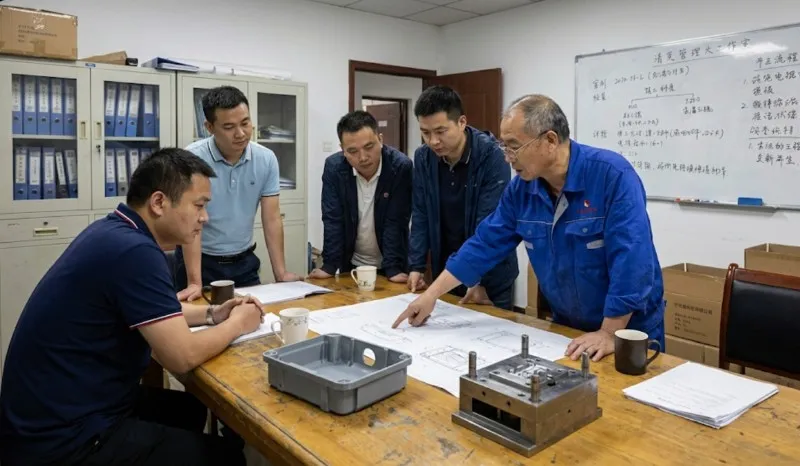
Cross-functional DFM review
When we design or adapt a housing for a solar garden light, our mold engineers do not work alone. They review the design together with:
- Injection technicians from our in-house or partner molding facilities
- Final assembly engineers who understand how parts are clipped, glued or screwed
- QC staff who will handle dimensional and appearance checks
- Project staff who understand the buyer’s MOQ, timeline and price target
Together, the team reviews:
- Gate positions, parting lines and ejector layout
- Wall thickness and ribs for dimensional stability
- Draft angles, undercuts and potential sticking points
- Areas that are critical for sealing, optical performance or assembly
- Whether the structure can support future color, finish or component changes
For plastic parts, this DFM review is closely connected with our injection molding process for decorative solar lights, because gate position, wall thickness and cooling design all affect production stability.
Design decisions tied to project goals
Different buyers have different priorities.
For example:
- If the buyer’s priority is fast lead time and low MOQ, we may recommend using or slightly modifying an existing shared mold.
- If the priority is a new signature shape or premium finish, we may design a dedicated tool, but still optimize for cycle time and maintenance access.
- If the product is only a small seasonal test order, we may help the buyer avoid unnecessary tooling investment at the early stage.
When a project starts from an existing structure, we may also review solar light housing options to see whether a shared platform can reduce tooling cost and MOQ pressure.
This front-loaded alignment reduces the chance that a “beautiful” design becomes a headache on the machine.
Step 2 – Treat Mold Trials Like Experiments, Not Just a One-Time Check
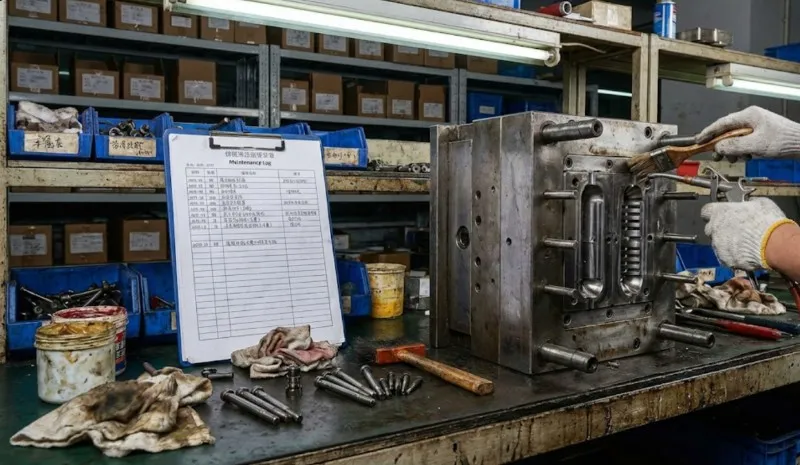
Many factories treat T0 or T1 trials as a simple pass/fail event.
At Glowyard, we treat mold trials as a structured experiment. The goal is not only to get several “OK samples”, but to find a stable production window that can be repeated later.
Systematic parameter mapping
During mold trials, we map and record:
- Melt and mold temperatures
- Injection speed and holding pressure
- Cooling time and demolding force
- Material batches and color masterbatch ratios
- Visible defects under different settings
- Cycle time changes and their effect on part quality
Instead of relying on one technician’s feeling, we record combinations and the resulting part quality.
The trial process helps us answer practical questions:
- Where does warpage disappear?
- At what parameters do we see the least sink marks?
- Which cycle time gives the best balance of quality and efficiency?
- Which defect is caused by mold structure, and which defect is caused by machine settings?
This is especially important for plastic housings, where stable parameters must be handed over clearly before the product moves into our plastic lights production process.
Output: a Golden Parameter Sheet
For each important mold, we output a parameter sheet that includes:
- Recommended machine type and screw size
- Verified process window for key settings
- Material and color masterbatch notes
- Known risk points and countermeasures
- Maintenance reminders for high-risk mold areas
For example, the sheet may note that the gate area is prone to burn marks if injection speed is too high, or that a specific decorative rib needs extra attention during demolding.
This sheet is handed over to production together with the physical mold. As a result, when the mold is moved across machines or shifts, technicians are not starting from zero every time.
For readers who want a more general view of how we standardize production steps, see our solar lights manufacturing guide.
Step 3 – Build a Mold Health File for Critical Parts
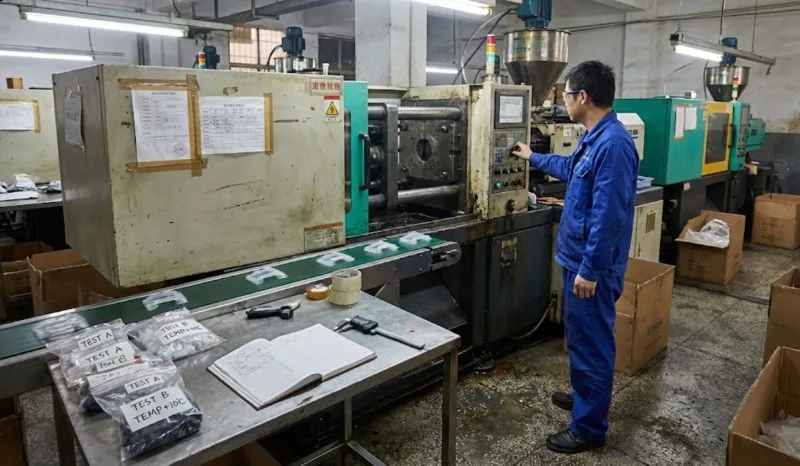
A mold should not be treated as a disposable tool. For important housings or repeat SKUs, we treat the mold as a long-term production asset.
What the mold health file records
For key molds, we keep a simple digital health file that tracks:
- Shot count and material types used
- Past parameter adjustments and the reasons
- All repairs and component replacements
- Quality incidents linked to that mold
- Notes from production restarts
- Maintenance history for inserts, lifters, sliders, vents and cooling channels
This makes it easier to understand whether a problem is new, repeated, or related to mold aging.
Preventive maintenance instead of emergency fixes
Based on the health file and shot count, we schedule:
- Routine cleaning of vents, cooling channels and moving parts
- Early replacement of worn pins and bushings
- Periodic dimension checks on critical features
- Inspection before peak-season production
- Review after abnormal scrap or repeated defects
This approach reduces unexpected breakdowns during busy seasons and extends tool life.
For buyers, this matters because mold life and mold stability directly affect long-term cost. If a mold breaks down during a holiday or seasonal order, the issue is no longer just technical. It becomes a delivery risk.
How This Supports Fast Delivery and Lower MOQs
All of the above might sound internal, but for buyers it creates visible business value.
Faster ramp-up from sample to mass production
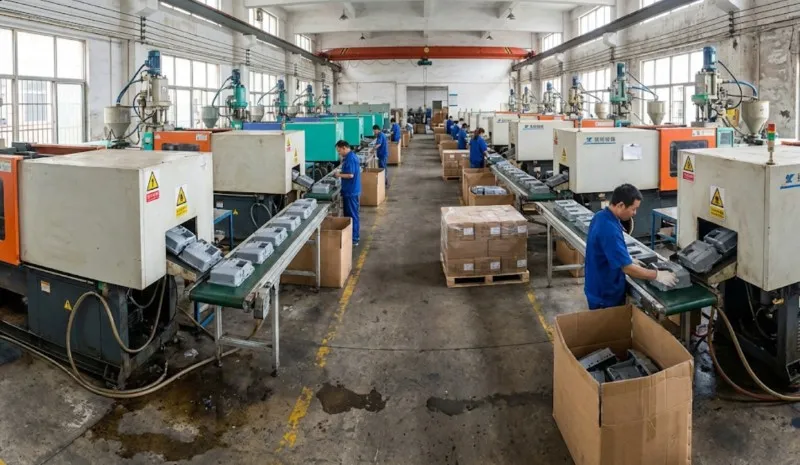
Because the mold and production package are delivered together:
- New molds can reach stable output in fewer trial runs.
- Seasonal or repeat orders can restart more quickly.
- Production teams do not need to rediscover old parameters.
- Quality teams can inspect against known risk points from the beginning.
This supports the lead times we commit to for sampling and mass production, as outlined in our broader factory production and quality-control workflow.
Making low to medium MOQs more realistic
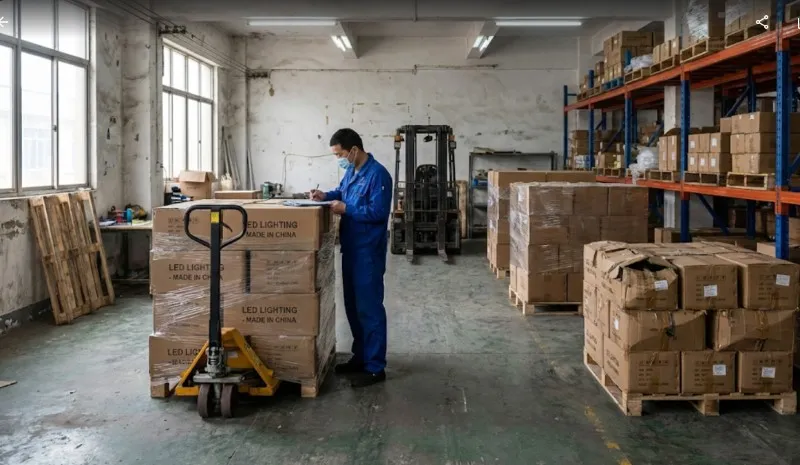
Glowyard’s production model is designed to support lower-than-industry MOQs, especially when:
- We adapt existing molds for new colors or minor appearance changes
- Multiple SKUs share a platform housing or internal structure
- The same mold can support several product finishes or seasonal variations
- The buyer starts with a smaller test order before scaling up
Because our molds start up faster and run more predictably, we can spread engineering and debugging cost over smaller batches without losing control of margin.
Buyers who want to understand how this connects with order quantities and pricing can also refer to our purchasing guide for MOQs and ordering process.
For buyers comparing private-label, OEM and ODM routes, this mold strategy also connects with the practical decisions explained in our OEM vs ODM guide for solar garden lights.
A Typical Case: From Always Debugging to Stable Output

One OEM client came to us after struggling with another supplier on a plastic solar wall light.
The product looked simple, but every new batch created problems:
- Each batch required days of debugging before stable production.
- Visible defects and dimensional issues caused scrap and rework.
- The supplier often blamed “mold problems”, but the root cause was never fully traced.
- The buyer became hesitant to place smaller repeat orders because every restart carried production risk.
When we took over the project, we did not only ask the factory to “try again”.
Instead, we:
- Re-reviewed the mold design with our partner toolmaker.
- Adjusted gating and venting based on actual defect behavior.
- Ran structured trials instead of relying on one-time sample approval.
- Created a golden-parameter package for repeat production.
- Set up a mold health file and basic preventive maintenance schedule.
In the next season:
- Time from “mold on machine” to stable mass production dropped by over 50%.
- Defects linked to the mold fell dramatically.
- The buyer became more comfortable placing smaller repeat orders.
- The production team could restart the project without repeating the same debugging cycle.
This is the real value of mold and production alignment. It turns custom production from a risky one-time project into a repeatable system.
What This Means for Importers and Brand Owners
For brand owners, importers and wholesale buyers, good mold-production coordination is not a “nice to have”. It directly affects:
- How quickly your custom design can reach the market
- Whether low or stepped MOQs are realistic
- How much hidden cost sits behind every unit you import
- Whether repeat orders can restart smoothly
- Whether your supplier can support seasonal demand without last-minute chaos
When you discuss a new project with Glowyard, you are not only buying a set of solar garden lights. You are also buying into a production system that connects:
- Product design
- Mold engineering
- Trial records
- Quality control
- Preventive maintenance
- Mass production planning
This is especially valuable for custom solar light projects where the buyer needs a balance between unique design, controlled tooling cost, fast sampling and flexible order quantities.
Planning a Low-MOQ Custom Solar Light Project?
If you are considering a new design or want to stabilize an existing project, our OEM services for solar garden lights are structured around this type of cross-department collaboration.
You can share your drawings, product ideas, existing problems, target price range and delivery timeline. Our team will help you review whether the project is better suited for:
- Existing mold adaptation
- Shared platform development
- New dedicated tooling
- Housing modification
- Step-by-step MOQ planning
- Full OEM or ODM development
By tightening the connection between mold design and mass production, Glowyard turns what used to be invisible internal friction into visible advantages for clients: shorter lead times, more flexible MOQs and more predictable profit on every shipment.




![do solar lights work in winter at cemeteries [2026 guide]](https://glowyard.com/wp-content/uploads/2026/03/Do-Solar-Lights-Work-in-Winter-at-Cemeteries-2026-Guide.webp)